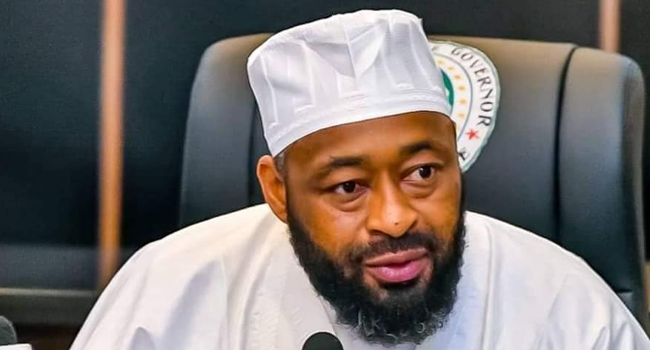
The Niger State Police Command has confirmed the arrest of a 38-year-old resident of Suleja, Hamisu Abdullahi, following a protest he staged during a visit by Governor Mohammed Bago, an incident that has sparked fresh concerns about civil liberties and the treatment of dissenting voices in the state.
The episode unfolded shortly after Eid-el-Fitr prayers at the palace of the Emir of Suleja, where the governor had paid a traditional Sallah visit. According to eyewitness accounts, Abdullahi drew attention when he shouted “no water, no light” in apparent protest against the lack of basic amenities in his community.
What appeared to be a brief outburst quickly escalated into a law enforcement matter, as security operatives at the scene moved in and took him into custody. The police later confirmed the arrest, describing his actions as disruptive.
Police spokesperson, Superintendent Wasiu Abiodun, said the suspect was detained over conduct deemed capable of interfering with official activities during the governor’s visit. He explained that Abdullahi was subsequently transferred to the State Criminal Investigation Department (SCID) in Minna for further investigation.
“One Hamisu Abdullahi, 38, of Suleja, was arrested and transferred to the State Criminal Investigation Department (SCID), Minna, on March 20, 2026, for suspected thuggery and attempting to disrupt government activities during the Sallah visit,” Abiodun stated.
He added that Abdullahi was later granted bail while investigations into the incident remain ongoing.
However, the circumstances surrounding the arrest and detention have raised questions, particularly following the account provided by Abdullahi himself after regaining his freedom.
According to his family, the electrician and father of four, who resides in the Unguwan Bayi area of Suleja, spent several days in detention before being released on Tuesday evening. He was initially held at the Suleja police division before being transferred to the SCID in Minna.
Speaking after his release, Abdullahi alleged that he had to pay ₦50,000 to secure his bail — a claim that has not been officially confirmed by the police.
“I was released on bail on Tuesday evening. The police at the CID office at police headquarters collected ₦50,000 from me for bail, and I was locked up at the Suleja police division the very day the incident happened on the orders of Bago before I was moved to CID in Minna on Saturday,” he said.
He also disclosed that, as part of his bail conditions, he has been instructed to report periodically to the police headquarters in Minna.
Beyond the financial aspect, Abdullahi made more serious allegations about his treatment at the scene of the incident. He claimed that before his arrest, he was physically assaulted by one of the governor’s aides in full view of those present.
“An aide to the governor slapped me in the presence of the governor the day the incident happened at the Emir’s palace before asking police to take me into their custody,” he alleged.
As of the time of reporting, the Chief Press Secretary to the governor, Bologi Ibrahim, said he was not aware of the incident when contacted, leaving several of the claims surrounding the arrest unaddressed.
The incident has since triggered wider conversations about governance, citizens’ rights, and the handling of public criticism in Niger State.
Observers note that the protest itself — a simple expression of frustration over lack of water and electricity — reflects broader concerns among residents about basic infrastructure and service delivery. In many parts of the country, access to essential amenities remains a major challenge, often fueling public discontent.
For some analysts and civil society actors, the arrest raises concerns about whether citizens are free to express grievances without fear of reprisal, especially in public settings involving government officials.
This is not the first time Governor Bago’s administration has come under scrutiny over issues related to dissent and civil liberties. In recent months, several actions attributed to the state government have attracted criticism from advocacy groups, media organisations, and political stakeholders.
One of the most notable incidents occurred in August 2025, when the governor ordered the closure of Badeggi FM, a radio station accused of inciting the public against his administration. The decision drew widespread condemnation, particularly because the station’s licence was reportedly revoked without due process involving the National Broadcasting Commission, the body legally empowered to regulate broadcasting in Nigeria.
Human rights organisations, including Amnesty International, criticised the move, describing it as an attack on press freedom and a troubling sign for media independence in the state.
Another incident that sparked public outrage was a viral video from July 2024, which appeared to show the governor directing security personnel to slap and arrest an Islamic cleric during a public event in Minna. The footage generated intense debate online, with many Nigerians condemning what they viewed as an abuse of power.
There have also been reports of individuals being detained for expressing critical views about the government on social media. In one case, a student was reportedly arrested over online comments, while a former aspirant under the All Progressives Congress was said to have been held for more than two weeks in November 2025 after criticising the state’s agricultural policies.
These developments have contributed to growing concern among press freedom advocates and civil society organisations. The International Press Institute (IPI) Nigeria went as far as listing Governor Bago in its so-called “Book of Infamy,” citing actions considered harmful to journalism and democratic principles.
In addition, some advocacy groups have called for international attention, including petitions urging foreign governments to impose visa restrictions and other sanctions, citing what they describe as a pattern of human rights violations.
Earlier this week, IPI Nigeria called on President Bola Ahmed Tinubu to intervene and caution the Niger State governor over actions that could undermine press freedom and democratic values.
In a statement signed by its Deputy President, Fidelis Mbah, and Legal Adviser, Tobi Soniyi, the organisation expressed concern that recent developments in the state may restrict journalists and media organisations from carrying out their duties without fear.
Against this backdrop, the arrest of Abdullahi has become more than an isolated incident. For many observers, it represents a broader pattern that raises important questions about governance, accountability, and the rights of citizens to express dissatisfaction.
While the police maintain that the arrest was justified on grounds of maintaining order during an official event, critics argue that such responses risk discouraging legitimate civic expression.
As investigations into the incident continue, attention is likely to remain on how authorities handle the case and whether it will prompt any broader reflection on the balance between security, authority, and citizens’ rights.
For Abdullahi, however, the experience has already left a mark — transforming what began as a spontaneous expression of frustration into a high-profile incident that has drawn national attention.