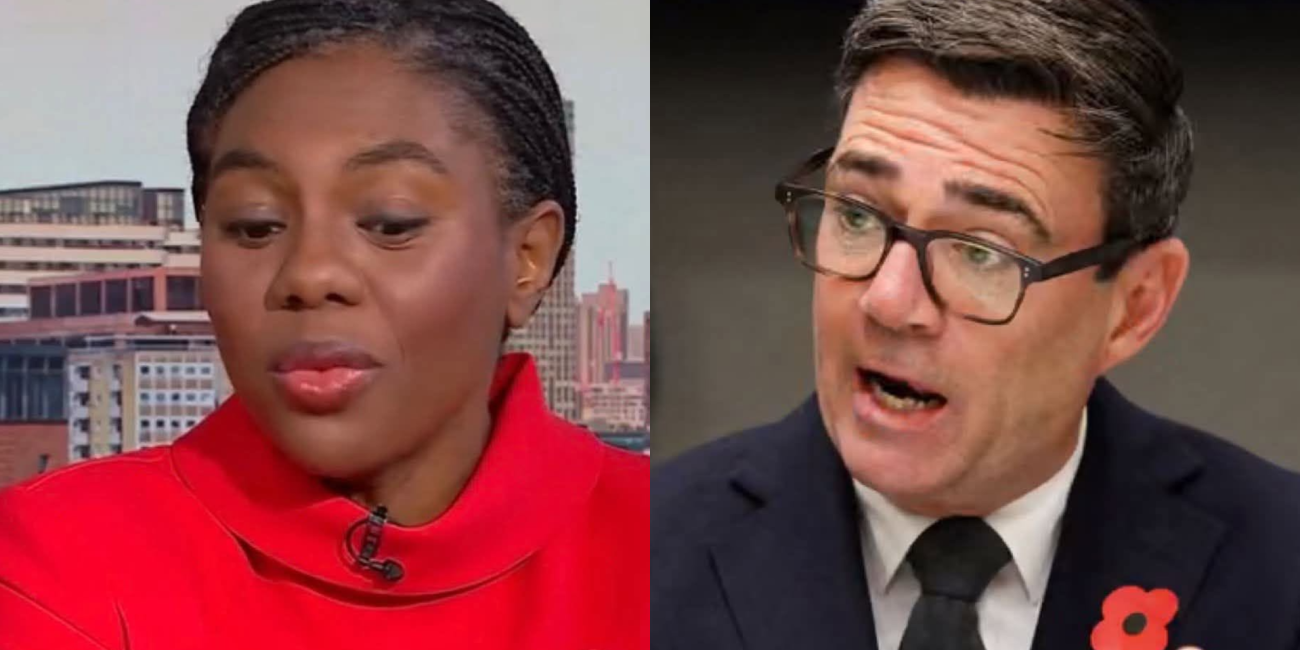
Badenoch warned that Burnham’s position could place the monarch in a difficult situation ahead of the forthcoming Commonwealth Heads of Government Meeting (CHOGM) in Antigua and Barbuda, where the King is expected to address Britain’s historical involvement in slavery.
Speaking during an interview with Sky News on Sunday, the opposition leader criticised the Prime Minister for publicly supporting discussions about a formal apology, arguing that his position could create expectations for the monarch to take a similar stance.
“I think that if he starts going into doing things which the Sovereign is not doing, I think that he could create pressure,” she said.
Her comments followed Burnham’s announcement on Friday that he was open to considering a formal apology on behalf of the British state for its involvement in the transatlantic slave trade.
The Prime Minister had proposed a structured dialogue with countries and communities affected by slavery, saying discussions about a formal apology would form an important part of the process. However, he ruled out direct financial reparations, instead indicating a willingness to explore ways of helping poorer countries restructure their debts on more favourable terms.
Badenoch argued that the Commonwealth summit should concentrate on strengthening relationships among member countries through security cooperation, economic partnerships and shared development priorities rather than reopening historical grievances.
“I don’t think that this is what our Prime Minister should be doing at this Summit,” she said.
“I think he should be talking about how Commonwealth countries should be making themselves, you know, looking at shared interests, allies working together, security cooperation, economic partnerships, not apologies and reparations. We’ve had enough of that.”
The Conservative leader also accused Burnham of making public statements without adequately considering their implications, citing his comments on Scottish independence, national security, social security and the possibility of the United Kingdom rejoining the European Union.
“He just keeps saying things off the top of his head,” she said.
Asked whether King Charles would be wrong to apologise if he chose to do so, Badenoch maintained that the decision rested with the monarch.
“The King is the Sovereign. He is the person who can make a call on that. I don’t think that he is doing that,” she stated.
She further urged the Prime Minister to focus on Britain’s security and international standing rather than what she described as an excessive preoccupation with apologising for the country’s historical actions.
“What I want to see is our Prime Minister actually talking about defending this country for once and being the Prime Minister, not the chief apologiser,” she added.
In a separate statement published on social media on Saturday, Badenoch also opposed calls for Britain to apologise formally and pay reparations to Caribbean countries affected by the transatlantic slave trade.
She argued that slavery was not perpetrated exclusively by European powers, pointing out that African kingdoms, rulers and merchants also participated in capturing, selling and profiting from enslaved people.
“Slavery was an evil in which people from every continent and region participated. We should be honest about the whole history, not select the parts that are politically convenient today, especially given Britain’s leading role in ending the transatlantic slave trade,” she wrote.
She questioned whether Caribbean countries demanding an apology from Britain would also seek similar apologies from descendants of African rulers and merchants who participated in the slave trade.
On the question of financial reparations, Badenoch argued that British taxpayers should not be held financially responsible for events that occurred generations before they were born.
She referenced previous international debt relief campaigns, including Jubilee 2000, Drop the Debt and Make Poverty History, claiming that although more than $100bn in debt was written off, some of the countries concerned had subsequently accumulated even greater debts.
Badenoch also criticised political leaders in Commonwealth countries who, she alleged, were using historical grievances against Britain to divert attention from domestic economic and governance challenges.
She maintained that former Prime Minister Tony Blair had already expressed Britain’s “deep sorrow and regret” over its role in the slave trade nearly two decades ago, arguing that this should be sufficient.
Meanwhile, Buckingham Palace has confirmed that King Charles will address what it described as the “most shameful aspects of the past” with “unflinching honesty, sincere sorrow” during his opening address at the Commonwealth summit on Tuesday.
The Palace, however, clarified that the King would speak in his capacity as Head of the Commonwealth and would not address specific British government policies. He is not expected to issue a formal apology during the summit.
The monarch had earlier acknowledged the suffering inflicted on enslaved Africans during his Caribbean engagements, describing the experience as part of the “great suffering of the past” during a visit to The Bahamas.
Badenoch’s position has attracted attention as several Caribbean leaders continue to press Britain for an apology and reparations.
Prime Minister Mia Mottley of Barbados welcomed Burnham’s willingness to consider an apology, while Antigua and Barbuda’s Prime Minister, Gaston Browne, described the development as significant and welcome.
The Bahamas Prime Minister, Philip Davis, has also welcomed the change in approach, although disagreements remain over the question of financial compensation.
The forthcoming Commonwealth summit is expected to intensify discussions about Britain’s colonial history, the transatlantic slave trade and demands for acknowledgement and reparatory justice from countries affected by the historical trade.
Badenoch warned that if Commonwealth summits continued to focus on demands for financial compensation from Britain, the country might need to reconsider the value of its participation.
“If every Commonwealth summit becomes an exercise in presenting Britain with demands for cash then we need to start asking if it is worth the effort,” she said.