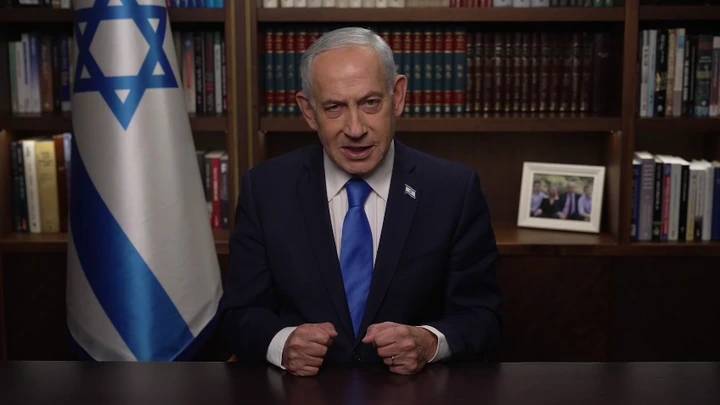
Israeli Prime Minister Benjamin Netanyahu declared Saturday that Israel, in coordination with the United States, has launched a new and significantly expanded military campaign against Iran, describing it as a decisive effort to eliminate what he termed the existential threat posed by the Ayatollah-led regime.
In a recorded address delivered in Hebrew and released to the public, Netanyahu announced the commencement of “Operation Lion’s Roar,” a joint Israeli-American operation aimed at dismantling Iran’s nuclear and missile capabilities and weakening the regime’s security apparatus. He characterized the campaign as substantially more forceful than the 12-day conflict Israel waged against Iran in June under “Operation Rising Lion.”
According to Netanyahu, the Israel Defense Forces (IDF) are targeting strategic assets associated with Iran’s ruling structure, including facilities linked to the Revolutionary Guards and the Basij paramilitary forces. In cooperation with the U.S. military, Israel is also striking ballistic missile sites that, he said, pose a direct threat to both Israeli territory and American forces in the region.
“This operation will continue as long as necessary,” Netanyahu stated, framing the campaign as a necessary response to decades of hostility. He accused Iran’s leadership of pursuing Israel’s destruction for nearly half a century, investing vast resources in nuclear weapons development and stockpiling tens of thousands of missiles intended to “erase Israel from the map.”
Framing the Threat
Netanyahu described the Iranian government as a destabilizing force not only within its own borders but across the broader Middle East. He asserted that Tehran has armed and financed militant proxies in Gaza, Lebanon, Syria, Iraq, Yemen, and the West Bank, contributing to bloodshed and regional instability.
He also cited what he called the regime’s violent repression of its own citizens. Referring to recent unrest in Iran, Netanyahu alleged that authorities in Tehran carried out mass killings, arrests, and acts of torture against civilians who sought greater freedom and dignity. These actions, he argued, further demonstrated the regime’s brutality and justified international intervention.
While Operation Rising Lion inflicted significant damage on Iranian assets, Netanyahu said the regime had attempted to recover and rebuild. He warned that Iran has been working to reconstruct and conceal its nuclear and missile infrastructure underground, potentially rendering it immune to future strikes.
“If we do not stop them now, they will become invulnerable,” he cautioned, accusing Iranian negotiators of using diplomatic talks to buy time. He contended that both Israel and the United States had concluded that continued negotiations would not neutralize the threat.
Partnership with Washington
Netanyahu emphasized that the new operation is being conducted in full coordination with the United States under the leadership of President Donald Trump. He praised Trump as a steadfast ally of Israel and a determined global leader willing to take difficult decisions.
“Together with the United States, we will strike hard at the terror regime,” Netanyahu said, adding that the campaign aims not only to degrade military capabilities but also to create conditions that could enable political transformation within Iran.
During the earlier conflict, Netanyahu had stated that regime change was not an explicit objective. However, he acknowledged that widespread protests within Iran suggested the possibility of internal upheaval. In this latest address, he suggested that the renewed military pressure could provide Iranians with an opportunity to reshape their political future.
Message to the Iranian People
In a direct appeal to Iranian citizens and members of the Iranian military, known as the Artesh, Netanyahu asserted that Israel does not regard them as enemies. Instead, he identified the ruling clerical establishment and its enforcement arms—the Revolutionary Guards and Basij—as the common adversary.
“You are not our enemies and we are not your enemies,” he declared. He urged those within Iran’s security forces to lay down their weapons, promising that doing so would safeguard their future.
Addressing Iran’s diverse population—including Persians, Kurds, Azeris, Balochs, and other ethnic communities—Netanyahu described the current moment as a historic opportunity to establish a new and free Iran. He portrayed Israeli and American forces as acting in support of that possibility, stating that “help has arrived.”
He expressed hope that one day Israel and a free Iran could cooperate in security, prosperity, and peace.
Call for Israeli Resilience
Turning to domestic audiences, Netanyahu acknowledged that the operation carries risks. “Every military action involves risk,” he said, but argued that inaction would be far more dangerous. A nuclear-armed Iran with a vast ballistic missile arsenal, he contended, would pose an intolerable threat to Israel’s survival.
He urged Israeli citizens to demonstrate patience and resilience, warning that the campaign could entail significant costs. He instructed the public to strictly follow directives from the Home Front Command, emphasizing that adherence to safety guidelines would save lives.
Netanyahu praised the IDF, the Air Force, the Intelligence Directorate, the Mossad, and emergency response personnel for their courage and professionalism. He stressed that the entire nation stands behind them.
Historical and Religious Symbolism
In closing, Netanyahu invoked historical and religious imagery, noting that the Jewish holiday of Purim was approaching. He referenced the biblical story of Queen Esther and Mordechai, who thwarted a plot to annihilate the Jewish people in ancient Persia.
Drawing a parallel between that narrative and current events, Netanyahu suggested that just as Haman’s plan ultimately failed, so too would the ambitions of Iran’s present rulers. Quoting the prophet Amos—“The lion has roared, who will not fear?”—he framed Operation Lion’s Roar as both a strategic and symbolic assertion of strength.
“Do not fear, Israel,” he concluded, calling for unity and collective resolve. “We will stand as one person with one heart, and with God’s help, we will ensure the eternity of Israel.”
The address underscores the gravity of the unfolding confrontation and signals Israel’s readiness, alongside the United States, to sustain a prolonged and expansive campaign against Iran’s military and political leadership.