One person has been killed and at least seven others injured after missile and drone strikes struck major aviation hubs in the United Arab Emirates, as Iran widened its retaliatory campaign across the Gulf region. The incidents mark a significant escalation in the ongoing confrontation between Tehran, Washington, and Tel Aviv, with civilian infrastructure now directly affected.
Authorities confirmed that the most serious impact occurred at Zayed International Airport in Abu Dhabi. Officials reported that an “incident” on Saturday night resulted in the death of an Asian national and injuries to seven others. Emergency services responded immediately, and the airport operator urged the public to rely solely on official updates rather than social media speculation.
In a formal statement, Abu Dhabi Airports confirmed the fatality and multiple injuries while emphasising that investigations were ongoing. Security protocols were activated, and parts of the airport complex were secured as authorities assessed the damage and reviewed surveillance data.
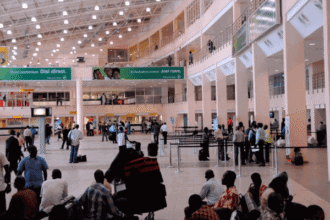
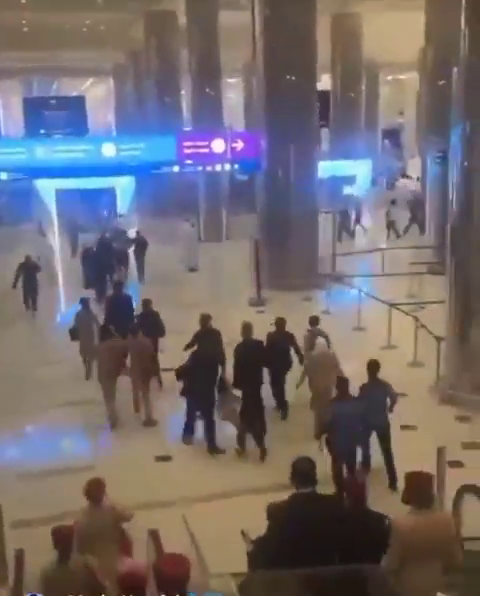
A separate explosion occurred at Dubai International Airport, the world’s busiest international airport by passenger traffic. Smoke was seen rising inside one of the terminals, and evacuations were initiated in affected sections of the facility.
The Dubai Media Office described the damage as minor and stated that the situation was “quickly contained.” According to officials, a concourse sustained limited structural impact. Four airport staff members were injured and received prompt medical attention. Most passenger areas had already been cleared earlier in the day due to precautionary measures linked to escalating regional hostilities.
Video circulating online showed smoke and scattered debris inside Terminal 3, with passengers and airport personnel seeking shelter. Flights had been suspended hours earlier as Gulf states implemented emergency airspace closures. On a typical day, approximately 250,000 passengers transit through Dubai International Airport, underscoring the scale of potential disruption.
In neighbouring Bahrain, authorities confirmed that Bahrain International Airport was targeted by a drone strike. The Ministry of the Interior stated that the attack caused material damage but no casualties. Security teams were deployed immediately to secure the perimeter and assess structural integrity.
The attack on Bahrain further illustrates the geographic breadth of Iran’s retaliatory actions, which have targeted multiple Gulf states hosting Western military assets.
The strikes followed large-scale military operations earlier in the day by the United States and Israel targeting Iranian infrastructure. Tehran subsequently declared that it had “no red lines” in its response. Iranian missiles and drones were launched toward US military installations and strategic facilities across the region, including energy infrastructure and transport hubs.
The escalation appears linked to the collapse of diplomatic talks aimed at restraining Iran’s nuclear and ballistic missile programmes. Explosions were also reported in several Iranian cities, including Tehran, as Israeli and American forces continued coordinated operations.
The missile exchanges triggered immediate airspace closures over Iran and Iraq, forcing aircraft to divert mid-flight. Thousands of travellers have been stranded across major transit hubs as airlines scramble to adjust routes and suspend operations.
Hotels in Abu Dhabi reported instructing guests to remain indoors amid concerns about falling missile debris. Staff distributed refreshments and issued safety advisories as loud explosions were heard in the distance.
At Dubai International Airport, passengers described confusion and uncertainty. British Airways passenger Mike Boreham said he was already seated on flight BA108 bound for London Heathrow when the captain announced that regional airspace had been closed.
“We were fully boarded,” he said. “About ten minutes after the ‘boarding complete’ announcement, we were told airspace is closed.” The flight was subsequently cancelled, leaving passengers disembarking into an airport operating under emergency protocols.
Authorities earlier released images showing fragments of intercepted rockets scattered across urban areas in the UAE. Air defence systems reportedly intercepted several projectiles, though debris from interceptions still caused localized damage.
The airport incidents followed a separate strike near the luxury Fairmont The Palm hotel in Dubai, where falling debris from Iran’s missile barrage injured four people. Emergency responders treated the wounded at the scene, and sections of the tourist complex were temporarily cordoned off.
While officials described much of the airport damage as limited, the symbolic and operational implications are substantial. Aviation infrastructure represents critical civilian lifelines in the Gulf, serving as global transit corridors linking Europe, Asia, and Africa.
The targeting of major airports signals a widening of the conflict beyond strictly military installations. Although Iranian statements framed the attacks as directed at strategic and military assets, the proximity to civilian aviation hubs has intensified international concern.
Airports such as Dubai International function as logistical arteries for global commerce and tourism. Disruption at this scale reverberates far beyond the region, affecting supply chains, connecting flights, and business travel.
Security analysts note that Gulf states host numerous US military facilities and serve as forward operating bases. Iran’s strategy appears designed to demonstrate regional reach and impose costs on states perceived as aligned with Washington and Tel Aviv.
Governments across the Gulf have urged residents and visitors to follow official instructions and avoid spreading unverified information. Emergency response teams remain on high alert as missile exchanges continue.
With diplomatic negotiations stalled and military operations intensifying, the risk of further strikes on civilian-adjacent infrastructure remains elevated. Aviation authorities are conducting continuous risk assessments, and additional flight suspensions are expected if hostilities persist.
The situation remains fluid, with casualty figures and damage assessments likely to evolve. For now, the attacks on UAE airports underscore the volatility of the current confrontation and the growing intersection between military escalation and civilian vulnerability.
As missile exchanges expand and key transport hubs come under threat, regional stability hangs in the balance. Governments and airlines alike face the immediate challenge of safeguarding passengers while navigating an increasingly unpredictable security environment.