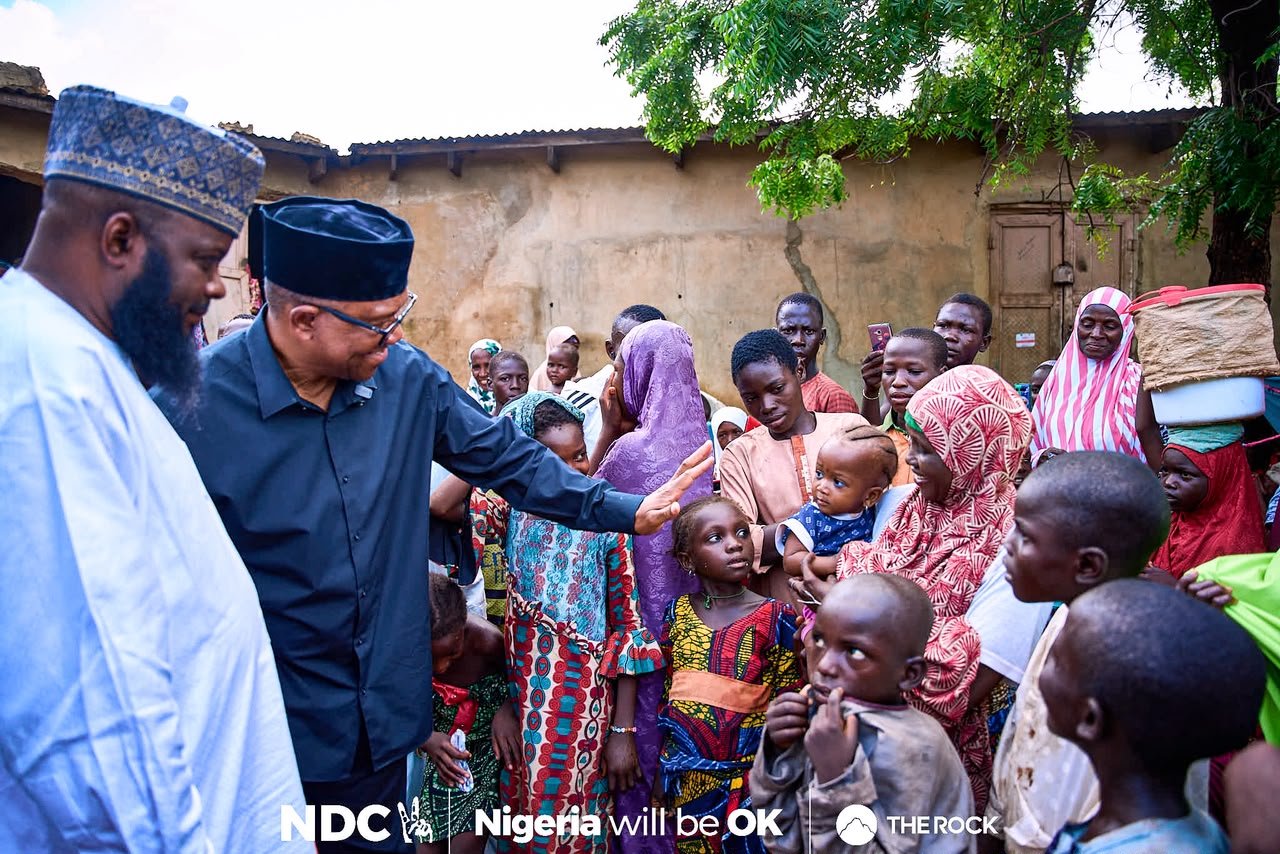
Presidential candidate of the Nigeria Democratic Congress, Peter Obi, has called on the Federal Government and relevant agencies to urgently improve the living conditions of internally displaced persons taking refuge at the Ramin Kura IDP Camp in Sokoto State.
Obi made the call after visiting the camp in Sokoto North Local Government Area on Monday, September 29, 2026, as part of his two-day engagement in the state. He later highlighted the conditions he observed at the camp in a statement shared on his X account.
The former Anambra State governor said the camp is currently accommodating more than 1,000 displaced Nigerians, many of whom, according to his account, are living in difficult circumstances.
He expressed particular concern over the condition of the accommodation provided for the displaced families, describing the shelters as largely makeshift structures and thatched rooms.
According to Obi, some of the rooms are reportedly occupied by as many as 10 people, raising concerns about overcrowding, privacy and the general welfare of residents.
The NDC presidential candidate also identified inadequate toilet facilities as one of the challenges confronting the camp. He further pointed to the absence of a primary healthcare centre and a basic school for children living within the facility.
Obi said the conditions required immediate attention from government authorities, arguing that displaced Nigerians should not be left without access to basic services while they remain away from their communities.
He urged the government and relevant agencies to address the immediate needs of the residents while simultaneously intensifying efforts to tackle the insecurity that forced many of them to abandon their homes.
“I have always insisted that as long as even one Nigerian lives in an IDP camp, we are all internally displaced,” Obi said.
His comments form part of a broader emphasis he has placed on the situation of internally displaced Nigerians during recent visits to displacement camps.
The Sokoto visit came shortly after another visit by Obi to an IDP camp in Mangu Local Government Area of Plateau State, where he also called for stronger efforts to secure communities affected by insecurity and create conditions for displaced residents to return home.
Obi has argued that temporary accommodation should not become a permanent substitute for restoring security to communities from which Nigerians have been displaced.
During the Sokoto visit, he called for better living conditions in the interim while urging authorities to intensify security operations and other measures necessary to enable displaced families to return safely to their ancestral communities.
For Obi, the long-term solution to displacement is not simply the provision of camps but the restoration of security, livelihoods and basic infrastructure in the affected communities.
He also used the occasion to appeal to political office holders to spend more time within Nigeria during their holidays and interact directly with citizens facing economic and social difficulties.
According to him, direct engagement with vulnerable Nigerians can provide political leaders with a clearer understanding of the challenges confronting communities across the country.
The former governor linked the conditions observed in IDP camps to what he described as inadequate attention to critical development priorities.
He therefore urged the government to take immediate steps to provide improved accommodation, sanitation, healthcare and educational facilities for residents of the Ramin Kura camp.
The absence of a basic school was of particular concern because children constitute a significant component of many displaced populations. Prolonged displacement can interrupt children’s education and expose them to additional social and economic vulnerabilities.
Similarly, the lack of adequate healthcare facilities can create difficulties for families requiring medical attention, particularly women, children, older persons and other vulnerable residents.
Obi’s call therefore extended beyond the provision of shelter to a broader package of services intended to improve the welfare of displaced Nigerians while they remain in temporary settlements.
The NDC presidential candidate also stressed the importance of creating the conditions necessary for displaced people to return to their communities.
He maintained that Nigerians affected by insecurity should be able to return to their ancestral homes, rebuild their communities, cultivate their farms and resume their livelihoods once adequate security has been restored.
The issue of displacement remains closely connected to insecurity in several parts of Nigeria, particularly in areas where attacks on communities have forced residents to seek refuge elsewhere.
In recent weeks, Obi has made visits to displaced communities and camps part of his engagements, using the visits to draw attention to the circumstances of Nigerians who have been forced away from their homes.
During his September visit to a Plateau IDP camp, he similarly argued that displaced Nigerians should not be forgotten and called for security measures that would allow them to return home safely.
His visit to Ramin Kura consequently adds another dimension to his recent engagements on displacement, security and humanitarian conditions.
Obi said the Sokoto visit was his 12th visit to an IDP camp in Nigeria and pledged to continue supporting displaced Nigerians.
He maintained that the welfare of people living in displacement should remain a national concern, regardless of the circumstances that led to their displacement or the geographical location of the camps.
The former governor concluded his message by renewing his call for what he described as a “New Nigeria,” using the phrase, “A New Nigeria is POssible and will be OK.”
The visit also formed part of Obi’s wider engagements in Sokoto, where he and his running mate, Rabiu Musa Kwankwaso, held political and community engagements during their stay in the state. They also paid a courtesy visit to the Sultan of Sokoto, Muhammad Sa’ad Abubakar III, where issues including national unity, security, poverty and employment were discussed.
Obi’s appeal over the Ramin Kura camp places renewed attention on the humanitarian dimension of Nigeria’s security challenges. While immediate assistance can improve conditions for displaced families, the broader challenge remains creating sufficient security and livelihood opportunities to enable affected Nigerians to leave temporary settlements and return to stable community life.
For residents of Ramin Kura, the issues raised during the visit include basic shelter, sanitation, healthcare and education. Obi has urged government authorities to treat those needs as urgent while pursuing longer-term measures aimed at restoring security and enabling displaced families to return home with dignity.