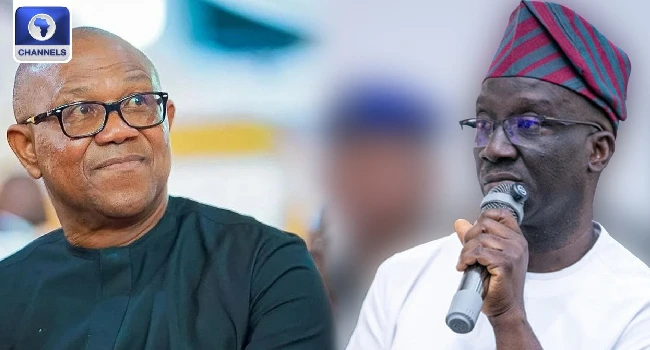
Governor Monday Okpebholo of Edo State has downplayed the political influence of former presidential candidate Peter Obi, asserting that the former Anambra State governor lacks the electoral capacity to deliver even his home state in future elections.
Speaking during an appearance on Politics Today on Channels Television on Thursday, Okpebholo argued that the political dynamics that shaped the 2023 general elections would not be replicated in 2027. He maintained that his administration’s performance and growing public support in Edo State place him in a strong position politically, dismissing concerns about opposition figures gaining traction.
“What is there to fear when you are delivering on the expectations of the people?” the governor asked. “Take a look at his own state—can he even secure it? The circumstances that influenced the last election cycle are no longer the same. Today, Edo has a functioning government, and the people are satisfied with the leadership they have.”
The governor’s remarks come amid increasing political maneuvering ahead of the 2027 general elections, with key actors positioning themselves and testing alliances across party lines. Okpebholo’s comments reflect a broader narrative within the ruling party that opposition figures may struggle to replicate past electoral gains under evolving political and governance conditions.
Addressing controversy surrounding his earlier remarks following Obi’s recent visit to Edo State, Okpebholo clarified that his intentions had been misconstrued. Reports had suggested that Obi’s visit encountered challenges, prompting reactions from political observers and supporters. However, the governor insisted that his primary concern was security.
“I made it clear to him that whenever he plans to visit, he should inform the state government in advance,” Okpebholo explained. “Given the current security climate, it is only appropriate that we are aware so that adequate arrangements can be made to ensure his safety. That is a responsibility I take seriously.”
He emphasized that Obi, as a prominent political figure, qualifies as a high-profile individual requiring enhanced security measures. According to the governor, prior notice would allow for proper coordination with relevant security agencies to guarantee a safe environment during such visits.
“There is nothing wrong with ensuring that a visitor of his stature is protected,” he added. “Providing security is not about politics; it is about responsibility and governance.”
Beyond state-level issues, Okpebholo used the platform to strongly defend the administration of President Bola Tinubu, describing him as the most widely supported political leader in the country at present. He attributed recent defections of governors and political figures to the ruling All Progressives Congress (APC) to what he characterized as the administration’s performance and policy direction.
“In politics, people align themselves where they see progress and opportunity,” he said. “If the President were not performing, you would not see this level of movement into the APC. These governors and stakeholders are making independent decisions based on what they perceive as the best path forward.”
The governor dismissed claims that such defections were orchestrated or coerced, insisting that they were voluntary and reflective of confidence in the current leadership. He argued that the administration’s policy choices, though sometimes difficult, are beginning to yield positive outcomes.
Among the key policies highlighted by Okpebholo was the removal of the long-standing fuel subsidy, a move that has generated both praise and criticism across the country. While acknowledging the immediate economic impact on citizens, he described the decision as a necessary step toward long-term fiscal stability.
“Taking tough decisions is part of leadership,” he said. “The removal of fuel subsidy is one of those bold steps that previous administrations avoided. It required courage, and it is already laying the foundation for a more sustainable economic framework.”
Okpebholo argued that such reforms, though challenging in the short term, are essential for addressing structural inefficiencies and unlocking economic growth. He maintained that the benefits of these policies would become more evident over time, as the government continues to implement complementary measures.
Responding to criticism from opposition leaders regarding economic hardship and insecurity, the governor dismissed such concerns as politically motivated. He suggested that some critics are unwilling to acknowledge progress because they are not part of the current administration.
“There are individuals who believe that if they are not the ones in charge, then nothing is being done correctly,” he said. “That mindset does not help the country. Governance should be assessed based on outcomes, not political affiliations.”
He reiterated that the federal government remains committed to addressing key challenges, including security, economic stability, and infrastructure development. According to him, ongoing reforms are part of a broader strategy to reposition the country and improve living standards.
Looking ahead to the 2027 elections, Okpebholo expressed confidence that President Tinubu would secure a second term in office. He pointed to what he described as growing nationwide support and increasing alignment among political stakeholders as indicators of the administration’s strength.
“The trajectory is clear,” he said. “There is a growing consensus across states that the current administration is on the right path. By 2027, the results of these policies will be even more visible, and the electorate will make its decision based on that reality.”
The governor’s remarks highlight the intensifying political discourse as Nigeria gradually moves toward another election cycle. With both ruling and opposition parties sharpening their strategies, debates around governance, economic policy, and political influence are expected to dominate the national conversation in the coming months.
For now, Okpebholo remains firm in his position that performance, rather than rhetoric, will ultimately determine political success, both at the state and national levels.