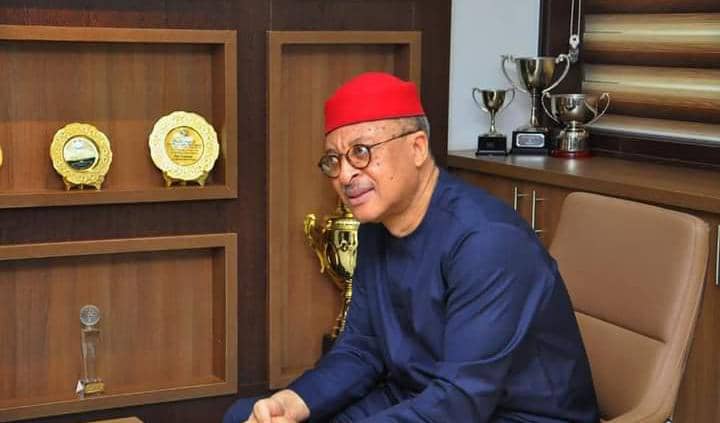
Political economist and prominent chieftain of the African Democratic Congress (ADC), Professor Pat Utomi, has painted a grim picture of Nigeria’s current state, describing the country as being in a “complete mess” caused by years of failed leadership, widespread corruption, and the steady erosion of public trust in government institutions.
Speaking during an interview with Vanguard, Utomi expressed deep concern about the trajectory of governance in Nigeria. According to him, the nation’s current challenges are not accidental but rather the result of systemic leadership failures that have prevented the country from making meaningful progress despite its vast resources and potential.
Utomi illustrated his argument with a comparative story about Egypt, which he encountered during a recent visit to Cairo for an international conference. The professor explained that the experience highlighted the stark contrast between the developmental priorities of Egypt and those of Nigeria.
He recalled that the conference was held in what is known as “New Cairo,” a massive urban development project that Egypt is constructing in the desert outside its current capital. The new city, he said, features expansive infrastructure including highways with as many as 14 to 16 lanes, symbolizing the Egyptian government’s ambition to create a modern metropolis that could eventually rival global cities such as Dubai.
Standing outside the conference venue, Utomi said he joined a group of senior Nigerian delegates who had gathered informally to reflect on the persistent problems facing Nigeria. As is often the case in such conversations, he noted, the discussion quickly turned to the country’s long-standing power crisis.
According to Utomi, Nigeria’s electricity sector remains in a state of deep dysfunction, despite repeated promises by political leaders to resolve the issue. He recalled that the current occupant of Aso Rock had once declared that he should be judged based on his ability to fix Nigeria’s power sector within a year. Utomi questioned why such promises appear to have faded without consequence, even though electricity supply remains unreliable across the country.
He emphasized that the failure of the power sector has had devastating implications for Nigeria’s economy, particularly for industries and small businesses that depend on reliable energy to function efficiently.
To illustrate the severity of the situation, Utomi cited his own personal experience living in what is classified as “Band A,” a category that supposedly guarantees a higher level of electricity supply under Nigeria’s electricity distribution framework. Despite paying significantly higher tariffs, he said he rarely receives consistent power.
Utomi explained that even with the expensive Band A tariff, he still relies heavily on alternative energy sources such as solar systems and diesel-powered generators just to maintain basic electricity supply. The combined cost of these alternatives, he noted, is extremely burdensome.
He lamented that the amount he pays for electricity in Nigeria is equivalent to roughly three times the salary of a university professor, yet the power supply he receives does not even meet half of his household’s needs. For Utomi, this represents a fundamental failure of governance and policy planning.
The professor argued that the absence of reliable electricity has crippled Nigeria’s industrial capacity. Manufacturing companies struggle to compete globally because they must generate their own power at extremely high costs. Similarly, small and medium-sized enterprises, which form the backbone of most economies, are finding it increasingly difficult to survive.
Many small businesses depend on petrol or diesel generators to power their operations, but the rising cost of fuel has significantly increased their operational expenses. As a result, several businesses either shut down or reduce their activities, further worsening unemployment and economic hardship.
Utomi further compared Nigeria’s approach to solving its electricity problems with the strategy adopted by Egypt when both countries partnered with Siemens around the same period to improve their power infrastructure.
According to him, Nigeria and Egypt approved projects with Siemens to increase their electricity capacity. Nigeria’s goal was to boost its generation to around 10,000 megawatts. Egypt, however, adopted a far more ambitious approach.
Rather than merely attempting to meet current demand, Egypt decided that its national strategy would be to always generate twice the amount of electricity it actually needs at any given time. This ensures that as the country’s demand grows, additional capacity is already available to support industrial expansion and economic development.
Utomi explained that Egypt approached Siemens with a proposal that allowed the company to raise financing globally while the Egyptian government provided state guarantees. Under this arrangement, Siemens could mobilize the required capital and construct the power infrastructure while ensuring long-term returns on its investment.
Nigeria, however, pursued a very different path. According to Utomi, Nigerian leaders opted to structure the agreement in a way that required the government to directly pay for various aspects of the project upfront. This meant that officials had to begin searching for funds that the country did not readily possess.
Utomi suggested that the motivation behind such decisions often stems from the corrupt incentives embedded in Nigeria’s political system. He alleged that many political leaders prefer arrangements that involve direct financial transactions because it provides opportunities for personal enrichment.
In his view, this pattern of behavior frequently leads to poorly designed agreements that do not serve the long-term interests of the nation.
The situation became even more problematic when the war in Ukraine began. Siemens later informed Nigeria that some of the equipment intended for the Nigerian project was being manufactured in Ukraine. Due to the war, the company indicated that it might not be able to supply all the equipment that Nigeria had already paid for.
Meanwhile, Utomi noted that Egypt’s power infrastructure project remained fully operational because Siemens had independently secured the necessary financing and ensured continuity in delivery.
During the conversation in Cairo, Utomi said one of the participants sharing insights was the president of the African Finance Corporation (AFC), who is also Nigerian. The discussion eventually shifted toward the broader issue of leadership quality in Egypt and how it has contributed to the country’s rapid development.
The AFC president then shared a story that Utomi described as a powerful example of decisive leadership.
According to the account, the AFC had been co-financing a road construction project in Egypt alongside the Egyptian government. The authorities had given the contractor a strict timeline to complete the project within 18 months and 10 days. The contractor was warned that failure to meet the deadline would attract penalties.
During the early stages of construction, the company encountered an unexpected obstacle. They discovered a mountain lying directly along the planned route of the road, which would make it impossible to meet the deadline.
Concerned about the situation, the contractors returned to the government to explain that the original timeline was unrealistic due to the unforeseen terrain.
Instead of simply extending the deadline, the Egyptian president reportedly instructed all relevant stakeholders—including financiers and contractors—to reconvene at the project site within two weeks.
When everyone gathered at the location on the appointed day, they were stunned by what they saw. The mountain that had posed the obstacle had completely disappeared.
Within those two weeks, the Egyptian authorities had blasted and removed the entire mountain from the route, effectively eliminating the problem.
Utomi said the president then calmly asked the contractors whether there were any further issues that might prevent them from meeting the original deadline.
The contractors and financiers reportedly looked at each other in amazement, realizing that the obstacle had already been solved with remarkable speed and determination.
For Utomi, this story symbolizes the type of decisive and results-oriented leadership that Nigeria has consistently lacked.
He concluded that until Nigeria develops a leadership culture defined by competence, accountability, and urgency, the country will continue to struggle with the same structural problems that have hindered its development for decades.