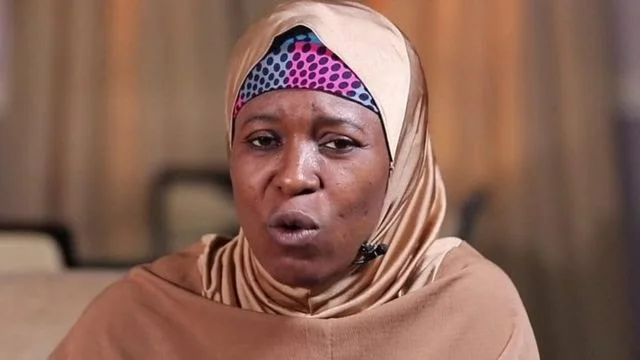
Human rights activist, Aisha Yesufu, has declared that President Bola Ahmed Tinubu has already lost the 2027 presidential election, citing what she described as the administration’s declining popularity and the government’s efforts to consolidate political alliances ahead of the polls.
Yesufu made the remarks on Thursday, March 5, while appearing on Politics Today, a political affairs programme on Channels Television. During the interview, the outspoken activist argued that the president’s reported attempts to persuade state governors to align with the ruling party demonstrate a lack of confidence in his chances of securing reelection.
According to her, the ongoing political manoeuvres within the ruling All Progressives Congress (APC) indicate that the administration is attempting to project strength by assembling a coalition of governors across the country. However, she maintained that such alliances do not necessarily translate into electoral victory.
“Yes, Bola Tinubu has already lost,” Yesufu said during the programme. “That is why he is going around looking for governors that he can gather together in order to create an illusion of power.”
She argued that Nigerian political history has shown that the number of governors controlled by a political party does not always determine the outcome of a presidential election. Drawing a comparison with past elections, Yesufu recalled how the Peoples Democratic Party (PDP) once controlled a large majority of state governments but still lost the presidency.
“At one point, I think the PDP had more than twenty governors,” she noted. “But that did not stop them from losing the election when the time came for them to lose.”
The activist further claimed that the ruling party’s apparent difficulty in mobilising grassroots support reflects a growing disconnect between the government and ordinary Nigerians. According to her, public response to recent political activities by the APC suggests that enthusiasm for the party has declined significantly.
She cited the example of a recent political registration exercise, which she claimed did not attract widespread interest from the public. In her view, the low level of participation was evidence that the ruling party no longer enjoys the same level of public engagement it once commanded.
“The fact that they do not have the people is obvious,” Yesufu said. “You could see it during the registration process. Nobody was interested, and hardly anyone cared enough to even visit their website.”
In contrast, she pointed to what she described as growing enthusiasm around the African Democratic Congress (ADC), which she claimed has recently witnessed increasing public support.
“But if you look at the ADC, you can see the kind of passion that has gathered around it,” she added.
Beyond electoral politics, Yesufu also used the platform to criticise the current state of governance in Nigeria, particularly in relation to economic management and national security. She argued that the country is currently facing severe institutional and governance challenges.
Describing the current situation in stark terms, the activist said Nigeria appears to be in a state of systemic dysfunction.
“Right now, Nigeria as a whole is a glitch,” she said. “There is nothing working—whether economically or in terms of security. We do not have any of that.”
Yesufu further lamented what she described as worsening insecurity across various parts of the country. According to her, incidents of abduction, killings and terrorist activities have continued to occur with alarming frequency, raising concerns about the government’s ability to protect citizens.
“I just explained to you that people are being taken away,” she said. “People are being killed, and terrorists are even coming out to show us their faces.”
The activist argued that the persistence of such security challenges suggests that governance structures are not functioning effectively. She maintained that many Nigerians now feel that the country has reached a point where little meaningful progress is being made.
“Nigeria is a glitch on its own,” she continued. “It is on a standstill. There is no governance, and nothing meaningful is going on.”
Yesufu’s comments add to a growing national debate over the political climate ahead of the 2027 general elections. Since assuming office in May 2023, President Tinubu’s administration has faced criticism from various quarters over economic reforms, inflation, fuel subsidy removal and ongoing security concerns.
Supporters of the administration, however, argue that many of the reforms introduced by the government are necessary long-term measures aimed at stabilising Nigeria’s economy and addressing structural problems that have persisted for decades.
Political analysts note that debates over the administration’s performance are likely to intensify as the country gradually approaches the next electoral cycle. The presidential election is currently scheduled for January 16, 2027, according to Nigeria’s electoral calendar.
Observers also point out that Nigeria’s political landscape often evolves rapidly in the years leading up to elections. Alliances shift, new political movements emerge, and public sentiment can change significantly before voters ultimately cast their ballots.
While Yesufu’s remarks represent one perspective within the broader political conversation, they underscore the growing scrutiny facing the current administration as political actors and civil society groups assess the government’s performance and its prospects for reelection.
As Nigeria moves closer to the 2027 polls, the interplay between political alliances, governance outcomes and public perception is expected to play a crucial role in shaping the direction of the country’s democratic process.