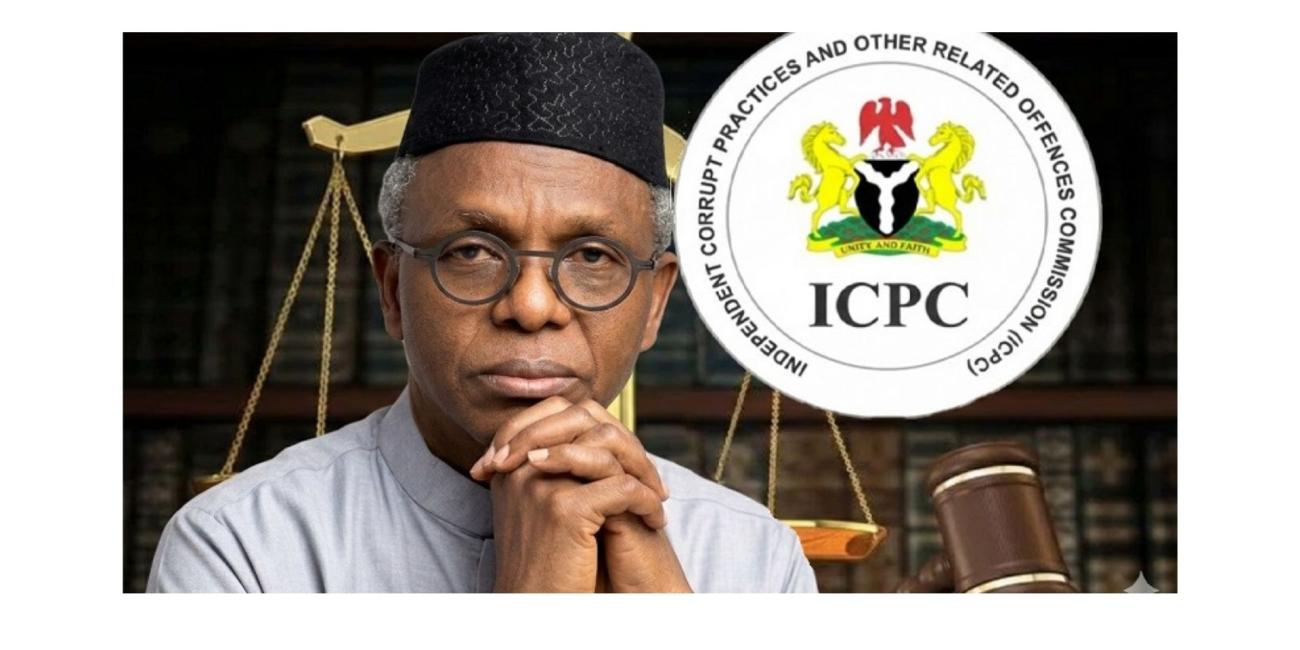
The Independent Corrupt Practices and Other Related Offences Commission (ICPC) has informed the High Court of the Federal Capital Territory that it recovered suspected electronic surveillance equipment and classified security documents from the Abuja residence of former Kaduna State Governor, Nasir El-Rufai.
The anti-corruption agency made the disclosure in court filings in response to a fundamental rights enforcement suit instituted by El-Rufai, who is challenging his detention and alleging political persecution. According to documents before the court, the commission executed a search warrant at the former governor’s residence located at No. 12 Mambila Street, Aso Drive, Asokoro District, Abuja, during which it claims to have retrieved devices allegedly capable of intercepting private communications.
In its affidavit, the ICPC stated that the search was conducted on February 19, 2026, in the presence of El-Rufai’s wife, Hadiza Isma el-Rufai, and his son, Hon. Mohammed Bello el-Rufai. The commission alleged that among the items recovered were “electronic magnetic equipment” purportedly designed for telephone interception, as well as sensitive documents belonging to various security agencies of the Federal Government.
The commission further asserted that some of the materials recovered were capable of compromising national security if improperly handled. It claimed that El-Rufai was asked to provide consent to enable investigators to access the electronic devices but declined to do so. A copy of the consent form, according to the agency, was attached to its court filings as an exhibit.
In addition to the physical items allegedly seized, the ICPC referenced a televised interview on Arise Television in which it claimed the former governor admitted to tapping the telephone conversations of the National Security Adviser, Nuhu Ribadu. The commission argued that such an admission, coupled with the items retrieved, raised serious concerns requiring thorough investigation.
Addressing claims of unlawful detention, the ICPC maintained that it acted strictly within the ambit of the law. It stated that on February 19, 2026, it obtained a remand order from a Magistrate Court sitting in Bwari, Federal Capital Territory, authorising El-Rufai’s detention for 14 days pending further investigation. According to the commission, the remand order is scheduled to lapse on March 5, 2026.
The court filings detailed the sequence of events leading to the former governor’s detention. The ICPC said it had earlier received a petition alleging corrupt practices against El-Rufai during his tenure as a two-term governor of Kaduna State. Following preliminary investigations, the commission said it retrieved relevant financial documents from banks and other government institutions.
It claimed that multiple attempts were made to invite the former governor for questioning through formal correspondence, but those efforts proved unsuccessful. On February 5, 2026, the commission said it received intelligence that El-Rufai had arrived at the Nnamdi Azikiwe International Airport. Operatives of the Department of State Services (DSS) were reportedly contacted to assist in effecting his arrest, but the attempt did not succeed.
Subsequently, the commission said it located his residence in Abuja and personally served him an invitation letter to appear before the agency on February 13, 2026. Through his legal representatives, El-Rufai reportedly requested to honour the invitation on February 18, 2026.
However, before that date, the ICPC said the former governor had honoured a separate invitation from the Economic and Financial Crimes Commission (EFCC), where he was detained. Though he was later granted administrative bail, he allegedly failed to meet the bail conditions and remained in EFCC custody until he was released to the DSS and subsequently handed over to the ICPC on February 18, 2026.
The commission also alleged that the former governor has refused to cooperate with investigators, opting to remain silent during interviews pending judicial determination of his case. It further claimed that one of the aides linked to the investigation has fled the country, while another potential prosecution witness has written to the commission seeking protection over alleged threats.
Beyond the alleged surveillance devices, the ICPC outlined several financial allegations against El-Rufai. These include questions surrounding the whereabouts of €1.4 million; 180 suspicious payments amounting to N2,158,799,199 from a Consolidated Revenue Account allegedly linked to Kaduna State’s Internally Generated Revenue (IGR) account; and transfers to undisclosed accounts.
The commission maintained that its actions were not politically motivated but were based on credible petitions and documentary evidence uncovered during preliminary investigations. It urged the court to dismiss the fundamental rights suit, insisting that the detention was lawful, procedurally backed by a valid court order, and necessary to prevent interference with ongoing investigations.
As legal proceedings continue, the case is expected to test the boundaries between investigative authority, individual rights, and national security considerations in Nigeria’s anti-corruption framework.