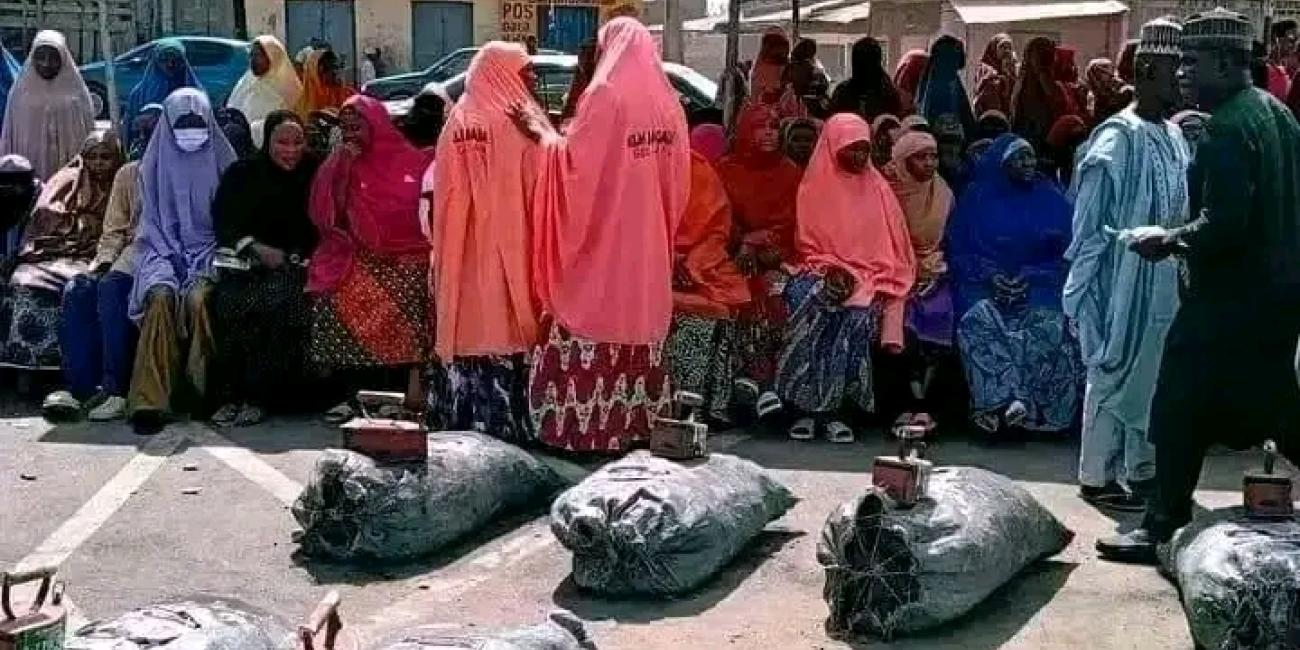
Abubakar Muhammad Tahir, the councillor representing Mayana Ward in Gusau Local Government Area of Zamfara State, has distributed bags of charcoal and charcoal pressing irons to residents of his ward in what was described as an empowerment initiative aimed at supporting small-scale economic activities.
According to information gathered, the items were shared among constituents in Mayana Ward as part of the councillor’s outreach efforts within the community. The distribution was reported by Nasarawa Daily News, which stated that the materials were intended to enable beneficiaries to engage in petty trading and other informal ventures requiring charcoal and charcoal irons.
Residents who received the items were said to include individuals involved in small domestic businesses such as local laundry services, food preparation, and street-level trading activities where charcoal remains a primary energy source. In many semi-urban and rural communities, charcoal pressing irons are still widely used, particularly in areas with unstable electricity supply.
The initiative adds to a growing list of similar empowerment gestures by public office holders across Nigeria, where items ranging from household goods to agricultural tools are distributed to constituents as part of poverty alleviation or youth employment programmes.
Critics, however, have often questioned the sustainability and long-term impact of such initiatives, arguing that they sometimes serve more as symbolic gestures than structural solutions to poverty and unemployment.
In May 2024, for example, the senator representing Kano Central Senatorial District, Rufai Hanga, distributed 5,000 white pieces of cloth and clay pots to constituents as burial materials for deceased loved ones. His senatorial district comprises 15 local government areas. An aide to the senator, Dawuud Auwal, shared a report about the project on Facebook, praising what he described as the lawmaker’s foresight and benevolence.
Similarly, in March 2024, a member of the House of Representatives representing Aba North/Aba South Federal Constituency, Alex Mascot Ikwechegh, distributed cooking stoves and other household items to constituents in Abia State under an empowerment programme.
In April 2022, SaharaReporters reported that Aliyu Wamakko, a former governor of Sokoto State who represents Sokoto North Senatorial District, donated wrappers and cash to indigent women as part of Eid-el-Fitr celebrations. His New Media aide, Bashar Abubakar, stated that beneficiaries included young girls, women and elderly residents, each receiving a set of wrappers along with cash to sew the fabrics.
Earlier, in February 2022, a councillor in Sokoto reportedly donated two plastic mats to residents of the Sadada community in Kebbe Local Government Area, posing for photographs with beneficiaries during the presentation.
In 2020, Hon. Abdullahi Mamudu, who represented Rijau/Magama Federal Constituency of Niger State in the House of Representatives, distributed wheelbarrows to youths as part of what was described as an employment initiative. Two years earlier, in 2018, Hon. Alhassan Ado Doguwa, representing Doguwa/Tudun Wada Federal Constituency of Kano State, distributed cutlasses and hoes to constituents under a youth empowerment scheme covered by local media.
Beyond these instances, various political office holders have distributed items such as tricycles, motorcycles, grinding machines, sachets of water and shoe-shining starter kits in the name of economic empowerment. In Kano, donkeys were reportedly given out to beneficiaries, while cassava stems were distributed in Anambra State under agricultural support initiatives.
An aide to former Benue State governor, Samuel Ortom, once distributed wheelbarrows branded with the inscription “Gov Ortom for You,” arguing that recipients could use them for errands or hawking to generate income.
The wheelbarrow empowerment model resurfaced in Taraba State when Maigari Bello-Kasimu, representing Jalingo/Yorro/Zing Federal Constituency, distributed wheelbarrows to constituents. His spokesperson, Saidu Na-Anabi, said the beneficiaries had previously hired wheelbarrows daily to earn a living but would now own their equipment outright.
In Enugu State, the late caretaker chairperson of Nsukka Local Government Area, Chinwe Ugwu, also distributed wheelbarrows to youths, stating that many could not afford to purchase them and had to rent at daily rates between N200 and N300.
Former Kano State Governor Abdullahi Ganduje announced that his administration spent N208 million to empower “Mai Shayi” or tea sellers by distributing cartons of noodles, crates of eggs, spaghetti, bread, cocoa beverages, milk, sugar, nylon and disposable cups to support their businesses.
In Katsina State, the late Commissioner for Education, Halimatu Idris, handed out goats to female students at Government Girls Arabic Secondary School in Dutsinma. The initiative reportedly required beneficiaries across 20 secondary schools to return the nanny goats to the state government after one year.
Against this backdrop, Tahir’s distribution of charcoal and charcoal irons in Mayana Ward has sparked mixed reactions. Supporters argue that even small-scale support can provide immediate relief and income-generating opportunities for low-income residents. Critics contend that such initiatives reflect a pattern of tokenistic interventions that do little to address systemic issues such as unemployment, infrastructure deficits and limited access to credit.
As Nigeria continues to grapple with economic hardship, inflation and high unemployment rates, debates over the effectiveness of grassroots empowerment programmes remain prominent. While local representatives maintain that such distributions are practical responses to immediate needs within their constituencies, public discourse increasingly questions whether more comprehensive, policy-driven solutions are required to achieve sustainable economic development.
For residents of Mayana Ward, however, the immediate impact of the charcoal and pressing irons will likely be measured in modest daily earnings and short-term household support, even as broader national conversations about political accountability and meaningful empowerment persist.