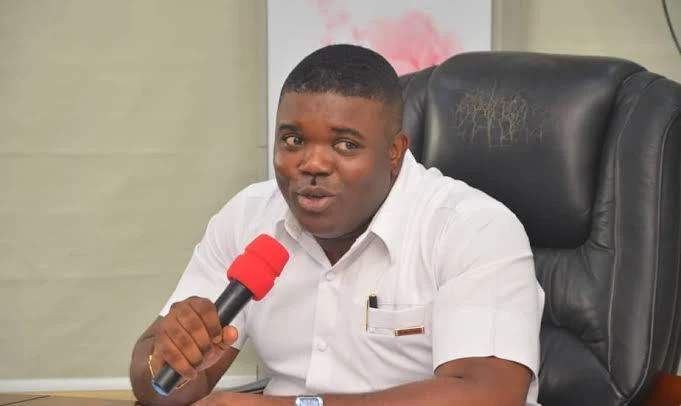
The Deputy Governor of Abia State and Chairman of the National Steering Committee for Membership Validation of the Labour Party, Ikechukwu Emetu, has firmly dismissed reports suggesting a rift between the party and the Nigeria Labour Congress (NLC), describing such claims as unfounded speculation.
Emetu made the clarification during an interview with The Punch on the sidelines of the official handover ceremony of the National Steering Committee’s progress report in Abuja. His remarks come amid months of swirling rumours that the NLC leadership, under Joe Ajaero, was contemplating dissolving the party’s National Caretaker Committee. The alleged grounds for such consideration included claims that the committee had failed to organise congresses and had taken steps that could push the party toward what critics described as “irreparable oblivion” ahead of the 2027 general elections.
Addressing the speculation directly, Emetu stressed that the Labour Party remains a broad-based political platform open to all Nigerians and not an exclusive group driven by factional interests.
“Labour Party is a national political platform. It is not a cult group where people are restricted from attending the party. So it’s a party that is for everybody,” he stated.
He rejected the notion that tensions existed between the party’s leadership and organised labour, noting that recent joint engagements contradicted claims of hostility or estrangement.
“Concerning the alleged rift with the NLC leader, you will recall that there was a time we had a meeting, and Ajaero was there with us. So, you should be very much aware that the new Labour Party is for everyone,” Emetu added.
He further assured party supporters that the confidence and goodwill the Labour Party enjoys in Abia State would be replicated at the national level.
“I can assure you that the trust Nigerians have in the Labour Party there in Abia State will be one they have at the national level,” he said.
His comments suggest an effort to stabilise perceptions of the party’s internal cohesion at a time when it is working to consolidate its position as a formidable opposition force ahead of the next general elections.
Echoing Emetu’s position, the Interim National Chairman of the Labour Party, Nenadi Usman, dismissed claims of a breakdown in relations with organised labour as baseless speculation.
She referenced a Special National Executive Council (NEC) meeting held on January 31 at the Abia Governors’ Lodge in Asokoro, Abuja, as evidence of continued collaboration between the party and labour leaders.
“Let me clear the opinion that many people are speculating that the Nigerian Labour Congress is not working with us. Recall that on January 31, we had a special NEC meeting at the Abia Governors’ Lodge in Asokoro,” she said.
According to Usman, key officials from both the NLC and the Trade Union Congress (TUC) were present at that meeting, underscoring the ongoing partnership between the party and organised labour.
“On that day, both the secretaries-general of the TUC and NLC, as well as their members, were there. So, if we are quarrelling, why are we attending meetings together?” she asked rhetorically.
She maintained that if there were unresolved disputes of significant magnitude, such visible cooperation would not be occurring.
“So, there is no quarrelling or issue whatsoever. We are working together. If we are having some unresolved issues, you wouldn’t see people like Prof. Theophilus Ndubuaku (Acting Chairman of the NLC Political Commission) here,” Usman added.
Her remarks appear aimed at countering narratives that the party’s historical alignment with organised labour has weakened or fractured.
Similarly, the party’s Interim National Secretary, Darlington Nwokocha, rejected suggestions of discord between the Labour Party and labour unions.
“It is not true. There is no rift between us and the NLC or the TUC. They are part of our stakeholders and as we talk, they have their representative here at this event,” Nwokocha said.
He emphasised that recent party meetings were inclusive and reflected broad participation across the party’s structures and affiliated groups.
“We don’t have any problem. We held our NEC meeting a few days ago, and it was all-encompassing. So, we have no problem within our rank and file at all. Everything is working together,” he stated.
By highlighting stakeholder representation at official events, Nwokocha sought to reinforce the message that the party’s internal processes remain consultative and coordinated.
The Labour Party emerged as a significant political force during the 2023 general elections, capturing widespread public attention and mobilising substantial grassroots support. However, in the aftermath of that electoral surge, the party has grappled with internal leadership disputes, questions over party structure, and calls for organisational reforms.
Some critics have argued that delays in conducting congresses and formalising leadership arrangements could weaken the party’s institutional stability. These concerns reportedly contributed to speculation that organised labour—historically linked to the party’s ideological roots—might intervene to restructure or dissolve certain party organs.
The NLC has long maintained a relationship with the Labour Party, given the party’s origins as a political platform aligned with labour interests. As such, any perceived tension between the two bodies has the potential to generate significant political implications.
Nevertheless, the consistent public denials by Emetu, Usman, and Nwokocha suggest a deliberate strategy to project unity and organisational coherence as the party repositions itself for 2027.
With the next general elections less than two years away, the Labour Party appears focused on consolidating its structures, validating its membership base, and reinforcing alliances with key stakeholders, including organised labour.
The National Steering Committee for Membership Validation, chaired by Emetu, is central to this process. By updating party records and verifying membership data, the committee aims to strengthen internal governance and enhance the party’s credibility.
At a time when political alignments are fluid and opposition parties are recalibrating their strategies, maintaining public confidence is critical. Persistent rumours of internal divisions or strained alliances could undermine voter trust and weaken mobilisation efforts.
The party leadership’s categorical rejection of rift narratives therefore serves both an internal stabilisation function and an external signalling purpose—communicating to supporters, potential allies, and the broader electorate that the party remains united.
Political analysts note that unity between the Labour Party and organised labour is not merely symbolic; it has practical implications for grassroots mobilisation, campaign financing, and policy alignment.
By affirming that representatives of the NLC and TUC continue to participate in NEC meetings and official events, party leaders are underscoring the institutional ties that bind both entities.
While acknowledging that internal debates and disagreements are natural in any political organisation, party officials insist that such issues do not amount to a structural breakdown in relations.
As the Labour Party seeks to transition from a protest-driven electoral surge to a durable political institution, its ability to maintain cohesion within its ranks and preserve strategic partnerships will be pivotal.
For now, the message from its top officials is unequivocal: there is no rift, no breakdown, and no impending dissolution. Instead, they present a party that remains intact, collaborative, and focused on strengthening its platform ahead of the 2027 general elections.