A group of House Republicans has introduced legislation aimed at compelling stronger United States action in response to what they describe as escalating religious persecution and mass atrocities in Nigeria.
The proposed legislation, titled the Nigeria Religious Freedom and Accountability Act of 2026 (H.R. 7457), seeks to formalise congressional oversight of U.S. policy toward Nigeria by mandating annual reporting requirements and exploring additional sanctions and designations targeting actors allegedly involved in violence against Christians and other vulnerable communities.
According to details first reported by the Daily Caller, the bill calls on the U.S. Secretary of State to submit an annual report to the House Foreign Affairs Committee and the Senate Foreign Relations Committee outlining steps taken by the United States to address religious persecution in Nigeria. The measure would also require the State Department to evaluate whether Fulani ethnic militias should be designated as a Foreign Terrorist Organization (FTO), a move that would trigger significant legal and financial consequences under U.S. law.
Beyond potential terrorist designation, the bill directs the Secretary of State to review sanctioned individuals connected to violence in Nigeria and assess whether U.S. assistance programs in the country may inadvertently contribute to or fail to deter persecution against Christian communities.
The legislation was co-sponsored by Representative Chris Smith of New Jersey, Chairman of the House Foreign Affairs Subcommittee on Africa; Representative Tom Cole of Oklahoma, Chairman of the House Appropriations Committee; and Representative Riley Moore of West Virginia. Several other senior Republican lawmakers have endorsed the measure, including House Foreign Affairs Committee Chairman Brian Mast of Florida, Appropriations Vice Chairman Mario Diaz-Balart of Florida, and Representative Bill Huizenga of Michigan, who chairs the House Foreign Affairs Subcommittee on South and East Asia.
In a statement accompanying the bill’s introduction, Smith argued that the United States must intensify its response to what he characterised as systematic violence against Christians and non-radical Muslims perpetrated by Islamist extremist groups.
“The Nigerian government’s blatant denial of the religious persecution occurring within its borders has only enabled the religious-based violence in the country to fester, with Christian deaths and church attacks reaching unprecedented numbers,” Smith said.
The bill references incidents including church burnings, mass abductions, sexual violence, and village raids. It cites estimates that between 50,000 and 125,000 Christians may have been killed between 2009 and 2025, figures that have been widely circulated by advocacy groups but remain contested in international policy circles due to the complexity of Nigeria’s conflict dynamics.
Nigeria has faced more than a decade of insurgency and widespread insecurity, particularly in the North-East, where Boko Haram and the Islamic State West Africa Province (ISWAP) have carried out sustained attacks on civilians, security forces, and infrastructure. In addition to jihadist insurgency, the country has experienced violent clashes involving armed bandits and communal militias in the North-West and Middle Belt regions. Analysts note that while some attacks have clear religious dimensions, many conflicts are also shaped by competition over land, political grievances, criminal enterprise, and ethnic tensions.
Nevertheless, proponents of H.R. 7457 argue that the scale and persistence of violence against Christian communities warrant a more robust American policy response.
Representative Riley Moore said he visited Nigeria as part of an investigation requested by President Donald Trump and witnessed firsthand the humanitarian and security challenges facing affected communities.
“As part of the investigation President Trump asked me to lead, I visited Nigeria and witnessed firsthand the horrors our brothers and sisters in Christ face and saw the security challenges Nigeria faces,” Moore said. He added that the legislation demonstrates that “the United States stands with our persecuted.”
Representative Tom Cole similarly framed the issue as both a moral imperative and a matter of strategic interest for the United States.
“Defending religious liberty across the globe, including in Nigeria, is not only the U.S.’s duty, but also serves a vital American interest,” Cole said, adding that the bill reinforces President Trump’s prior actions and underscores that “religious persecution will not be tolerated.”
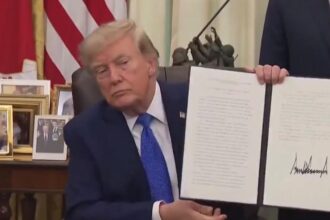
In November 2025, President Trump designated Nigeria as a “Country of Particular Concern” (CPC) under the International Religious Freedom Act. The designation enables the executive branch to employ diplomatic and economic tools, including sanctions, to address severe violations of religious freedom. The administration also conducted coordinated airstrikes with Nigerian authorities on Christmas Day targeting militant groups, signalling a willingness to combine diplomatic pressure with security cooperation.
H.R. 7457 would build on these executive measures by institutionalising congressional oversight and compelling periodic review of U.S. engagement in Nigeria. In addition to focusing on religious violence, the bill calls on the Secretary of State to counter what it describes as “hostile foreign exploitation” linked to illegal Chinese mining operations in Nigeria — a provision reflecting broader geopolitical competition between Washington and Beijing across Africa.
Advocacy organisations monitoring religious violence have welcomed the proposal. Judd Saul, head of Equipping the Persecuted and Truth Nigeria — groups that provide on-the-ground reporting on attacks — described the legislation as “a step in the right direction.”
Saul commended the sponsors for elevating the issue in Congress and pressing for sustained accountability mechanisms. He has previously criticised both U.S. and Nigerian authorities for what he views as insufficient responses to the scale of violence affecting Christian communities.
The bill is expected to advance swiftly through the House of Representatives, according to supporters, though its prospects in the Senate remain uncertain. If enacted, it would mark one of the most comprehensive congressional efforts to shape U.S. religious freedom policy toward Nigeria.
Nigerian officials have consistently rejected assertions that the country’s violence constitutes targeted religious persecution sanctioned or ignored by the state. They argue that the security crisis is multifaceted and affects both Christians and Muslims, pointing to attacks in predominantly Muslim communities as evidence that extremist groups do not discriminate solely on religious lines.
The debate surrounding H.R. 7457 therefore intersects with broader questions about how to categorise and address Nigeria’s complex security landscape. Whether framed primarily as religious persecution, insurgency, or communal conflict, the violence has had devastating humanitarian consequences, including mass displacement, economic disruption, and loss of life.
As Congress considers the bill, the issue is likely to remain at the centre of U.S.–Nigeria relations, shaping diplomatic engagement, security cooperation, and foreign assistance policy in the months ahead.