Nigeria’s First Lady, Senator Oluremi Tinubu, has described the United States military airstrikes carried out on Christmas Day against Islamist militants in Sokoto State as a “blessing,” indicating the Nigerian government’s openness to expanded security cooperation with Washington amid worsening insecurity across the country.
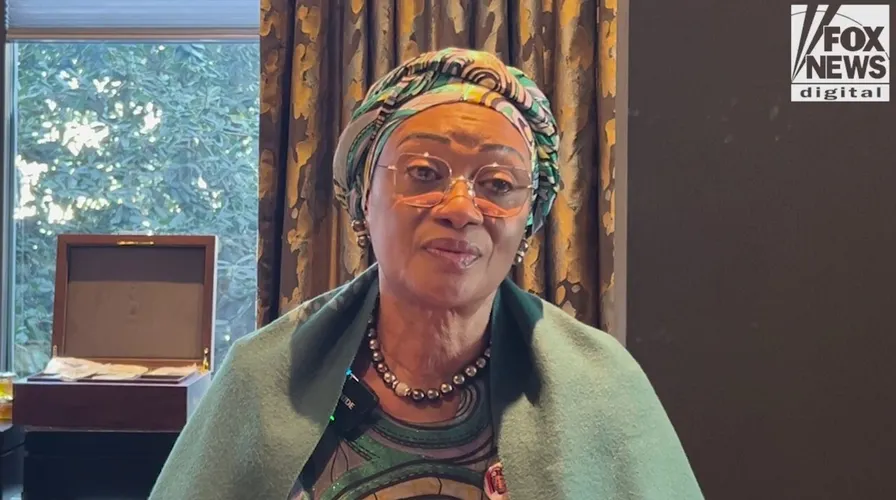
Tinubu made the remarks in an interview with Fox News Digital during a week-long visit to the United States, where she engaged senior officials and policymakers in a bid to ease long-standing tensions between Nigeria and some members of the U.S. Congress over terrorism, religious violence, and human rights concerns in Africa’s most populous nation.
The Christmas Day airstrike, reportedly conducted by U.S. forces targeting Islamist militants operating in northwest Nigeria, marked a rare instance of direct American military action on Nigerian soil in recent years. The operation was welcomed by Abuja, Tinubu said, as Nigeria continues to grapple with insurgent groups, banditry, and organised criminal networks that have spread violence across several regions.
“The intervention of the U.S. was quite a welcome development,” Tinubu said, describing the strike as timely support in Nigeria’s protracted fight against insecurity.
She added that the Federal Government hopes the engagement with Washington will deepen beyond isolated actions. “Nigeria is looking forward to collaboration with the United States on security issues,” she said. “We are expecting that there will be more.”
Tinubu’s comments come as the fight against Islamist militancy in Nigeria increasingly features in U.S. domestic political debates, particularly among conservative lawmakers and supporters of former President Donald Trump. During his previous administration, Trump designated Nigeria a “Country of Particular Concern” over alleged violations of religious freedom, a classification that strained diplomatic relations between Abuja and Washington.
The administration of President Bola Tinubu has consistently rejected the label, arguing that Nigeria’s security crisis is complex and not rooted in religious persecution. Nigerian officials maintain that the violence cuts across religious, ethnic, and regional lines, and that both Christians and Muslims are victims of attacks by extremist groups and criminal gangs.
Tinubu echoed this position during her U.S. engagements, stressing that terrorism in Nigeria should not be framed as a religious war.
“Terrorist groups hide in the forest, and also bandits and other people are kidnapping for ransom,” she said, underscoring the multifaceted nature of the security threats confronting the country.
Earlier this year, gunmen believed to be Islamic extremists killed at least 162 people in Kwara State, a predominantly Muslim area, burning homes and looting shops in communities whose residents were reportedly targeted for rejecting extremist ideology. Nigerian authorities have cited such incidents as evidence that extremist violence is not directed at any single religious group.
“We are concerned about our people’s safety,” Tinubu said, pointing to measures already taken by the federal government to address the crisis.
She listed the declaration of a nationwide security emergency, plans to recruit 50,000 additional police officers, and the redeployment of more than 11,000 personnel from VIP protection duties to conflict-affected areas as part of the administration’s response.
Despite persistent criticism from Christian advocacy groups in the United States, which argue that Christians have been disproportionately targeted in Nigeria, Tinubu said the heightened international attention has at least opened channels for dialogue between both countries.
“We have that attention. We have the conversation going,” she said. “And we are expecting that there will be more. It’s going to yield better fruit for us, and both for us and also America.”
During meetings with senior U.S. officials, lawmakers, and policy advisers, Tinubu said she worked to clarify Nigeria’s security realities and challenge narratives she believes oversimplify the crisis.
“We live in Nigeria. We know the situation on the ground,” she said, adding that decisions about security policy must be informed by local context rather than external assumptions.
Tinubu’s profile as First Lady places her at a unique intersection of Nigeria’s religious and political diversity. A former senator who served in the National Assembly until 2023 and previously held the role of First Lady of Lagos State between 1999 and 2007, she is also a prominent Christian leader and an ordained pastor. Her husband, President Bola Tinubu, is Muslim—a pairing often cited as symbolic of Nigeria’s religious pluralism.
Beyond her political background, Tinubu runs a Christian podcast and leads outreach initiatives through the Renewed Hope Initiative, a non-profit organisation aligned with the administration’s social welfare agenda.
In her remarks, she linked security improvements directly to Nigeria’s economic recovery and ability to attract foreign investment. Nigeria holds significant deposits of lithium, cobalt, and other critical minerals, resources that have drawn increasing interest from the United States as it seeks to counter China’s dominance in Africa’s minerals sector.
However, insecurity in many mining regions remains a major deterrent to large-scale investment.
“We’re doing all we can to make sure that when investors come, they can feel comfortable and their investment can yield,” Tinubu said.
Nigeria, home to more than 230 million people and over 500 languages, has struggled for decades with corruption, weak institutions, and economic mismanagement despite its vast natural wealth. Tinubu said the current administration, which assumed office in 2023, inherited deep structural challenges and is working to reverse them through security reforms and difficult economic decisions.
Violence linked to Islamist insurgents and criminal militias has claimed tens of thousands of lives over the past decade. Groups such as Boko Haram and the Islamic State West Africa Province (ISWAP), alongside heavily armed bandit networks, continue to destabilise large swathes of the country, particularly in the North-East, North-West, and parts of the North-Central regions.
Christian advocacy organisations estimate that more than 50,000 Christians have been killed in Nigeria since 2009, figures that are frequently cited by U.S. religious freedom advocates but remain difficult to independently verify. Nigerian authorities argue that casualty figures are often politicised and fail to capture the full spectrum of victims across different communities.
Still, Tinubu acknowledged that the scale of violence demands sustained international cooperation.
As Nigeria seeks to reposition itself diplomatically and economically, her comments signal a willingness by Abuja to embrace closer security ties with Washington, provided the engagement is framed as a partnership rather than external intervention.
For the Tinubu administration, restoring security remains central not only to protecting lives but also to rebuilding trust, stabilising the economy, and redefining Nigeria’s standing on the global stage.