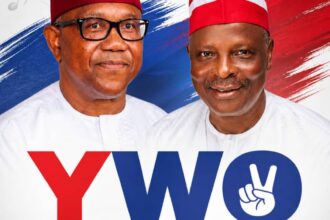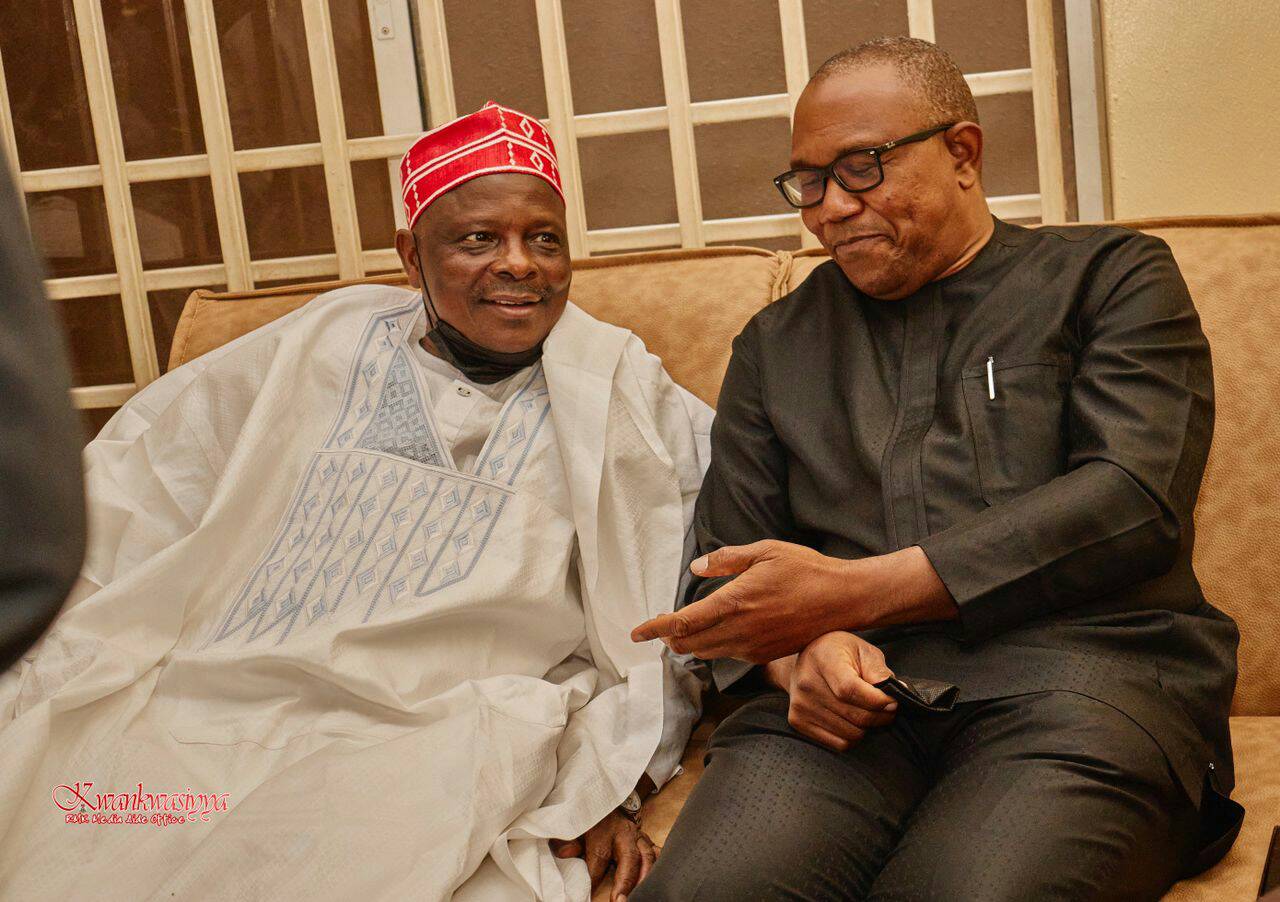
A political advocacy group, the Kwankwaso Support Group 2027, has proposed a joint presidential ticket pairing former Anambra State Governor, Peter Obi, with former Kano State Governor and senator, Rabi’u Musa Kwankwaso, ahead of the 2027 general elections. The group says the proposed alliance represents a strategic and nationalistic response to Nigeria’s deepening socio-economic and security challenges.
Speaking at a press interaction in Kano on Friday, the leader of the group, Abba Gwale, said the proposal was driven by growing public dissatisfaction with the current direction of governance and a desire among Nigerians for a credible, people-centred alternative. According to him, supporters of Senator Kwankwaso across the country believe that an Obi–Kwankwaso ticket offers a realistic pathway to national renewal.
“As loyal supporters of Senator Kwankwaso, we consider it necessary to appeal to Nigerians to rally behind a joint presidential ticket with Peter Obi,” Gwale said. “This is not about personalities alone; it is about rescuing the nation from insecurity, hunger, unemployment and hopelessness. The current political trajectory has shown clearly where the tide is shifting.”
Gwale stressed that the proposal was not limited to any particular political party, noting that the alliance could be pursued within any platform capable of accommodating the shared vision of both leaders. He argued that the political climate ahead of 2027 suggests a strong appetite for realignment and coalition-building, especially among voters disillusioned with traditional power blocs.
“If this duo secures the mandate of Nigerians in the next election, the country will undoubtedly be a better place,” he said. “People are genuinely tired of insecurity, hunger and starvation. Nigerians want leadership that understands their pain and has the competence and discipline to address it.”
According to the group, the strategic logic of the proposed ticket lies in its ability to bridge Nigeria’s long-standing regional and political divides. Obi is widely regarded as commanding significant grassroots support in the South, particularly among young voters and the urban middle class, while Kwankwaso retains a formidable political structure in the North, especially in Kano and other parts of the North-West.
“We are advocating a political alliance that harmonises Obi’s strong support base in the South with Kwankwaso’s deep-rooted influence in the North,” Gwale explained. “Such a coalition has the potential to fundamentally reshape the political landscape and pose a serious challenge to the ruling All Progressives Congress.”
He added that beyond electoral arithmetic, the proposed partnership is anchored on what he described as shared values and policy priorities. Both Obi and Kwankwaso, he noted, have consistently projected themselves as leaders committed to social welfare, education, poverty reduction and inclusive economic growth.
“At the heart of this alliance is a shared ambition to wrest power from the APC and introduce meaningful change in governance,” Gwale said. “Both men have records that show concern for the common man. Their partnership is seen by many Nigerians as a crucial step towards building a more equitable and functional country.”
Gwale, who hails from the same constituency as Kano State Governor Abba Kabir Yusuf, said the momentum behind the Obi–Kwankwaso idea is being fuelled by widespread dissatisfaction with the current administration. He argued that rising living costs, persistent insecurity and declining public trust in institutions have created fertile ground for a broad opposition coalition.
“The message of hope and change being associated with this proposed alliance is resonating strongly with Nigerians across regions,” he said. “With their combined political strength and national appeal, Obi and Kwankwaso are emerging as a formidable force capable of challenging the status quo.”
As discussions around the 2027 elections gather pace, Gwale said attention will increasingly focus on how such an alliance could be formalised, structured and marketed to voters. He noted that while no official agreement has been announced by either Obi or Kwankwaso, the growing public discourse reflects a strong desire among their supporters for unity rather than fragmented opposition.
“As 2027 approaches, all eyes will be on this proposed alliance to see how it can convert popular enthusiasm into concrete political action and, ultimately, votes,” he said. “One thing is clear: there is a determination among their supporters to shake up Nigerian politics and usher in a new era.”
Gwale also addressed reports suggesting that Senator Kwankwaso had demanded a significant number of political appointments or concessions from the ruling APC in exchange for joining the party. He dismissed such claims as either exaggerated or misconstrued, insisting that any negotiation involving Kwankwaso should be understood within the context of his political stature and nationwide following.
“If there is anything like that, it should not be misrepresented or sensationalised,” Gwale said. “Given the calibre of Senator Kwankwaso and the scale of his support base, it would be unreasonable to portray legitimate political negotiations as personal greed or ambition.”
According to him, Kwankwaso’s engagements, where they exist, are focused on ensuring that the interests of his supporters and political associates across the 36 states and the Federal Capital Territory are adequately represented.
“Supporters of Kwankwaso cut across all divides,” Gwale added. “They are mostly ordinary Nigerians who are struggling to survive from hand to mouth. Any political demand associated with him should be seen in the light of addressing the needs and aspirations of these people.”
While neither Peter Obi nor Rabi’u Kwankwaso has formally responded to the proposal, the growing advocacy for a joint ticket underscores a broader trend in Nigerian politics: increasing calls for opposition unity as a counterweight to entrenched power. Whether the Obi–Kwankwaso vision will evolve from a support-group proposal into a concrete political alliance remains to be seen, but its emergence signals a restless electorate searching for credible alternatives ahead of 2027.