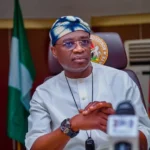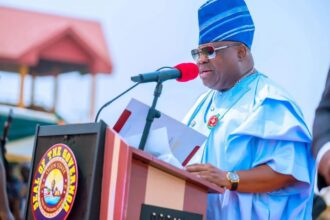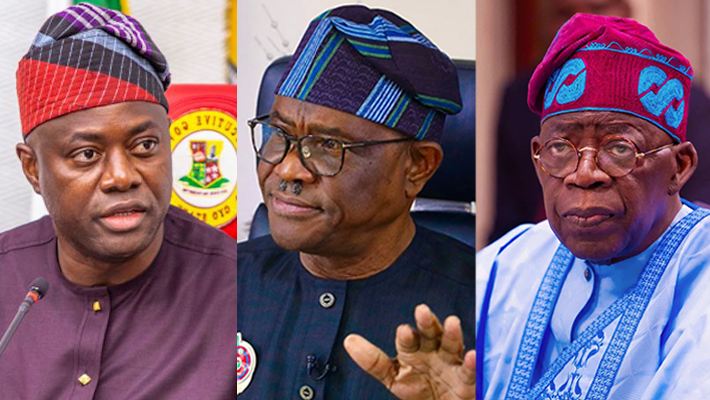
Oyo State Governor, Seyi Makinde, has disclosed details of a high level political meeting which, according to him, sheds light on the internal crisis rocking the Peoples Democratic Party (PDP) and the growing alignment of some of its leaders with the ruling All Progressives Congress (APC) ahead of the 2027 general elections.
Speaking during a media interaction in Ibadan on Tuesday, the governor explained why he would not support President Bola Ahmed Tinubu’s re election bid in 2027, warning that deliberate efforts to weaken opposition parties pose a serious threat to Nigeria’s democratic foundations.
Makinde revealed that he was present at a meeting attended by President Tinubu, the Minister of the Federal Capital Territory, Nyesom Wike, and other political actors, where Wike allegedly offered to neutralise the PDP for the benefit of the ruling party ahead of the next election cycle.
Related posts:
- Wike Denies Presidential Ambition, Declares Support for Tinubu’s 2027 Re-election
- NDLEA speaks on Pretty Mike’s arrest, warns against rising drug party culture
- PBAT Media Centre Debunks Claims Linking President Tinubu to Alleged Distribution of Buses for 2027 Campaign
- Jubilation as Seyi Makinde raises salary of security guards from ₦18,800 to ₦80,000 after outcry
According to the Oyo State governor, the offer was not solicited by the president but was voluntarily made by Wike, who is a former governor of Rivers State and a prominent figure within the PDP despite currently serving in an APC led federal government.
“I was in a meeting where President Tinubu was present, along with Nyesom Wike and others,” Makinde said. “At that meeting, Wike openly said he would hold the PDP down for Tinubu until 2027. The president did not ask for it. It was an offer he made on his own.”
Makinde stressed that while Wike is entitled to his political choices and alliances, he personally would not follow the same path. He said his decision not to support Tinubu’s re election bid was rooted in principle and a firm belief in the importance of a strong opposition for the survival of democracy.
The governor warned that attempts by the ruling party or its allies to weaken the PDP could gradually erode Nigeria’s multiparty system and pave the way for a de facto one party state.
“If you destroy the opposition, you are destroying democracy,” Makinde said. “As democrats, we must be very careful. Nigeria cannot afford to slide into a one party system. It may look convenient today, but it will be disastrous in the long run.”
He emphasised that democracy thrives on competition, accountability, and the freedom of citizens to choose between alternatives, adding that opposition parties play a critical role in checking excesses of those in power.
Makinde said Nigerians must be allowed to make independent political choices without coercion, manipulation, or the systematic weakening of opposition platforms.
Addressing speculations about his own political future, the Oyo State governor did not rule out a possible presidential ambition in 2027. He stated clearly that he possesses the experience, competence, and credentials required to contest the highest office in the land if he chooses to do so.
“I have heard people ask whether I am positioning myself for the presidency in 2027,” Makinde said. “Let me be very clear. I am qualified. I am even overqualified.”
He noted that by the end of his current tenure in May 2027, he would have completed two full terms as governor of Oyo State, giving him extensive executive experience in public administration.
“By God’s grace, by the end of May 2027, I would have served two terms as governor of Oyo State,” he said. “Before then, I also had a solid professional background. I ran a private company from the age of 29. I understand both governance and enterprise.”
Makinde added that leadership is not merely about ambition but about preparedness, competence, and a clear vision for national development. While he did not formally declare his intention to run, his comments signalled openness to future political responsibility at the national level.
Beyond national politics, the governor also spoke about the legacy he hopes to leave behind as Oyo State governor. He said his administration is focused on building strong institutions that can sustain development beyond his time in office, rather than concentrating solely on physical infrastructure.
“Infrastructure is important, but institutions are even more critical,” Makinde said. “You can build roads and bridges, and in 10 or 20 years people may forget who built them. But when you build strong systems and institutions, they endure and continue to deliver good governance.”
According to him, sustainable development is anchored on transparent processes, accountable leadership, and policies that outlive political office holders.
Makinde also addressed allegations of land grabbing and displacement linked to the ongoing Rashidi Ladoja Circular Road project in Ibadan. He dismissed claims that his administration arbitrarily acquired land for the project, explaining that the corridor was legally established long before he assumed office.
The governor said the 500 metre right of way for the circular road was officially gazetted on November 19, 2018, several months before his administration began in May 2019.
“This is not something we woke up and decided to do,” he said. “The corridor was gazetted in 2018, before I became governor. We are simply implementing a long term development plan for Ibadan.”
Makinde explained that the 110 kilometre Rashidi Ladoja Circular Road is designed to decongest traffic within Ibadan metropolis, meet modern motorway standards, and serve as an industrial and commercial corridor that will stimulate economic growth across the state.
He said the road project is expected to open up new economic opportunities, attract investment, and improve the movement of goods and services within and beyond Oyo State.
On the issue of compensation, the governor said his administration has adopted a humane and inclusive approach, particularly for residents affected by the project.
According to him, compensation is being paid not only to landowners with formal documentation but also to residents who may not have legal titles, provided they can present credible proof of residence to support resettlement efforts.
“We are being very humane,” Makinde said. “Even people without formal documents are being considered, as long as they can show proof that they lived there. We are not interested in displacing people without support.”
The governor said this approach reflects his administration’s commitment to balancing development with social justice and human dignity.
Makinde’s remarks have added fresh dimensions to ongoing debates about the future of the PDP, the nature of political alliances ahead of 2027, and the broader health of Nigeria’s democracy. His comments are expected to provoke reactions within both the PDP and APC, as political actors reposition themselves in the build up to the next general elections.
As Nigeria approaches another critical electoral cycle, Makinde’s warnings against opposition suppression and one party dominance underscore growing concerns about political pluralism, internal party democracy, and the direction of governance in the country.