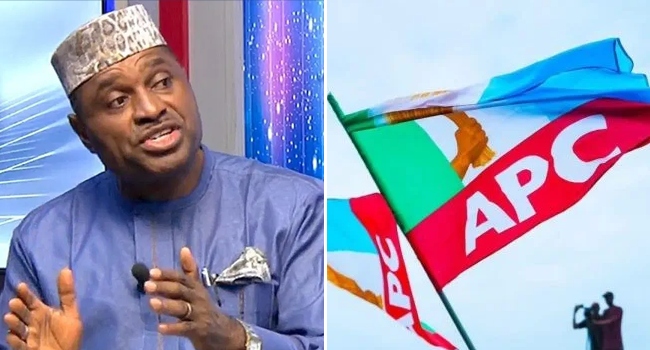
Ahead of Nigeria’s 2027 general elections, a chieftain of the African Democratic Congress, Kenneth Okonkwo, has expressed confidence that the emerging opposition coalition will successfully challenge and ultimately end the dominance of the ruling All Progressives Congress in the country’s political landscape.
Okonkwo made the remarks while speaking as a guest on Channels Television’s Morning Brief, where he discussed the evolving political alignments ahead of the next presidential and legislative elections. According to him, the momentum building around the coalition is only the beginning of what he described as a determined effort by opposition forces to unseat the ruling party.
He argued that recent developments within Nigeria’s political arena, including defections by several lawmakers to the ADC, signal the start of a broader realignment that could reshape the balance of power before the 2027 polls.
“We are still coalescing,” Okonkwo said during the programme. “You can see that the journey towards removing APC has just begun. Nine senators and an innumerable number of members of the House of Representatives have joined the ADC. The movement is gaining momentum.”
Okonkwo also criticised the leadership of the Senate, particularly Senate President Godswill Akpabio, accusing him of sending mixed signals regarding the growing number of defections from opposition parties to the ADC.
“You can see how Akpabio is double-speaking in everything that he is doing,” he said, suggesting that the Senate leadership is uneasy about the growing strength of the opposition coalition.
The former Labour Party spokesperson also used the opportunity to question the credibility of the February 21 Area Council elections held in the Federal Capital Territory. In those polls, the ruling APC secured a dominant victory by winning five out of the six chairmanship positions contested across the area councils.
The Peoples Democratic Party managed to win only one council, Gwagwalada, while the ADC and other parties failed to secure any of the chairmanship seats.
However, Okonkwo dismissed the outcome of the election, describing the entire exercise as deeply flawed and lacking the essential conditions required for a credible democratic process.
“Do not judge us by those elections,” he insisted. “The FCT election was a sham. There was no election. In an election where people were restricted from moving freely to cast their votes, you cannot call that a credible process.”
Okonkwo alleged that the environment in which the election was conducted was heavily influenced by the Minister of the Federal Capital Territory, Nyesom Wike, whom he accused of interfering in the electoral process.
According to him, opposition members and supporters were prevented from moving around the city on election day, while those aligned with the ruling party were allegedly allowed to move freely from one polling unit to another.
“Wike was restricting the opposition from moving, while his supporters were moving as they liked from polling unit to polling unit, interfering in the election,” Okonkwo alleged.
He argued that the minister had no constitutional authority to be involved in the conduct of elections within polling units, noting that such responsibilities belong exclusively to electoral officials and security agencies.
“Wike was not an elected person in the FCT,” he said. “He was not an official of the Independent National Electoral Commission and not part of any security agency assigned to oversee elections. He had no business being around polling units.”
Okonkwo therefore concluded that the municipal elections in the Federal Capital Territory should not be considered legitimate, insisting that the process failed to meet the basic standards required for a credible vote.
“That FCT municipal election was a sham and should not even be counted as an election at all,” he added.
He also raised concerns about alleged vote-buying during the election, claiming that individuals were apprehended by the Economic and Financial Crimes Commission while carrying large sums of money believed to be intended for influencing voters.
Despite the controversy surrounding the FCT elections, Okonkwo maintained that the African Democratic Congress has emerged as the most viable opposition platform in Nigeria.
“The truth is that ADC, the African Democratic Congress, is today the leading opposition party in Nigeria,” he said.
According to him, the emergence of the ADC as a central opposition force was the result of earlier calls for unity among opposition leaders across different political parties.
Okonkwo revealed that he had long advised leaders within the PDP, the Labour Party, and other opposition movements to set aside their differences and form a coalition capable of mounting a strong challenge against the ruling APC.
“I said this a long time ago,” he explained. “PDP, LP and other parties on their own are not viable enough to defeat the APC. The opposition leaders and parties should come together and form a coalition.”
According to him, that advice eventually led to discussions among prominent opposition figures, culminating in the decision to adopt the ADC as the political platform for the emerging coalition.
“When they finally coalesced, they were able to deal with the APC, which has constituted itself as an enemy of democracy and certainly an enemy of the welfare of the Nigerian people,” Okonkwo stated.
He added that the coalition’s objective goes beyond merely winning elections, saying the alliance was formed around a shared vision of building what he described as a “new Nigeria” founded on democratic accountability, economic progress, and social justice.
Okonkwo also predicted that more politicians would defect from their current parties to join the ADC as preparations for the 2027 elections gather momentum.
According to him, the shifting political landscape reflects growing dissatisfaction among politicians and citizens alike with the current state of governance in the country.
“You will see more politicians joining us soon,” he said confidently. “As the political environment continues to evolve, people will realise that ADC represents the future.”
The actor-turned-politician expressed optimism that the ruling APC would eventually lose its grip on power once the opposition coalition fully consolidates its strength across the country.
“APC will soon be history by the grace of God,” he declared.
Nigeria’s 2027 general elections are expected to be one of the most competitive in recent years, with several political figures already positioning themselves and their parties for the contest.
Political analysts believe the formation of coalitions among opposition parties could significantly alter the dynamics of the election, particularly if prominent political leaders decide to rally behind a single platform.
For now, however, the political landscape remains fluid, with alliances, defections, and strategic negotiations continuing to shape the road to 2027.