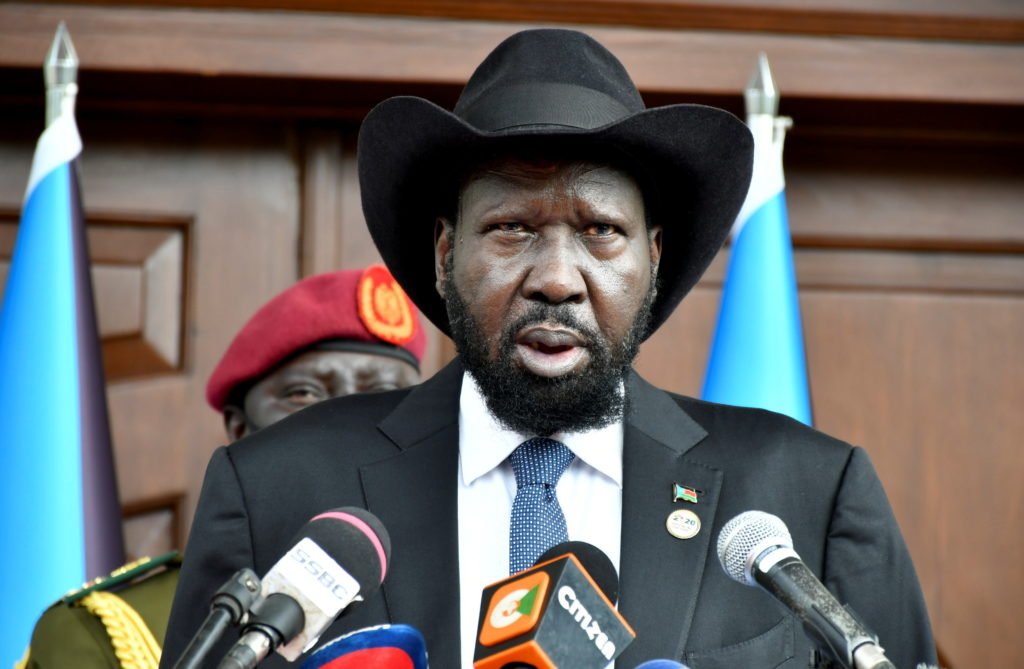
Fresh concerns have emerged over the health of South Sudanese President Salva Kiir Mayardit after he was seen struggling to walk unaided during the African Union Summit in Addis Ababa, Ethiopia, prompting questions about the potential implications for political stability in the world’s youngest nation and the wider region.
Kiir, who has led South Sudan since its independence in 2011, appeared visibly frail as he arrived at the summit venue, moving slowly and seemingly requiring assistance. Video clips and images circulating from the high-level gathering showed the 72-year-old president walking with difficulty, drawing immediate attention from delegates and observers.
The African Union Summit, held at the AU headquarters in Ethiopia’s capital, brings together heads of state and government from across the continent to deliberate on pressing political, economic and security issues. Kiir’s presence was expected as part of ongoing regional engagements, particularly given South Sudan’s fragile political transition and security challenges.
However, his physical condition became a focal point of discussion, overshadowing some of the summit’s deliberations. While South Sudanese officials have not issued any formal statement regarding his health, the images have intensified speculation about his ability to continue leading the country at a critical juncture.
Kiir has been at the helm of South Sudan’s political landscape for more than a decade, navigating the country through a devastating civil war that erupted in 2013 and subsequent fragile peace agreements. The 2018 Revitalized Peace Agreement, brokered with regional and international support, created a unity government that includes former rival Riek Machar as First Vice President. The agreement aims to pave the way for long-delayed national elections and a permanent constitution.
Analysts say that any uncertainty surrounding Kiir’s health could have significant ramifications for the peace process. South Sudan’s political system remains highly centralized around the presidency, with power balances delicately managed among former adversaries. A sudden leadership vacuum or perceived weakness at the top could risk unsettling these arrangements.
Regional actors have also been closely involved in South Sudan’s stability, with neighboring countries such as Uganda, Kenya, Ethiopia and Sudan playing roles in mediation efforts over the years. As a member of the Intergovernmental Authority on Development (IGAD), South Sudan’s internal stability directly affects broader regional security dynamics, including cross-border trade, refugee flows and armed group movements.
Observers note that South Sudan continues to grapple with economic hardship, intercommunal violence, and delays in implementing key provisions of the peace agreement. Preparations for national elections, which have been postponed multiple times, remain incomplete. In this context, questions about the president’s health add another layer of uncertainty to an already fragile political environment.
Kiir, recognizable for his trademark black cowboy hat, has rarely addressed public speculation about his health in the past. Throughout his presidency, the government has generally maintained tight control over official communications, particularly on sensitive issues. As of now, there has been no confirmation from Juba that the president is facing any serious medical condition.
Political analysts caution against drawing definitive conclusions from a single public appearance. They note that fatigue, travel strain, or temporary medical issues could explain the observed difficulty. Nonetheless, in a country where political transitions have historically been turbulent, even the perception of vulnerability at the highest level can trigger concern.
South Sudan’s constitution outlines procedures for presidential succession, but the practical application of those provisions could prove complex in a politically divided environment. The unity government arrangement, while designed to foster inclusivity, has also entrenched rival power centers that could compete for influence in the event of leadership uncertainty.
International partners, including the African Union and the United Nations, have consistently emphasized the importance of maintaining momentum toward democratic transition in South Sudan. The AU Summit itself underscored themes of governance, peacebuilding and institutional strengthening across the continent—issues that are particularly salient for Juba.
For now, Kiir remains in office, and there has been no official indication of any change in his status. However, his appearance in Addis Ababa has intensified scrutiny at home and abroad. In a region where leadership health has, in the past, influenced political trajectories, developments surrounding South Sudan’s presidency will likely continue to attract close attention.
As South Sudan navigates its next phase of political transition, the stability of its leadership remains a critical factor. Whether the concerns raised in Addis Ababa prove fleeting or consequential may depend on forthcoming clarifications from the government and the resilience of the country’s still-evolving institutions.
Watch video: