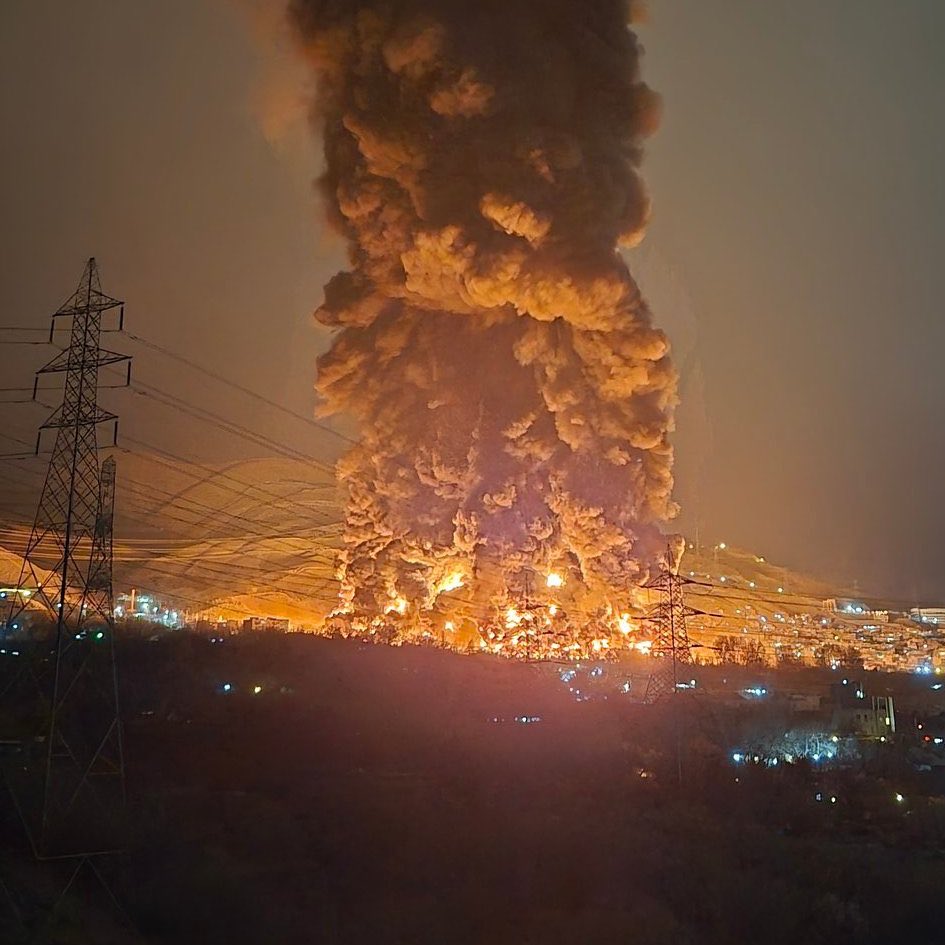
A major escalation in the ongoing Middle East conflict occurred after United States and Israeli forces carried out airstrikes on oil storage facilities in Tehran, including one of the Iranian capital’s largest fuel depots. The attack triggered massive explosions, towering flames, and thick clouds of black smoke that blanketed large parts of the city, raising fears of environmental damage and further escalation of the regional war.
The strikes, which targeted multiple oil sites in and around Tehran, mark one of the most significant attacks on Iran’s energy infrastructure since the conflict intensified earlier in 2026. The incident has deepened global concerns about the security of energy supplies and the possibility of a broader confrontation across the Middle East.
Related posts:
- Death Toll in U.S.-Israeli Strikes on Iran Rises to 555 as Tehran Vows Defiance
- Misguided Bombs and Dangerous Narratives: When the Fight Against Terror Misses Its Target
- Iran’s Supreme Leader Moved to Underground Bunker as US–Iran Tensions Reach Critical Point
- Nigeria Ranked World’s Fourth Largest Homeless Population as Displacement Crisis Deepens
According to reports from Iranian and international media, warplanes struck several oil storage depots overnight, causing huge explosions that lit up the skyline of Tehran. Residents reported seeing massive fireballs rising above the city, while emergency services rushed to contain fires at the affected facilities.
One of the main targets was believed to be a major oil depot near Tehran, part of the capital’s fuel distribution network. The facility reportedly holds large volumes of petroleum products used to supply fuel to millions of residents and industries across the metropolitan area.
Videos circulating on social media showed flames shooting high into the air and thick black smoke spreading across the city. Authorities later confirmed that the strikes had caused multiple fires at the site and forced emergency teams to begin containment operations.
Initial reports indicated that at least four tanker drivers were killed during the attack, while several others were injured. The explosions also caused widespread alarm among residents living near the affected areas.
The attack triggered severe environmental concerns, with Iranian authorities warning that the burning fuel tanks released dangerous pollutants into the air.
The Iranian Red Crescent warned residents to stay indoors due to the possibility of toxic fumes and acid rain caused by the chemical composition of the smoke. Experts said that when petroleum storage facilities burn, they release hydrocarbons and other toxic compounds that can pose serious health risks.
Meteorologists also warned that the smoke could remain over the city for several days due to weak winds, increasing the likelihood of hazardous air pollution.
Residents described the atmosphere as dark and suffocating, with some neighborhoods reportedly covered by what witnesses called “black rain”, caused by particles from the burning fuel mixing with moisture in the atmosphere.
Authorities urged citizens to limit outdoor activities and take precautions such as wearing protective masks if they had to go outside.
The airstrike is widely seen as a strategic attempt to weaken Iran’s logistical and economic capacity during the ongoing war.
Oil depots and refineries are crucial components of a country’s energy infrastructure. In the case of Tehran, the targeted depot plays an important role in storing and distributing fuel for transportation, electricity generation, and industrial activities.
Energy facilities are often targeted during conflicts because damaging them can disrupt fuel supply, strain the economy, and reduce a country’s ability to sustain military operations.
Analysts say that striking such infrastructure could also create domestic pressure within Iran if fuel shortages begin to affect daily life.
Previous attacks in earlier phases of the conflict had already targeted oil refineries and gas facilities, but the latest strikes represent a more direct attempt to damage the capital’s fuel storage network.
The bombing of Tehran’s oil depot was not an isolated event. Reports indicate that five oil facilities in and around Tehran were hit during the overnight air campaign, suggesting a coordinated effort to damage multiple energy assets at once.
The strikes form part of a broader military campaign launched by the United States and Israel against Iranian targets after the conflict escalated in late February 2026.
Earlier attacks targeted military installations, government buildings, and nuclear facilities. However, the expansion of the campaign to include energy infrastructure marks a new phase of the conflict.
Observers say the strategy appears aimed at crippling Iran’s economic backbone, as the country relies heavily on oil production and distribution to sustain its economy.
Iran has strongly condemned the attacks, accusing the United States and Israel of targeting civilian infrastructure and violating international law.
Iranian officials warned that such strikes would not go unanswered and vowed to retaliate against what they described as “aggression.”
In recent days, Iran has already launched missile and drone strikes against targets linked to the United States and its allies in the Gulf region, including attacks in Bahrain and other countries hosting American military facilities.
The retaliatory strikes have further intensified fears of a wider regional conflict involving multiple countries.
Iran’s leadership has also called on the international community to condemn the attacks and pressure Washington and its allies to halt the bombing campaign.
For residents of Tehran, the strikes have created a climate of anxiety and uncertainty.
The Iranian capital is home to around 10 million people, making it one of the largest cities in the Middle East. The attacks on nearby fuel storage facilities have disrupted daily life, with some petrol stations temporarily closing while authorities assess potential supply disruptions.
Although officials have said there is no immediate nationwide fuel shortage, authorities have urged residents to reduce fuel consumption and avoid panic buying.
Many residents have chosen to remain in the city despite the risks, citing the high cost of relocating and the difficulty of traveling during wartime conditions.
The persistent sound of explosions and air defense systems has also become a grim reality for many residents, who fear that additional strikes may occur in the coming days.
The bombing of Tehran’s oil infrastructure has also triggered concerns in global energy markets.
Any disruption to Iran’s oil industry could have significant consequences for global supply, especially given the strategic importance of the Strait of Hormuz, through which a large portion of the world’s oil shipments passes.
The conflict has already caused fluctuations in global oil prices, with traders closely monitoring the situation for signs of further escalation.
Energy analysts warn that if Iran’s oil infrastructure continues to be targeted—or if the conflict spreads to other oil-producing countries—the result could be higher fuel prices and increased economic pressure worldwide.
The strikes on Tehran’s oil depots underscore how quickly the conflict between Iran and its adversaries is escalating.
What began as targeted strikes on military and nuclear sites has now expanded into attacks on energy infrastructure and retaliatory strikes across the region.
International organizations and several governments have urged both sides to exercise restraint to prevent the situation from spiraling into a full-scale regional war.
However, with both sides continuing to exchange attacks and escalate their rhetoric, the prospects for immediate de-escalation remain uncertain.
For now, the flames rising from Tehran’s oil depots serve as a stark reminder that the conflict has entered a dangerous new phase—one that could reshape the geopolitical and economic landscape of the Middle East for years to come.