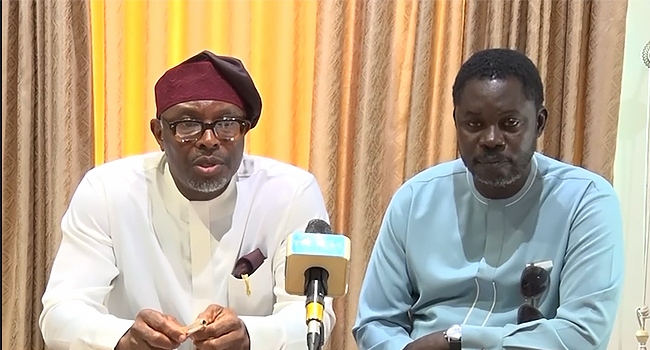
Two members of the Rivers State House of Assembly have appealed to their colleagues to halt the ongoing impeachment process against Governor Siminalayi Fubara and his deputy, Professor Nma Odu, urging lawmakers to seek a political solution rather than pursue a course that could further destabilise the state.
The appeal was made on Monday during a press briefing in Port Harcourt by the Minority Leader of the House, Hon. Sylvanus Nwankwo, alongside the member representing Degema Constituency, Hon. Peter Abbey. The lawmakers cited growing concerns among traditional rulers, political leaders, civil society actors, and constituents who have called for restraint and dialogue amid the deepening political crisis in the state.
According to Nwankwo, while the impeachment process may be procedurally grounded, the broader implications for governance, peace, and development in Rivers State demand a more cautious and conciliatory approach.
“Rivers State has issued a notice of impeachment on the Governor, Sir Siminalayi Fubara, and his Deputy, Professor Nma Odu,” Nwankwo said. “We are appealing to our fellow colleagues to temper justice with mercy and see how this matter can be resolved without resorting to impeachment proceedings.”
He noted that several respected voices within and outside the state have intervened since the impeachment notices were announced, all urging the Assembly to consider the consequences of plunging the state into another round of political uncertainty.
“Having listened to numerous calls from our elders and leaders, both within and outside Rivers State, we are begging our colleagues to reconsider the steps taken so far and explore ways of resolving this matter amicably, even though the Governor and his Deputy are alleged to have infringed on certain constitutional provisions,” he added.
The appeal follows the formal presentation of impeachment notices against Governor Fubara and his deputy last Thursday, marking a renewed escalation in the long-running political feud that has engulfed Rivers State since 2023.
During a plenary session, the Majority Leader of the House, Hon. Major Jack, presented a notice of impeachment signed by 26 lawmakers. The notice accused the governor of multiple acts of gross misconduct, as provided for under Section 188 of the 1999 Constitution.
Among the allegations levelled against Governor Fubara are claims of extra-budgetary expenditure running into over ₦800 billion without legislative approval, the withholding of statutory funds allocated to the Rivers State House of Assembly Service Commission, and the demolition of the Assembly complex without the consent of lawmakers.
The notice also accused the governor of willfully disobeying Supreme Court judgments relating to legislative autonomy, actions which the lawmakers argued amounted to a deliberate attempt to undermine the authority and independence of the legislature.
In a separate notice read on the floor of the House, the Deputy Governor, Professor Nma Odu, was accused of conniving with the governor in the execution of unconstitutional expenditures and other alleged violations of due process.
The Speaker of the House, Hon. Martin Amaewhule, subsequently announced that the impeachment notices would be served on the governor and his deputy within seven days, in line with constitutional provisions governing impeachment proceedings at the state level.
However, Governor Fubara has publicly denied receiving any formal impeachment notice from the House of Assembly. Speaking to journalists, the governor maintained that as of the time of his remarks, no official communication had been served on him regarding the impeachment process.
The unfolding events represent the latest chapter in a prolonged and bitter political crisis in Rivers State, rooted in the fallout between Governor Fubara and his immediate predecessor, Nyesom Wike, who currently serves as Minister of the Federal Capital Territory.
The rift, which became public shortly after Fubara assumed office in 2023, has since polarised the political landscape in the state, dividing the House of Assembly, party structures, and key stakeholders into rival camps aligned with either the governor or his predecessor.
Previous attempts to impeach Governor Fubara in 2023 and again in 2025 were suspended following interventions from President Bola Tinubu and other national leaders, who appealed for calm and dialogue in the interest of stability.
Despite those interventions, tensions continued to simmer, culminating in a declaration of a state of emergency in Rivers State by President Tinubu in March last year, following escalating political unrest and threats to public order.
Political analysts warn that a fresh impeachment process could reopen old wounds and reverse fragile gains made in restoring calm to the state. They argue that prolonged political instability could distract the government from addressing critical development challenges, including infrastructure deficits, unemployment, and security concerns.
Hon. Peter Abbey echoed these sentiments, stressing that lawmakers must weigh the legal merits of impeachment against the broader public interest.
“This Assembly has a constitutional responsibility not only to uphold the law but also to protect the peace and stability of Rivers State,” Abbey said. “Impeachment is a grave step with far-reaching consequences, and it should be treated as a last resort.”
He urged both the executive and legislative arms to engage in constructive dialogue, possibly through mediation by respected national and state leaders, to prevent further escalation.
As the impeachment timeline unfolds, all eyes remain on the Rivers State House of Assembly, the governor’s camp, and the federal authorities, whose responses may once again shape the trajectory of the crisis.
For many residents of Rivers State, the renewed political standoff raises fears of prolonged uncertainty in a state critical to Nigeria’s oil and gas economy. Civil society groups have also begun calling for transparency, adherence to constitutional processes, and restraint by all parties involved.
Whether the appeals by Nwankwo, Abbey, and other moderating voices will prevail remains uncertain. What is clear, however, is that Rivers State stands at another critical crossroads, where the choices made by its political actors in the coming days could determine the state’s political and economic stability for years to come.