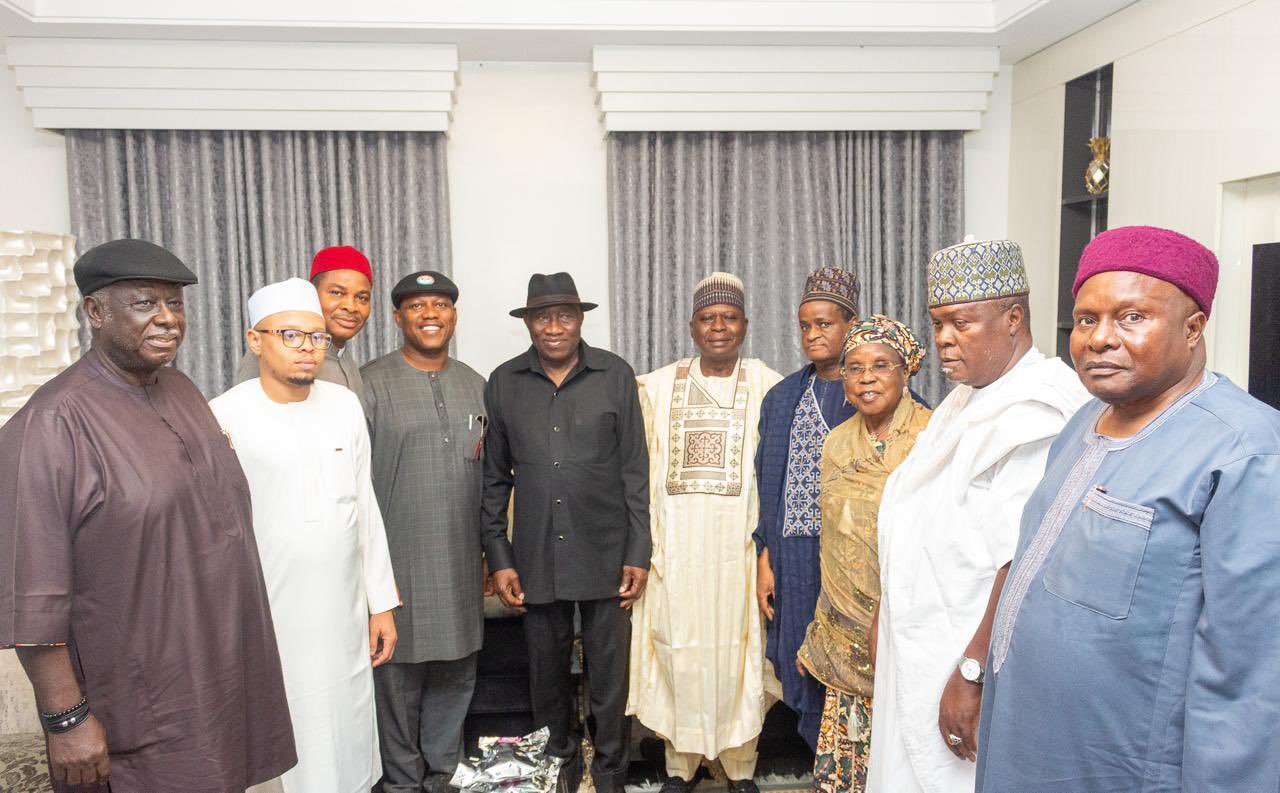
The National Working Committee of the Peoples Democratic Party on Tuesday held a high-level closed-door meeting with former President Goodluck Jonathan as part of ongoing efforts to address the party’s internal challenges and reposition it ahead of forthcoming elections.
The meeting took place at Jonathan’s private office in the Maitama district of Abuja and was attended by members of the PDP National Working Committee as well as several state chairmen of the party. The delegation was led by former Minister of Special Duties, Tanimu Turaki, who currently heads one of the contending factions within the party’s national leadership.
Sources familiar with the meeting disclosed that discussions focused on critical issues affecting the party, including its lingering leadership crisis, ongoing legal battles, strategies for reconciliation, and broader national concerns. The engagement is understood to be part of a wider consultation process by the PDP leadership aimed at stabilising the party and restoring unity amid deepening internal divisions.
Related posts:
- PDP National Convention: Ex-Minister Tanimu Turaki set to emerge new national chairman
- PDP Chairman, Turaki leads delegation to visit former president Obasanjo
- FOSAD condemns exclusion of South-East & South-South in President Tinubu’s US–Nigeria Security Working Group, demands immediate reconstitution
- Oshiomhole, Ndume Clash During Reno Omokri’s Ambassadorial Screening at Senate Committee
Addressing journalists after the meeting, Turaki said the PDP delegation briefed the former president on the party’s current situation, particularly with regard to the legal disputes surrounding its leadership. He noted that Jonathan expressed optimism about the party’s prospects and reaffirmed his commitment to supporting the PDP.
According to Turaki, Jonathan told the delegation that the party had played a significant role in his political career and that he felt a responsibility to contribute to its stability and future success. “He assured us that the PDP has done enough for him and that he will do his best to give back to the party,” Turaki said.
The meeting comes against the backdrop of a protracted leadership crisis within the PDP, which has seen two individuals laying claim to the position of national chairman. The dispute has polarised the party and created uncertainty over its official leadership structure, with implications for its participation in upcoming elections.
One faction is led by Abdulrahman Mohammed and is reportedly backed by allies of the Minister of the Federal Capital Territory, Nyesom Wike. The rival faction is headed by Tanimu Turaki and enjoys the support of key party figures, including Bauchi State Governor Bala Mohammed and Oyo State Governor Seyi Makinde. The existence of parallel leadership structures has resulted in confusion, internal friction, and a series of legal and administrative challenges for the opposition party.
The crisis has also drawn the attention of the Independent National Electoral Commission, which has expressed concern over the implications of the leadership dispute for the conduct of forthcoming elections. On December 19, 2025, the INEC Chairman, Joash Amupitan, convened a meeting with leaders of the two PDP factions at the Commission’s headquarters in Abuja.
That meeting was initiated by INEC in view of the approaching Federal Capital Territory area council elections, as well as the Osun and Ekiti State elections scheduled for February 21, 2026. According to INEC, the conflicting claims of leadership within the PDP had resulted in contradictory correspondences submitted to the Commission, creating uncertainty over who was authorised to act on behalf of the party.
The INEC meeting was attended by members of the National Working Committee led by Tanimu Turaki, as well as representatives of the rival group associated with Samuel Anyanwu. Amupitan said the engagement was necessary to prevent administrative confusion and to ensure that electoral preparations were not disrupted by internal party disputes.
He explained that the Commission had already released its election timetable and guidelines to all registered political parties and was determined to ensure smooth, credible, and transparent polls in the affected states and councils. However, he noted that the unresolved leadership tussle within the PDP posed challenges that required urgent clarification.
Amupitan said INEC’s intervention was guided by its constitutional mandate and its responsibility to ensure orderly electoral processes. He stressed that the Commission remains neutral and would not take sides in the internal affairs of any political party, but would strictly apply the provisions of the Constitution, the Electoral Act, and its own regulations.
“The Commission operates within a three-tier legal framework comprising the 1999 Constitution, the Electoral Act, and INEC regulations and guidelines,” Amupitan said at the meeting. “Our actions are firmly rooted in these laws, and we will continue to adhere strictly to them.”
He expressed satisfaction with the attendance of senior officials from both PDP factions, describing the meeting as an opportunity for open and constructive dialogue. He urged the contending parties to engage sincerely with one another in order to resolve their differences in the interest of the party and the wider democratic process.
Following the initial plenary session, discussions at the INEC meeting continued behind closed doors, with the Commission encouraging both sides to explore pathways toward reconciliation and clarity ahead of the upcoming elections.
The visit to former President Jonathan is widely seen as part of the PDP’s broader effort to draw on the experience and moral authority of senior party elders in resolving the crisis. Jonathan, who served as Nigeria’s president from 2010 to 2015 under the PDP platform, remains one of the most influential figures within the party and is regarded as a stabilising voice during periods of internal turmoil.
Party insiders say the leadership is hopeful that Jonathan’s intervention and guidance could help de-escalate tensions and foster a negotiated settlement among the warring factions. The former president has previously played behind-the-scenes roles in mediating party disputes and promoting internal cohesion.
As the PDP grapples with its leadership challenges, analysts note that resolving the crisis quickly is critical to its ability to effectively challenge the ruling party in forthcoming elections. Prolonged internal discord, they warn, could weaken the party’s organisational capacity, confuse supporters, and undermine its electoral prospects at both the state and national levels.
With key elections approaching and legal battles still pending, the outcome of ongoing consultations, including the meeting with Jonathan, is expected to shape the immediate future of Nigeria’s main opposition party. For now, party leaders say efforts are ongoing to bridge divides, clarify leadership structures, and present a united front capable of addressing both internal reforms and national issues.