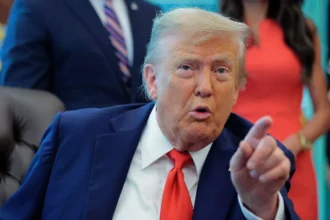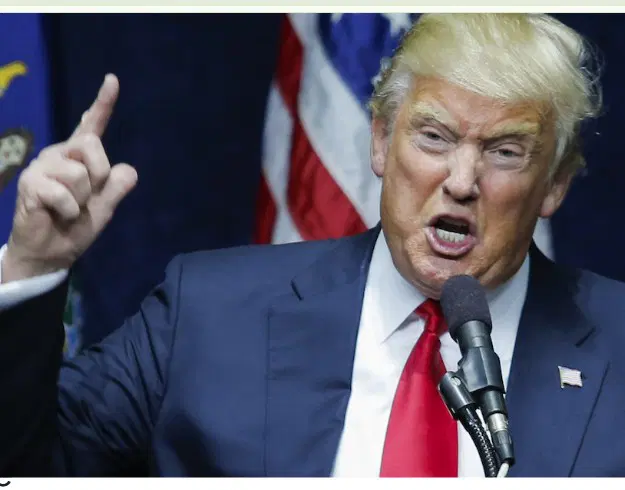
The President of the United States, Donald Trump, has issued a warning to the Iranian national football team, suggesting that their participation in the upcoming FIFA World Cup in North America could put their “life and safety” at risk amid the escalating conflict in the Middle East.
Trump made the remarks on Thursday, March 12, in a message posted on his social media platform, Truth Social. His comments came against the backdrop of intensifying hostilities involving Iran and Western allies, which have raised uncertainty about the country’s involvement in international sporting competitions.
The statement marked a notable shift in tone from comments Trump made only two days earlier during a meeting with the president of the global football governing body, Gianni Infantino, at the White House. At that meeting, Trump had reportedly reassured the FIFA chief that Iran’s national football team would be welcome to compete in the tournament despite the ongoing conflict.
However, in his latest remarks, the American president expressed concerns that the current security situation might endanger Iranian players if they travel to North America for the competition.
“The Iran National Soccer Team is welcome to the World Cup,” Trump wrote. “But I really don’t believe it is appropriate that they be there, for their own life and safety.”
The warning has added another layer of uncertainty to Iran’s participation in the men’s football World Cup scheduled to take place later this year across three host countries—Canada, Mexico, and the United States.
The tournament, organised by FIFA, is expected to attract millions of fans and teams from around the world, making it one of the largest global sporting events.
Yet the ongoing conflict involving Iran has cast a shadow over the preparations. The war, which began after joint military strikes by the United States and Israel on February 28, has heightened geopolitical tensions and raised questions about travel safety, diplomatic relations, and security arrangements for participating teams.
Observers say Trump’s warning reflects growing concerns within Washington that the conflict could have spillover effects on international events involving Iranian athletes.
Earlier in the week, Infantino had indicated that he discussed the situation with Trump during their meeting at the White House. Following the talks, the FIFA president wrote that the two leaders had addressed the “current situation in Iran” and its potential implications for global football.
Infantino noted that during the meeting, Trump reiterated that the Iranian national team would still be permitted to participate in the tournament in the United States.
“President Trump reiterated that the Iranian team is, of course, welcome to compete in the tournament in the United States,” Infantino said in a statement released after the meeting.
His remarks represented the first time the FIFA president publicly acknowledged the war’s possible impact on the global football calendar.
The comments also highlighted the delicate balancing act facing FIFA as it navigates geopolitical tensions while attempting to maintain the principle that sports should remain separate from politics.
In December, Infantino had drawn attention when he established a new FIFA peace prize and awarded the inaugural honour to Trump. The decision sparked debate among football observers and political commentators, with some praising the initiative while others questioned the optics of linking global football recognition to a political leader.
The current situation surrounding Iran’s national team has now placed FIFA in an even more complex position as it seeks to ensure the tournament proceeds smoothly while avoiding diplomatic controversies.
Trump’s recent comments have also drawn attention to another case involving Iranian footballers abroad. Earlier this week, the U.S. president weighed in on the situation of members of Iran’s women’s national football team who were visiting Australia for an Asian Cup tournament.
According to reports, several players feared they might face punishment or retaliation if they returned home after declining to sing Iran’s national anthem before a match.
The gesture, which some observers interpreted as a form of silent protest, sparked concerns among the athletes about possible consequences from authorities in Tehran.
Trump publicly urged Australian officials to grant asylum to the players who wished to remain in the country.
His call added international visibility to the case and intensified diplomatic attention on the situation.
Australian authorities later confirmed that five of the players who chose to remain in the country had been granted asylum.
The development highlighted the broader political tensions surrounding Iranian athletes competing abroad during periods of domestic and international upheaval.
For Iran’s men’s national football team, the uncertainty surrounding the upcoming World Cup now extends beyond sporting considerations.
Analysts say the players may face pressure from multiple directions—security concerns related to the ongoing conflict, political scrutiny at home, and the expectations of international sporting bodies that aim to keep global competitions free from political interference.
The World Cup itself is expected to be one of the largest sporting events ever held, as the tournament will be jointly hosted across multiple countries in North America.
Matches will take place in stadiums across the United States, Canada, and Mexico, drawing fans from around the globe and showcasing some of the world’s best football talent.
However, the geopolitical tensions involving Iran have introduced new challenges for tournament organizers.
Security experts say that ensuring the safety of players, officials, and supporters will be a top priority, particularly given the scale of the event and the complex political dynamics surrounding certain participating nations.
Trump’s comments suggesting that Iranian players could face safety risks may further complicate discussions between FIFA, host governments, and football authorities in Iran.
While the U.S. president’s warning appeared to be framed as a concern for the players’ well-being, it also underscored the broader geopolitical tensions influencing international sports.
For FIFA, the situation highlights the difficulty of maintaining neutrality in a world where political conflicts increasingly intersect with global sporting events.
As the World Cup approaches, it remains unclear whether Iran’s national team will ultimately participate in the tournament or whether diplomatic and security concerns will lead to further discussions between football authorities and government officials.
For now, Trump’s remarks have added another dimension to the debate over Iran’s presence at the competition—raising questions not only about sporting participation but also about safety, politics, and the broader impact of international conflict on the world of football.