U.S. President Donald Trump has announced that the United States will escalate its military campaign against Iran over the next two to three weeks, even as he suggested that the conflict is approaching a decisive phase.
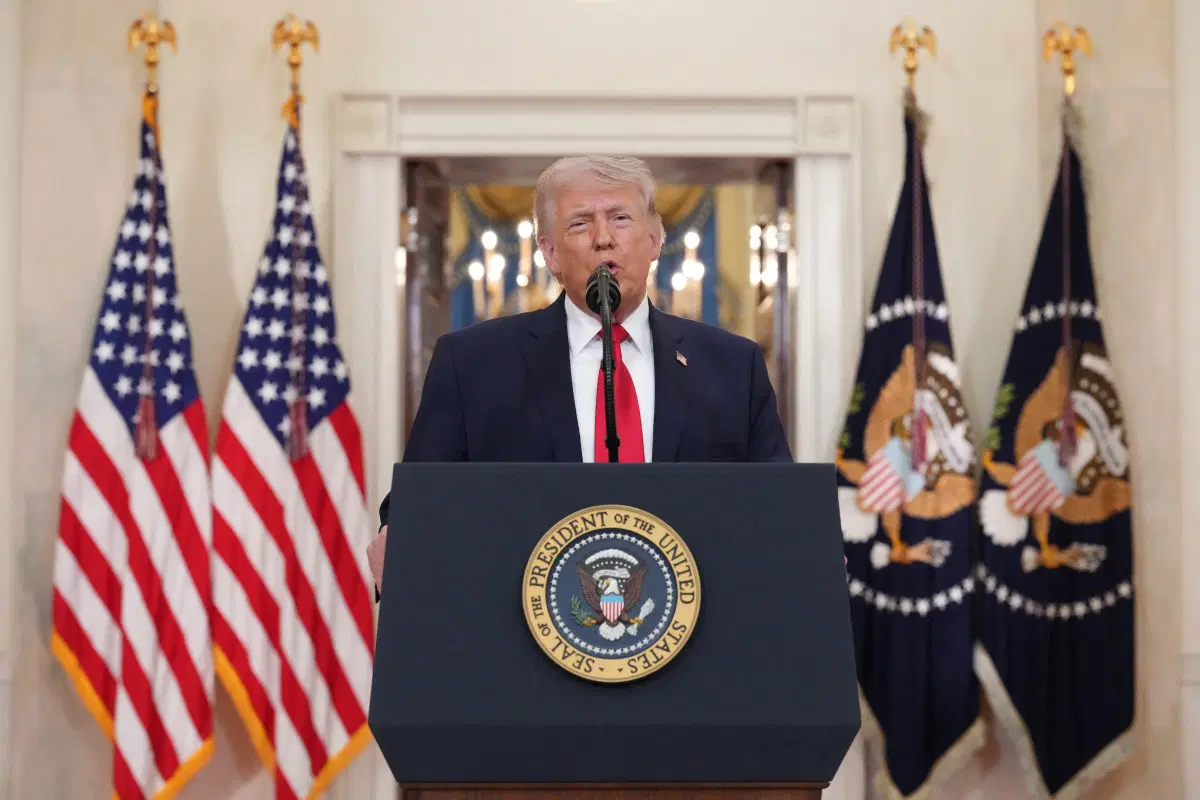
In his first national address since the war began on February 28, Trump sought to reassure Americans that significant progress had been made toward achieving the United States’ strategic objectives. Speaking from the White House, he described the ongoing joint offensive with Israel as nearing completion, while making it clear that military pressure on Iran would not be eased just yet.
“Thanks to the progress we’ve made, I can say tonight that we are on track to complete all of America’s military objectives shortly—very shortly,” Trump stated. His remarks reflected confidence in the direction of the campaign, even as fighting continues across multiple fronts.
Despite this optimism, the president emphasized that the coming weeks would be marked by intensified military operations. “We are going to hit them extremely hard over the next two to three weeks,” he said, signaling that the United States intends to deliver a final series of forceful strikes aimed at weakening Iran’s remaining capabilities.
The conflict, which has drawn in regional and global attention, has seen close coordination between U.S. forces and Israeli military operations. Throughout his address, Trump underscored Washington’s continued commitment to its allies in the Middle East, particularly Israel and Gulf nations such as Saudi Arabia, Qatar, United Arab Emirates, Kuwait, and Bahrain.
He assured these partners that the United States would continue to provide military support and protection, particularly in light of ongoing missile and drone attacks attributed to Iran. These attacks have targeted both Israeli cities and U.S. military installations in the region, raising fears of a broader escalation.
At the same time, Trump left the door open for diplomacy. He suggested that Iran’s new leadership may be more open to negotiation, describing them as “less radical and much more reasonable” compared to previous authorities. However, his tone remained firm, warning that if diplomatic efforts fail, the United States is prepared to escalate further by targeting critical infrastructure.
Among the potential targets he mentioned were Iran’s electricity generation facilities, a move that could significantly disrupt the country’s domestic stability. Analysts say such a step would represent a major escalation, with far-reaching humanitarian and economic consequences.
Meanwhile, the global economic impact of the conflict is already being felt. Energy markets have reacted nervously, with oil prices rising amid fears that the Strait of Hormuz could be closed. This narrow passage is one of the most critical oil transit routes in the world, carrying roughly one-fifth of global supply.
Iran’s Islamic Revolutionary Guard Corps has reportedly vowed to keep the strait shut to what it describes as hostile nations, further heightening concerns about disruptions to global energy flows. Any prolonged closure could have severe consequences for international markets, particularly for countries heavily dependent on oil imports.
Despite signals from Washington suggesting openness to dialogue, Iran has publicly rejected calls for a ceasefire. Officials in Tehran described U.S. demands as “maximalist and irrational,” indicating that significant gaps remain between the two sides.
Iranian authorities have also denied engaging in direct negotiations with the United States, although reports suggest that indirect communication channels may be active through intermediaries. This reflects a complex diplomatic landscape in which both sides appear to be keeping options open while continuing military operations.
Earlier statements from Trump claimed that Iran’s president had expressed interest in a ceasefire, but the U.S. leader insisted that any such agreement would require Iran to first reopen the Strait of Hormuz. This condition remains a major sticking point, as Tehran views control of the waterway as a strategic lever in the conflict.
The war itself began with a large-scale joint airstrike campaign by U.S. and Israeli forces targeting Iranian military and strategic installations. Since then, it has evolved into a broader confrontation involving missile exchanges, drone strikes, and attacks on key infrastructure across the region.
In a notable development ahead of Trump’s address, Iran’s president, Masoud Pezeshkian, issued a direct appeal to the American public. In his message, he questioned whether the ongoing war aligns with the “America First” doctrine that has guided much of Trump’s political agenda.
Pezeshkian accused the United States of committing war crimes and sought to distinguish between the American government and its citizens, emphasizing that ordinary Americans are not viewed as enemies by Iran. His remarks appeared aimed at influencing public opinion within the United States, even as hostilities continue.
On the ground, the conflict shows no immediate signs of slowing. Iranian forces have launched fresh waves of missile and drone attacks targeting major Israeli cities, including Tel Aviv and Eilat, as well as U.S. bases in the Gulf region.
Israeli authorities reported that their air defense systems were activated multiple times to intercept incoming threats. The situation has created a climate of uncertainty and fear among civilians, particularly as attacks have coincided with significant cultural and religious observances.
As Israel marked the beginning of the Passover holiday, air raid sirens sounded repeatedly in several areas. Emergency responders confirmed that a missile strike injured at least 14 people, including an 11-year-old girl, underscoring the human cost of the ongoing conflict.
In a related incident, Iran’s Revolutionary Guards claimed responsibility for an हमला on an oil tanker in the Gulf believed to have links to Israel. A maritime security agency later confirmed that the vessel was struck off the coast of Qatar. While the ship sustained damage, no casualties were reported.
As the conflict enters what may be its final phase, the coming weeks are expected to be critical. With military operations intensifying, diplomatic efforts uncertain, and global markets on edge, the situation remains highly volatile.
Trump’s address suggests that the United States is determined to bring the war to a swift conclusion—but whether that outcome will come through force, negotiation, or a combination of both remains an open question.