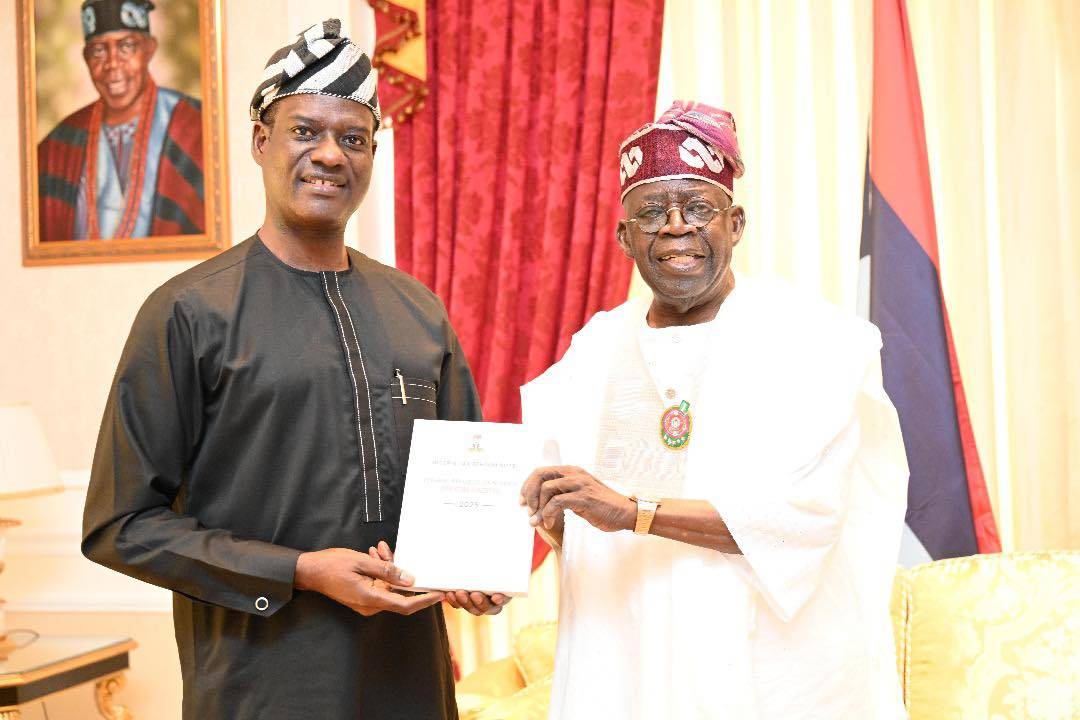
President Bola Ahmed Tinubu has nominated the immediate past Chairman of the Presidential Committee on Fiscal Policy and Tax Reforms, Taiwo Oyedele, as Minister of State for Finance, in a move that signals continuity in the administration’s fiscal reform agenda.
The nomination was conveyed in a State House press release dated March 3, 2026, and signed by the President’s Special Adviser on Information and Strategy, Bayo Onanuga. According to the statement, Oyedele is to replace Dr Doris Anite-Uzoka, who has been redeployed to the Ministry of Budget and National Planning as Minister of State. The reassignment marks her third ministerial portfolio under the Tinubu administration, underscoring ongoing cabinet adjustments as the government recalibrates its economic management team.
President Tinubu has formally transmitted Oyedele’s nomination to the Senate for confirmation in a letter addressed to Senate President Godswill Akpabio. The confirmation process is expected to draw significant attention, given Oyedele’s central role in shaping and defending the administration’s far-reaching tax reforms.
Until his nomination, Oyedele served as Chairman of the Presidential Committee on Fiscal Policy and Tax Reforms, the body mandated to review Nigeria’s tax framework and propose structural changes aimed at boosting revenue generation, improving compliance, and rationalising the country’s fragmented tax architecture.
Under his leadership, the committee spearheaded a set of tax reform bills that were signed into law by President Tinubu on June 26, 2025. The presidency described the legislation as the most consequential overhaul of Nigeria’s tax system in decades. A key feature of the reforms is the proposed establishment of a unified Nigeria Revenue Service, intended to streamline tax administration and eliminate duplication across federal revenue agencies.
Supporters of the reforms argue that the measures are designed to broaden the tax base while reducing the burden on low-income earners and small businesses. However, the legislative process and subsequent implementation have been dogged by controversy.
In December 2025, Oyedele publicly maintained that the new tax laws would come into effect on January 1, 2026, despite growing backlash from various quarters. Allegations had surfaced that the versions of the bills signed into law by the President differed in material respects from those debated and passed by the National Assembly.
“The plan to commence the new laws on January 1, 2026, will go ahead as planned,” Oyedele told journalists following a closed-door meeting with President Tinubu in Lagos.
He insisted that the reforms would deliver tangible relief to Nigerians, stating that approximately 98 percent of workers would pay little or no Pay-As-You-Earn (PAYE) taxes under the new regime. He further claimed that 97 percent of small businesses would be exempt from Corporate Income Tax, Value Added Tax (VAT), and Withholding Tax, describing the framework as pro-poor and growth-oriented.
The meeting at which he made those remarks was attended by the Chairman of the Nigerian Revenue Service, Zacchaeus Adedeji, and the Chairman of the National Tax Policy Implementation Committee, Joseph Tegbe—both key figures in the rollout of the reforms.
Nevertheless, skepticism within the National Assembly persisted. A member of the House of Representatives, Abdussamad Dasuki, publicly raised concerns that the gazetted documents released to the public did not align with the versions debated by lawmakers. The discrepancy fueled allegations of executive tampering and deepened tensions between the legislature and the executive over the integrity of the legislative process.
These unresolved questions are likely to resurface during Oyedele’s confirmation hearings, as senators probe both the substance of the reforms and the transparency of their enactment.
Beyond the controversy, Oyedele’s professional background positions him as one of the country’s most prominent fiscal policy experts. He hails from Ikaram in Akoko, Ondo State. An economist, chartered accountant, and public policy specialist, he holds a Higher National Diploma in Accountancy and Finance from Yaba College of Technology and a Bachelor of Science degree in Applied Accounting from Oxford Brookes University.
He has also undertaken executive education programmes at leading global institutions, including the London School of Economics, Yale University, the Gordon Institute of Business Science, and the Harvard Kennedy School. His academic and professional training reflects a strong grounding in fiscal policy design, tax administration, and public sector reform.
Before entering public service, Oyedele spent 22 years at PwC, where he rose to become Fiscal Policy Partner and Africa Tax Leader. In that capacity, he advised governments and multinational corporations on tax policy, compliance frameworks, and cross-border fiscal issues. His transition from the private sector into public office was widely viewed as an attempt by the Tinubu administration to bring technocratic expertise into its economic reform agenda.
In addition to his policy work, Oyedele is a professor at Babcock University in Ogun State and serves as a visiting scholar at Lagos Business School, further cementing his influence in academic and policy circles.
If confirmed, his appointment as Minister of State for Finance would place him at the heart of Nigeria’s fiscal management apparatus, working alongside the substantive Minister of Finance to implement revenue reforms and stabilise public finances amid ongoing economic headwinds.
However, the Senate’s deliberations are expected to be robust. Lawmakers may use the confirmation process to seek clarity on the disputed tax legislation, the structure of the proposed Nigeria Revenue Service, and the broader implications of the reforms for federalism and subnational revenue autonomy.
Oyedele’s nomination thus represents both an endorsement of his reformist credentials and a test of the administration’s commitment to transparency and legislative collaboration. As the confirmation process unfolds, attention will focus not only on his technical competence but also on how he navigates the political sensitivities surrounding one of the most ambitious fiscal overhauls in Nigeria’s recent history.