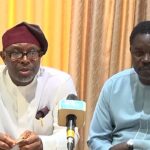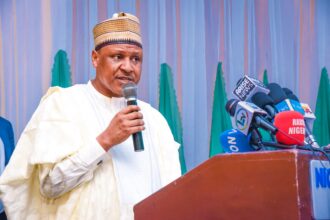
Former Governor of Enugu State and ex-national chairman of the Peoples Democratic Party (PDP), Chief Okwesilieze Nwodo, has faulted political leaders in Nigeria’s South-East who have publicly aligned with the All Progressives Congress (APC) and endorsed President Bola Ahmed Tinubu for a second term, insisting that such declarations do not represent the views or aspirations of the people of the region.
Speaking during an interview on ARISE News on Monday, Nwodo argued that elite political realignments in the South-East are disconnected from grassroots sentiment, warning that endorsements by governors and prominent politicians should not be mistaken for popular support.
“These are our leaders that are not speaking the mind of our people. I can tell you that for certain,” Nwodo said. “It is information you can gather on the streets, in the marketplace, anywhere you go. That is the natural feeling of the people.”
Related posts:
- FOSAD condemns exclusion of South-East & South-South in President Tinubu’s US–Nigeria Security Working Group, demands immediate reconstitution
- South-East APC Endorses Tinubu for 2027, Warns Against Fragmentation of Igbo Votes
- Muktar Shagari, Okwesilieze Nwodo, others attend Prof. Ofili’s book launch, laud his contributions to accounting profession (photos)
- South-East Academic Doctors Condemn Life Imprisonment Verdict, Demand Immediate Release of Nnamdi Kanu
According to him, while some South-East governors and political heavyweights have defected to the APC or pledged loyalty to President Tinubu’s re-election bid, ordinary citizens across the region remain deeply sceptical of the ruling party and unconvinced by the rationale behind these political shifts.
Nwodo questioned the motivations driving the wave of defections to the APC, particularly by elected officials who were voted into office on the platforms of opposition parties.
“Many of us in this country are wondering what is the attraction for our governors in particular, who are leaving their parties for the APC,” he said. “We do not see the justification in the ideology of the APC, and we do not see it in the performance of the central government, which is run by the APC.”
He warned that the trend could signal a dangerous drift toward a one-party system, not anchored on ideology, competence, or measurable governance outcomes.
“People are wondering why we should be drifting to a one-party state, not based on ideology, not based on the performance of that party,” Nwodo said, noting that such a development would undermine democratic pluralism and accountability.
Addressing speculation that South-East political leaders were abandoning former Anambra State governor and 2023 Labour Party presidential candidate, Peter Obi—now associated with the African Democratic Congress (ADC)—Nwodo said political behaviour is often driven by individual interests rather than collective ideology.
“Every politician has a reason for his action,” he said. “I will not act on behalf of any of our politicians in the Southeast, which is to support the president for a re-election.”
Nwodo, who is a leading figure within the ADC, explained that the party’s priority was not blind opposition but issue-based engagement with the current administration. He said the ADC seeks to interrogate government policies, evaluate their effectiveness, and present Nigerians with credible alternatives.
“We in the African Democratic Congress want to engage the current president of Nigeria and his party on issues, on their policies, on the efficacy of their execution of their policies and promises to the Nigerian people,” he said.
He added that the ADC intends to juxtapose the record and proposals of the Tinubu administration with the policy ideas advanced by opposition figures, including Peter Obi, to allow Nigerians to make informed political choices.
“I will put this side by side with the candidates that we are supporting, the former governor of Anambra, Peter Obi, and the solutions he is putting on the table for Nigerians to make a choice,” Nwodo said.
The former governor further argued that despite the growing dominance of the APC among political elites, the party has struggled to build genuine grassroots support in the South-East, citing electoral outcomes in Enugu State as evidence.
“APC has not been a popular party in our state. PDP was,” Nwodo said. “Before the 2023 election, PDP had won all the councilorship elections in our state since the party was formed. All the local government elections, all the state assembly elections, all the House of Representatives elections, all the senatorial elections, and all the governorship elections.”
He noted that the APC’s showing in the 2023 governorship election in Enugu State underscored its limited appeal.
“But come 2023, and APC had a candidate for governorship in our state,” he said. “The candidate in the entire state scored 14,000 votes. That was how unpopular it was.”
According to Nwodo, the emergence of the Obedient Movement ahead of the 2023 general elections fundamentally altered the political landscape in the South-East, eroding the PDP’s longstanding dominance and reshaping voter behaviour.
“It was not helped by the tsunami, that even that popularity that PDP had was swept over by the Obedient tsunami,” he said. “What you found on the streets at that time is even stronger today.”
He maintained that the same grassroots energy continues to define political conversations across the region, with many citizens questioning why influential politicians are now aligning with the APC.
“People cannot find justification why important politicians are declaring for APC,” Nwodo said. “If they can, they will join freely and happily.”
While acknowledging the advantages of incumbency and federal power enjoyed by the ruling party, Nwodo argued that these factors alone may not be sufficient to override public sentiment.
“In spite of what appears that APC is now a behemoth, unchallengeable, with federal might and incumbency, people are still anxious to do what they have to do to salvage their country and secure a better life for themselves,” he said.
Nwodo also expressed doubt that South-East governors who support President Tinubu would necessarily be able to deliver votes for the APC at the presidential level.
“When it comes to the presidential election, I doubt that those people that will vote for their governor because he is doing well will automatically vote for the APC presidential candidate,” he said.
He reiterated that the APC has historically struggled to gain acceptance in the South-East.
“Since APC was formed in the Southeast, it has never taken root,” Nwodo said. “It has been seen as the party that singles out the Southeast from the rest of the country.”
Looking ahead to the 2027 general elections, Nwodo stressed the importance of electoral reforms and active citizen participation in safeguarding Nigeria’s democracy.
“It is a matter for all of us,” he said. “We must put pressure on the National Assembly to ensure that electoral reforms meet the expectations of Nigerians.”
He concluded by urging citizens to take ownership of the democratic process, warning against political apathy amid worsening economic conditions.
“Nobody is going to come to do it for us from outer space,” Nwodo said. “It is us, Nigerians, who must make sure that this happens.”
With rising hardship and public dissatisfaction, Nwodo said civic engagement is no longer optional.
“If we are all saying that we are living under extreme hardship in this administration, all hands must be on deck to ensure we have a better government come 2027,” he added.