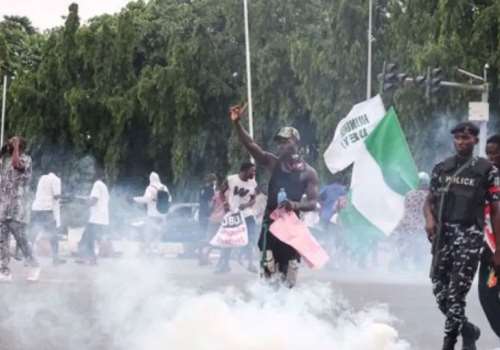
Armed police officers on Tuesday dispersed peaceful demonstrators gathered at the entrance of the National Assembly complex in Abuja, firing teargas into a crowd assembled under the banner of #OccupyNASS. The protesters were demanding legislative action to make real-time electronic transmission of election results mandatory in Nigeria’s electoral framework.
The rally, which drew activists, civil society leaders and concerned citizens, was abruptly disrupted as security operatives moved in to break up the gathering shortly after protest leaders addressed supporters at the Assembly gate.
Among prominent figures present at the protest were former Minister of Education, Oby Ezekwesili; former presidential candidate of the African Action Congress (AAC), Omoyele Sowore; and former Social Democratic Party presidential candidate, Adewole Adebayo. Their participation lent political weight to the demonstration, which focused squarely on electoral reform and transparency.
The demonstrators had converged at the National Assembly to press lawmakers to pass amendments to the Electoral Act that would require the immediate electronic upload of polling unit results to the Independent National Electoral Commission’s Results Viewing Portal (IREV). Protesters argued that mandatory electronic transmission is essential to prevent manipulation of results during collation and to restore public confidence in Nigeria’s elections.
Chanting slogans such as “We no go gree, Akpabio pass the bill” and “Our vote must count,” participants held placards bearing messages including “Don’t alter the bill, pass it” and “Rigging election is a coup.” Their demands were directed at Senate President Godswill Akpabio and the leadership of the National Assembly, whom they accused of delaying or weakening reforms aimed at strengthening electoral transparency.
Speakers at the rally emphasised the urgency of codifying electronic transmission in the law ahead of the next general election cycle. They maintained that recent electoral disputes and judicial battles have exposed vulnerabilities in the existing legal and technological framework, making it imperative for lawmakers to close perceived loopholes.
Tensions escalated shortly after leading figures concluded their addresses. According to witnesses, police officers, reportedly led by the Divisional Police Officer in charge of the National Assembly area, deployed anti-riot personnel to disperse the crowd.
Without prior warning to vacate the premises, officers fired multiple canisters of teargas into the gathering. The sudden release of the gas triggered panic, as demonstrators scrambled for safety, coughing and shielding their faces from the fumes. Some protesters were seen assisting others who struggled to breathe amid the chaos.
Several individuals reportedly sustained minor injuries during the stampede that followed the initial dispersal. Though no official casualty figures were immediately available, eyewitness accounts described scenes of confusion and distress near the Assembly gate.
Despite the forceful intervention, protesters regrouped a short distance from the main entrance, vowing to continue their demonstration. The atmosphere remained tense as reinforcements arrived, including multiple police Hilux vehicles carrying armed personnel. Additional rounds of teargas were subsequently discharged to scatter the reassembled crowd.
Before the disruption, Ezekwesili, Sowore and Adebayo had each urged demonstrators to remain peaceful but resolute in their advocacy. They framed the protest as a civic duty rather than a partisan mobilisation, stressing that electoral integrity is foundational to democratic governance.
Sowore’s arrival at the protest site was met with cheers from supporters, who marched and sang alongside him. His presence appeared to energise participants, many of whom pledged to sustain pressure on lawmakers until concrete legislative action is taken.
Ezekwesili, a long-time advocate for governance reforms, emphasised the need for citizens to demand accountability from elected representatives. She argued that transparency in the electoral process is a non-negotiable pillar of democracy and warned that failure to enact robust safeguards could erode public trust.
Adebayo similarly underscored the importance of strengthening institutional mechanisms to ensure that votes cast at polling units are accurately reflected in final results. He described mandatory electronic transmission as a critical reform to eliminate ambiguity in result collation.
The protest comes amid ongoing deliberations within the National Assembly over proposed amendments to the Electoral Act. Civil society organisations have expressed concern that certain provisions relating to electronic transmission and digital result management may be diluted during legislative negotiations.
The Independent National Electoral Commission (INEC) has previously deployed technology for voter accreditation and partial result transmission, but ambiguities in the legal framework have been cited in post-election litigations. Advocates argue that a clear statutory mandate would reduce disputes and enhance the credibility of the electoral process.
For many protesters, the issue transcends party politics. They contend that transparent elections are essential for political stability, economic development and international confidence in Nigeria’s democratic institutions.
As of the time this report was filed, the Nigeria Police Force had not released an official statement detailing the rationale for the dispersal or addressing allegations of excessive force. The absence of immediate clarification has fueled criticism from rights groups, who argue that peaceful assembly is protected under the Constitution.
Observers note that the use of teargas against non-violent demonstrators may intensify scrutiny of security agencies’ crowd-control tactics, particularly in politically sensitive contexts. Calls for an independent review of the incident are likely to grow if no official explanation is forthcoming.
Despite the disruption, protest organisers signalled their intention to persist. Some demonstrators indicated plans to reconvene and expand mobilisation efforts, both online and offline, to keep electoral reform at the forefront of national discourse.
For participants in the #OccupyNASS movement, Tuesday’s events underscored both the volatility and the urgency of the debate over electronic transmission of results. While the immediate gathering was forcibly dispersed, the broader demand for legally guaranteed transparency in Nigeria’s elections appears far from extinguished.
Whether the National Assembly will respond decisively to these calls remains uncertain. What is clear, however, is that electoral reform has once again emerged as a flashpoint in Nigeria’s democratic evolution, with citizens determined to assert their stake in the integrity of the ballot.