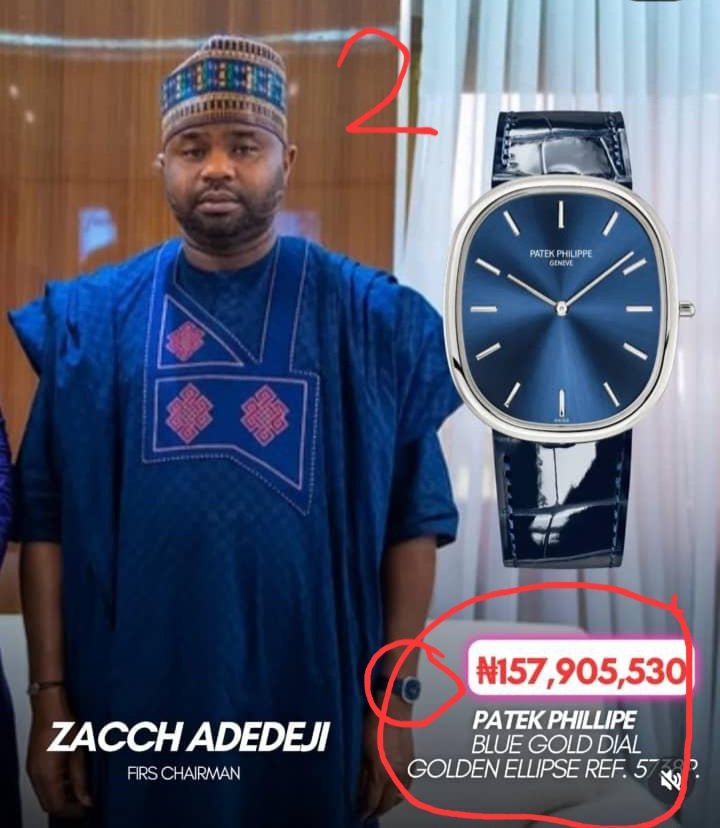
Outrage as Nigeria’s Tax Chief Flaunts ₦25.5 Million Luxury Watch Amid Rising VAT and Economic Hardship
As millions of Nigerians struggle to cope with worsening economic conditions, surging inflation, and the burden of a 7.5 per cent Value Added Tax (VAT), public outrage has erupted following the appearance of the Executive Chairman of the Nigerian Revenue Service (NRS), formerly the Federal Inland Revenue Service (FIRS), Zacch Adedeji, wearing a luxury wristwatch valued at over ₦25.5 million.
The luxury timepiece, identified as a Patek Philippe Golden Ellipse, has drawn widespread criticism due to its association with extreme wealth and exclusivity, particularly at a time when citizens are being urged to endure fiscal tightening and higher taxation in the name of economic reform.
Related posts:
- Tinubu Government Approves $9 Million Lobbying Deal With Republican Firm Amid Rising Tensions With Trump Administration
- (Video) 24 Abducted Kebbi Schoolgirls Regain Freedom Amid Rising Security Concerns in Northern Nigeria
- There is no Christian persecution in Nigeria – Chief of Defence Staff
- Peter Obi laments rising insecurity, political instability, Says Nigeria has become a “Now Disgraced Nation”
Checks by SaharaReporters revealed that the wristwatch worn by Adedeji belongs to the prestigious Golden Ellipse Collection by Patek Philippe, one of the world’s most renowned luxury watchmakers. The brand is synonymous with elite status and is favoured by global billionaires, royalty, and collectors of ultra-high-end timepieces.
According to information available on the official Patek Philippe website, the watch features a sunburst blue dial crafted from an 18-karat gold dial plate. It is adorned with white gold baton-style hour markers and fitted with refined white gold cheveu-style hands, giving it a minimalist yet opulent appearance.
Further scrutiny suggests that the watch closely resembles the Patek Philippe Golden Ellipse Ref. 5738P-001, a highly coveted platinum model that commands significant attention within luxury watch circles. Industry pricing places the value of the watch at approximately ₦25,568,118.56, based on prevailing exchange rates.
The Ref. 5738P-001 is regarded as one of the most distinguished models in the Golden Ellipse line. It features Patek Philippe’s iconic elliptical case design, a blue gold dial, and the ultra-thin Calibre 240 automatic movement, widely praised for its precision and engineering excellence.
Often described as the “Jumbo” Golden Ellipse, the watch comes in a 34.5mm by 39.5mm platinum case and is paired with a navy blue alligator leather strap secured with a platinum prong buckle. A distinctive hallmark of platinum Patek Philippe watches is the discreet single diamond set at the 6 o’clock position on the case, a subtle marker of exclusivity.
The technical sophistication of the watch is equally notable. It houses the Calibre 240 ultra-thin automatic movement, powered by a 22-karat gold micro-rotor, a signature innovation of Patek Philippe. The watch is water-resistant up to 30 metres and is celebrated for seamlessly blending classic Swiss horological tradition with contemporary refinement.
The Golden Ellipse collection itself dates back to 1968 and was inspired by the Golden Ratio, a mathematical concept long associated with balance, harmony, and aesthetic perfection. The lugless elliptical case, smooth curves, and distinctive blue gold dial have made the collection one of the most recognisable and enduring designs in luxury watchmaking.
Watch industry records indicate that the Ref. 5738P-001 was introduced to mark the 40th anniversary of the Golden Ellipse collection. Due to its limited production and timeless appeal, it remains one of the most sought-after models among collectors worldwide.
In a related price comparison, SaharaReporters found that luxury fashion retailer FARFETCH lists a Patek Philippe Golden Ellipse 27mm watch at $18,008, underscoring the premium value associated with the brand and collection.
The public display of such an expensive luxury item by the head of Nigeria’s tax authority has sparked widespread anger and debate, particularly as ordinary Nigerians contend with rising fuel prices, food insecurity, declining purchasing power, and mounting unemployment.
Critics argue that it is morally troubling for the official responsible for enforcing tax compliance and overseeing VAT collection to be seen flaunting symbols of extreme wealth. Many Nigerians have taken to social media to question whether public officials, especially those in charge of revenue generation, should maintain such lavish lifestyles while citizens are repeatedly urged to tighten their belts.
The controversy is further amplified by recent developments in Nigeria’s tax regime. SaharaReporters had earlier reported that Nigerians would begin paying a 7.5 per cent VAT on selected banking services from January 19, 2026, following a new regulatory directive backed by the federal government.
The directive mandates financial institutions to collect VAT on certain electronic banking charges and remit the proceeds to the Nigerian Revenue Service. A notice obtained by SaharaReporters from Moniepoint informed customers of the impending implementation of the tax.
“We would like to inform you of an upcoming government-endorsed regulatory change regarding Value Added Tax (VAT),” the notice stated. “From Monday, 19 January 2026, we are required to collect a 7.5% VAT, to be remitted to the Nigerian Revenue Service (NRS) (formerly known as the Federal Inland Revenue Service).”
According to the notice, the VAT will apply to “certain banking services,” including mobile banking transfer fees, USSD transaction charges, and card issuance fees.
For many Nigerians, the timing of the luxury watch sighting could not be more unsettling. With the cost of living at record highs and new taxes extending into everyday financial transactions, the image of the nation’s tax chief adorned with a watch worth tens of millions of naira has come to symbolise, for critics, a widening disconnect between Nigeria’s ruling elite and the economic realities faced by ordinary citizens.
As debates rage over ethics, public accountability, and the optics of leadership, the incident has once again brought into sharp focus questions about governance, transparency, and the standards expected of public officials in a country grappling with deep economic challenges.