Nigeria’s already fragile aspirations of securing a place at the 2026 FIFA World Cup have suffered a major setback following the dismissal of its petition against the eligibility of the Democratic Republic of Congo’s national team. The decision, delivered by FIFA through its Disciplinary Committee, effectively confirms DR Congo’s participation in the intercontinental play-offs and leaves Nigeria’s qualification hopes hanging by a thread.
The Nigeria Football Federation (NFF) confirmed the development on Tuesday, acknowledging that its complaint had been rejected. The ruling represents a significant blow to Nigerian football authorities, who had hoped that their legal challenge might reopen a pathway back into contention for the global tournament.
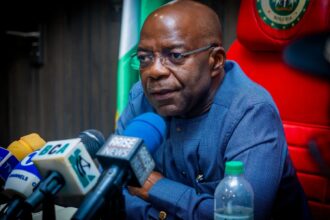
NFF General Secretary Mohammed Sanusi, speaking in an official statement to journalists, expressed dissatisfaction with the verdict and indicated that the federation would immediately initiate an appeal process. According to him, the NFF remains convinced that its petition was grounded in legitimate concerns and that further legal steps are warranted.
“We have received the decision of the FIFA Disciplinary Committee on our petition,” Sanusi stated. “However, we are not satisfied with the outcome, which rejected our submission. I want to assure Nigerians that the NFF has immediately commenced the process of appealing the decision.”
The controversy stems from Nigeria’s elimination during the African qualifying play-offs by the DR Congo national team. Following that defeat, Nigerian football authorities lodged a formal protest alleging that certain Congolese players may not have been eligible to represent their country under domestic constitutional provisions related to dual citizenship.
At the core of Nigeria’s argument was the claim that although the players in question possessed valid Congolese passports and were cleared under FIFA’s eligibility regulations, they may have been in breach of DR Congo’s internal laws governing nationality and dual citizenship. The NFF contended that such constitutional discrepancies should invalidate their participation in the qualifiers.
However, FIFA appears to have reaffirmed its long-standing regulatory position that eligibility for international competition is determined primarily by the possession of a valid passport issued by the relevant national association. Under FIFA statutes, domestic constitutional debates within member states do not override the organization’s eligibility framework. This interpretation effectively rendered Nigeria’s argument insufficient in the eyes of the Disciplinary Committee.
The dismissal of the petition aligns with FIFA’s earlier announcement listing DR Congo among the six teams qualified for the intercontinental play-off tournament. That competition is scheduled to take place in Guadalajara and Monterrey between March 26 and March 31, 2026.
The intercontinental play-offs will determine the final two qualification slots for the expanded 48-team 2026 FIFA World Cup, which will be jointly hosted by United States, Canada, and Mexico. FIFA had earlier confirmed that DR Congo would enter directly into the play-off finals as one of the highest-ranked participating teams—a development widely interpreted as a clear indication that Nigeria’s protest had failed.
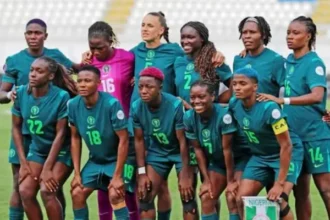
For Nigeria’s national team, the Super Eagles, the implications of this ruling are profound. Once regarded as one of Africa’s most formidable football nations, Nigeria has not featured at the World Cup since 2018. Missing out on the 2022 edition already marked a painful chapter in the country’s football history. Failure to qualify again for 2026 would represent an unprecedented second consecutive absence from the tournament.
Such a scenario would not only damage Nigeria’s international football reputation but could also have broader ramifications for player development, sponsorship opportunities, and national morale. The World Cup has long served as a global stage where Nigerian talent shines, inspiring millions of fans at home and abroad. A prolonged absence risks diminishing the country’s influence within African and world football circles.
The fallout from the qualifying defeat to DR Congo has been both prolonged and controversial. Critics have questioned aspects of Nigeria’s preparation, tactical approach, and administrative oversight during the qualification campaign. The subsequent legal battle over player eligibility has further extended the period of uncertainty and frustration.
Observers note that FIFA’s eligibility framework has historically prioritized administrative clarity over domestic legal complexities. In numerous previous cases, the possession of valid documentation issued by the relevant football association has been deemed sufficient proof of eligibility. By adhering to this principle, FIFA has sought to maintain uniform standards across its 200-plus member associations.
Nevertheless, the NFF’s decision to appeal suggests that Nigerian authorities believe there may still be grounds for reconsideration. The appeals process within FIFA’s judicial system could involve review by higher adjudicatory bodies, including the FIFA Appeals Committee or potentially the Court of Arbitration for Sport (CAS), depending on the procedural path chosen.
While the appeal offers a glimmer of hope, time is not on Nigeria’s side. Preparations for the intercontinental play-offs are already underway, and the tournament schedule is firmly set. Any reversal of FIFA’s decision would require swift and decisive legal action.
For Nigerian fans, the ruling has triggered a mixture of disappointment and renewed debate about the state of football administration in the country. Many supporters had hoped that the legal challenge might provide a lifeline after the heartbreak of elimination on the pitch. Instead, the dismissal underscores the finality of competitive outcomes and the limited scope for post-match redress under international regulations.
The Super Eagles now face the sobering reality that their pathway to the 2026 World Cup has narrowed dramatically. Whether through a successful appeal or through renewed rebuilding efforts for future competitions, Nigerian football must confront the challenges ahead with strategic clarity and institutional reform.
As the global football community turns its attention toward North America for the historic 48-team tournament, Nigeria finds itself at a crossroads. The coming weeks will determine whether the appeal process can revive the nation’s hopes—or whether this episode will mark another chapter in a difficult period for one of Africa’s most storied football powers.