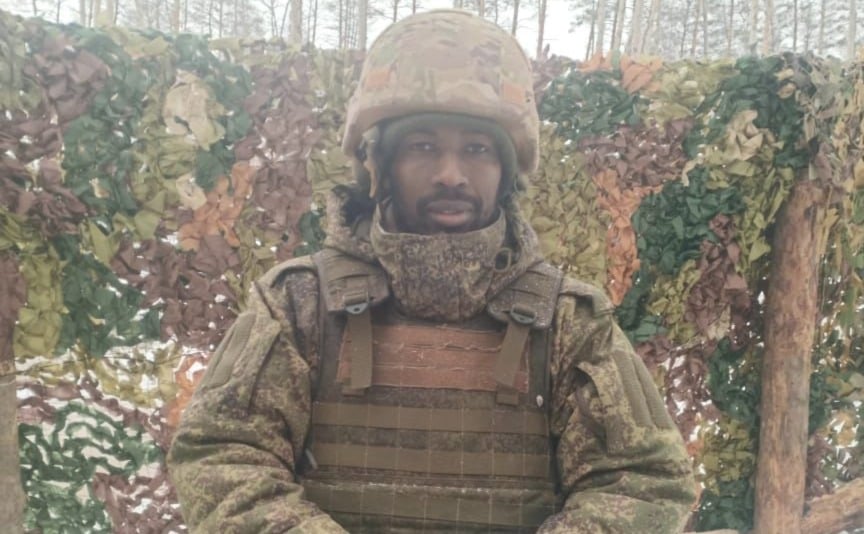
A Nigerian national, Abubakar Adamu, has appealed to the Federal Government of Nigeria to urgently facilitate his return home, alleging that he was deceived into joining the Russian military after being promised civilian employment in Moscow.
According to Zagazola Makama, a counter-terrorism publication that first reported the development, Adamu’s legal representatives have formally notified relevant Nigerian authorities of his situation and requested diplomatic intervention. The lawyers maintain that their client travelled to Russia under the belief that he had secured legitimate employment, only to discover upon arrival that he had been enlisted into the Russian armed forces under circumstances they describe as coercive and deceptive.
Documents cited by his legal team indicate that Adamu departed Nigeria on a tourist visa issued on October 16, 2025, by the Russian Embassy in Abuja. He was reportedly informed that he had obtained a job as a sentry — a civilian security role — and travelled to Moscow in good faith to take up the position.
However, shortly after his arrival in Russia, events allegedly took an unexpected turn. According to his lawyers, Adamu’s passport and other travel documents were confiscated. They further claim that he was presented with enlistment documents written entirely in Russian and pressured to sign them without the assistance of a translator or interpreter.
It was only after completing the paperwork, his legal team alleges, that Adamu realised he had effectively been recruited into the Russian military. By that stage, they say, he was already under the control of military authorities and unable to freely leave or challenge the process.
The lawyers assert that Adamu is currently being held at a Russian military camp. They state that he has refused deployment to combat zones in Ukraine, a decision that has reportedly left him in a precarious and uncertain position. His continued refusal to participate in combat operations, they suggest, has further complicated his circumstances and heightened his vulnerability.
The case has intensified concerns within Nigeria and across parts of Africa regarding reports that foreign nationals are being drawn into Russia’s ongoing war effort in Ukraine under questionable recruitment practices. Advocacy groups and international media investigations have in recent months highlighted allegations that African citizens have been lured to Russia with promises of civilian jobs, only to find themselves enlisted into military service.
On Thursday, February 12, Ukraine’s Defence Intelligence publicly announced that it had recovered the bodies of two Nigerian nationals in the Luhansk region, an area that has witnessed heavy fighting. The individuals were identified as Hamzat Kazeem Kolawole, 42, and Mbah Stephen Udoka, 38. Ukrainian authorities alleged that the men had been fighting on behalf of Russian forces.
Reports suggest that Kolawole and Udoka died in late November 2025, just months after joining the Russian military. Their deaths have raised alarm within Nigeria, prompting renewed calls for greater oversight and public awareness regarding overseas job offers that may conceal military recruitment schemes.
A recent CNN investigation shed further light on the broader issue. The report described how individuals from countries including Ghana, Nigeria, Kenya, and Uganda were allegedly enticed to Russia with assurances of civilian employment opportunities, such as driving positions or private security roles. According to the investigation, some recruits were subsequently compelled to sign military contracts and given minimal training before being deployed to active combat zones.
The report suggested that financial incentives, including promises of steady pay and residency benefits, were used to attract economically vulnerable individuals seeking opportunities abroad. Critics argue that such recruitment tactics exploit the aspirations of young Africans facing unemployment and economic hardship in their home countries.
In response to mounting allegations, Russian Ambassador to Nigeria Andrey Podyelyshev has denied that the Kremlin is running any covert recruitment programme targeting Nigerians or other African nationals. Speaking earlier this week, he dismissed the claims as unfounded and rejected suggestions that Russia was systematically deceiving foreign nationals into military service.
Despite these denials, the growing number of reported cases has heightened diplomatic sensitivity. For Nigeria, Africa’s most populous nation, the issue carries both humanitarian and geopolitical implications. The Federal Government may face increasing pressure to investigate the circumstances under which its citizens are travelling abroad for work and to strengthen safeguards against potential exploitation.
Legal experts note that if Adamu’s allegations are substantiated, the matter could raise serious concerns under international law, including issues of informed consent, coercion, and the confiscation of travel documents. The seizure of a passport and the signing of legally binding documents without translation or proper explanation could potentially violate both domestic and international legal standards.
At the same time, the situation underscores the risks associated with informal or poorly vetted overseas employment arrangements. Labour migration experts have long warned that individuals seeking work abroad should verify job offers through official channels and ensure that employment contracts are properly reviewed and translated before signing.
For Adamu, the immediate concern remains his safe return to Nigeria. His legal team is urging Nigerian diplomatic authorities to engage their Russian counterparts to secure his release and repatriation. They argue that he travelled to Russia under false pretences and should not be compelled to serve in a foreign military against his will.
As the conflict in Ukraine continues, scrutiny of foreign recruitment practices is likely to intensify. Governments across Africa may also reassess how to better protect their citizens from potentially exploitative overseas schemes.
For now, Adamu’s appeal places the spotlight squarely on Nigerian authorities, who must determine the appropriate diplomatic and legal steps to address his claims and ensure his safety. The outcome of his case could set an important precedent for how similar situations are handled in the future.