The Lagos State House of Assembly has invited leaders of communities affected by the recent demolition in Makoko and adjoining waterfront settlements to a meeting scheduled for Tuesday, February 3, 2026, as public anger and humanitarian concerns continue to mount over the exercise.
The invitation was conveyed in a letter dated January 27, 2026, and signed by the Clerk of the House, Olalekan Onafeko. The letter stated that the meeting was convened in response to a petition submitted by the affected communities protesting the demolition of their homes and the eviction of residents.
According to the letter, the meeting will be held by the House Committee on Rules and Business at 10:00 a.m. at the Chamber’s Conference Room on the second floor of the Assembly Complex in Alausa, Ikeja. Community leaders were requested to attend alongside heads of their respective communities and to present relevant documents to aid deliberations.
“I write to acknowledge the receipt of your petition dated 14th January, 2026, on the above subject and invite you to a meeting with the Committee on Rules and Business on Tuesday, 3rd February, 2026, at the 2nd Floor, Chamber’s Conference Room, Assembly Complex, Alausa, Ikeja, by 10:00 a.m.,” the letter read.
“You are requested to kindly attend the meeting along with heads of the communities as well as relevant documents that would facilitate fruitful deliberations.”
The intervention by the state legislature comes amid weeks of tension, protests, and widespread hardship following the demolition of structures in Makoko and surrounding waterfront communities. Residents and human rights organisations have repeatedly condemned the exercise, alleging that it was carried out without adequate notice, compensation, or resettlement plans, thereby rendering thousands homeless.
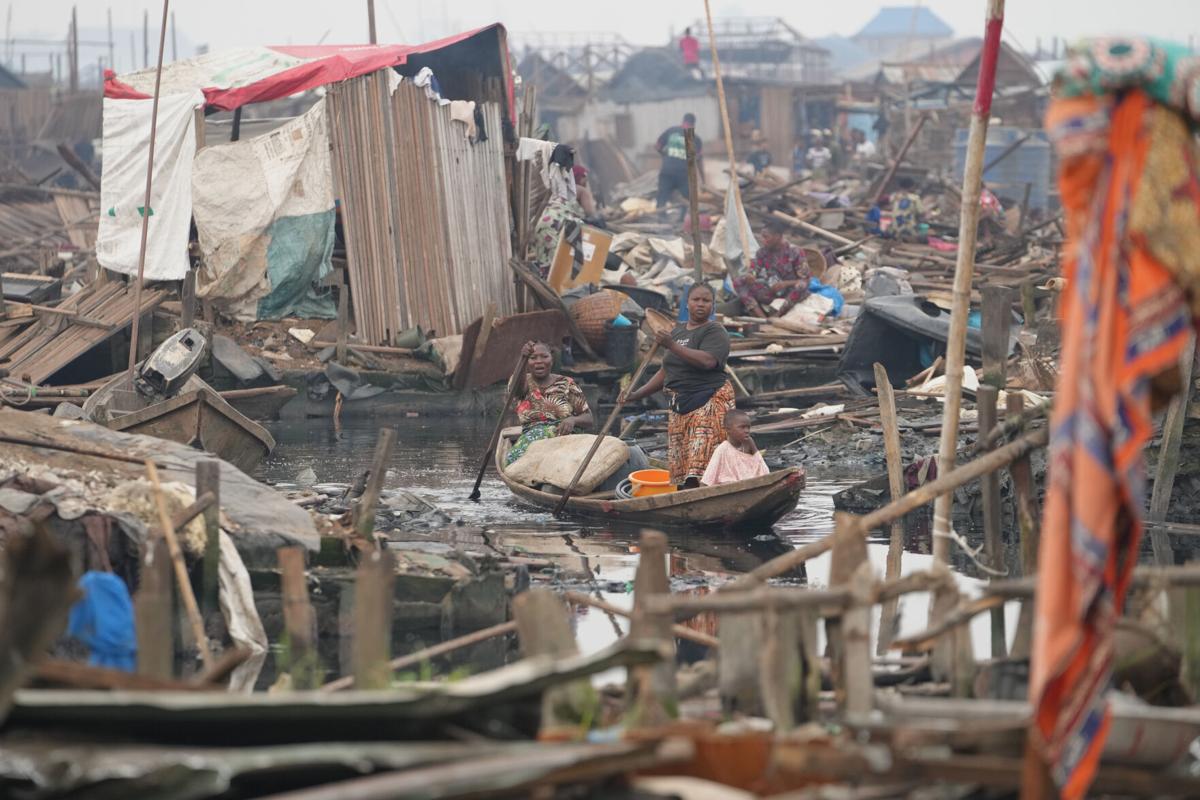
A visit to the affected communities over the weekend revealed grim living conditions for displaced residents. Some families were seen sleeping inside wooden boats on the lagoon, while others had taken refuge with neighbours whose structures had not yet been demolished. Community members said many residents who could not find shelter within Makoko had relocated to other parts of Lagos State, often under precarious conditions.
Community leaders alleged that the demolition went far beyond what was originally agreed with government officials. According to them, the exercise was initially presented as a safety measure to remove structures built too close to high-tension power lines running along the lagoon. However, they claimed that the demolition later expanded indiscriminately, destroying homes, schools, and small clinics.
A community chief, Francis Samson, told our correspondent that government officials had initially agreed to limit the demolition to structures located within 30 metres of the high-tension power line. He said the understanding was reached after several meetings between community leaders and the Permanent Secretary for Physical Planning, Gbolahan Oki.
“Before the demolition, the Permanent Secretary for Physical Planning called us community leaders three times,” Samson said. “After the meetings, he said the government wanted to remove structures within 30 metres of the power line because people had built houses directly under it. We went back to inform our people based on that agreement.”
Samson, however, alleged that when the demolition began, it exceeded the agreed limit. “When they came, we expected them to clear the 30 metres and spare the others. But the demolition continued beyond that. When we confronted them, we were told it would be extended to 100 metres. We pleaded with them, but they continued until about 520 metres. That is where they eventually stopped,” he said.
He added that Makoko consists of four distinct communities spanning both land and waterfront areas and claimed that the waterfront settlements had been almost entirely destroyed. According to him, the demolition has displaced fishermen from their homes and means of livelihood, forcing some to live permanently on boats.
Samson also alleged that deaths were recorded during and after the demolition exercise. He claimed that the use of tear gas by security operatives attached to the demolition task force worsened the situation.
“During the demolition, tear gas canisters were fired,” he said. “Three children and two adults have died. One child reportedly died from tear gas exposure, while an adult died from hypertension after his house was demolished. When it rained heavily about a week ago, the condition of our people became terrible. We are appealing to the government to come to our aid.”
Another community leader, Oluwo Felix Fasinu, supported Samson’s account and said repeated appeals to the government to clearly demarcate the boundary of the demolition zone had not been heeded.
“What we want is simple,” Fasinu said. “The government should clearly define the boundary we should not exceed. They cannot displace us completely after most of us have spent our entire lives here.”
For many residents, the demolition has translated into personal tragedy and uncertainty. A resident who identified himself simply as Mautin described the experience of sleeping in the open or inside a boat as deeply distressing.
“Sleeping inside a boat or in an open space is not something anyone should experience,” he said. “It is the same as homelessness, and that is what this demolition has subjected us to. We don’t know what will become of us. If relocation is the government’s plan, we would prefer a riverside area where we can continue our fishing work.”
The human cost of the demolition was further highlighted by the account of a carpenter, Papa Eve Amossou, who said he lost his three-week-old daughter during the chaos. Amossou narrated that his wife, who was carrying the baby, jumped into the lagoon while fleeing after policemen fired tear gas to disperse residents.
According to him, although his wife and the baby were rescued from the water and rushed to the hospital, the infant was confirmed dead on arrival. The incident has intensified calls from residents and advocacy groups for an independent investigation into the conduct of the demolition exercise.
Despite the growing controversy, efforts to obtain an official response from the Lagos State House of Assembly were unsuccessful. When contacted on Sunday, the Chairman of the House Committee on Information, Strategy and Security, Stephen Ogundipe, did not respond to enquiries sent to his phone as of the time of filing this report.
As community leaders prepare to appear before the House Committee on Rules and Business, residents say they hope the meeting will mark a turning point. Many are calling for immediate humanitarian assistance, clear communication from the government, and a long-term solution that balances safety, urban planning, and the rights and livelihoods of the Makoko waterfront communities.
For now, uncertainty hangs over the affected settlements, as displaced families await the outcome of the Assembly’s intervention and the possibility of relief after weeks of hardship and loss.