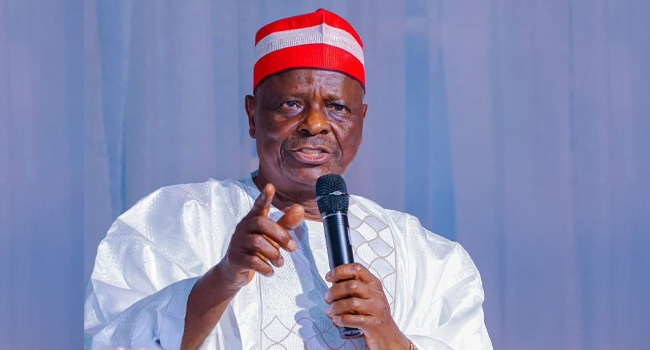
The Kwankwasiyya Movement has expressed deep concern over reports that a proposed bill before the United States Congress—the Nigeria Religious Freedom and Accountability Act 2026 (HR 7457)—allegedly references its leader and principal, Senator Rabiu Musa Kwankwaso, in connection with claims of “severe religious freedom violations.”
In a statement issued on Wednesday night by the Movement’s spokesperson, Habibu Sale Mohammed, the group firmly rejected the allegations, describing them as baseless, misleading, and incompatible with the established public record of the former Kano State governor.
“We state unequivocally that these allegations are unfounded, misleading, and inconsistent with the verifiable public record of Senator Kwankwaso’s life and service,” the statement declared.
The Movement highlighted Senator Kwankwaso’s extensive political career spanning more than three decades, during which he has occupied several high-profile public offices. He has served as Deputy Speaker of the House of Representatives, two-term Governor of Kano State, Minister of Defence, Senator of the Federal Republic, and most recently, a presidential candidate.
According to the statement, throughout this period of public service, Senator Kwankwaso has never been indicted, prosecuted, or credibly accused of religious persecution, extremism, or violations of human rights. The group argued that any attempt to associate him with such allegations lacks substantiation and disregards his long-standing record in governance.
Addressing concerns about the constitutional development of Sharia-based legal systems in some northern Nigerian states, the Movement emphasized that such frameworks were not unique to Kano State nor the initiative of a single individual. It explained that multiple states adopted similar legal systems within the scope of Nigeria’s federal constitutional structure, legislative processes, and judicial safeguards.
“These systems remain subject to constitutional oversight and appellate review,” the statement noted. “To single out Senator Kwankwaso while similar constitutional arrangements exist across several states raises serious questions about the basis, consistency, and evidentiary standard behind such a recommendation.”
The Movement further underscored the principle of constitutional sovereignty in international relations, arguing that foreign legislative actions should be guided by contextual understanding and respect for a nation’s legal architecture. It pointed out that the United States maintains diplomatic and strategic relationships with several sovereign countries whose legal systems incorporate elements of Islamic jurisprudence.
“It would therefore be inconsistent,” the statement continued, “to treat Nigeria’s constitutionally grounded legal pluralism differently without clear, individualized evidence of wrongdoing.”
In defending Kwankwaso’s record, the Movement maintained that he has consistently stood against violence, extremism, and terrorism. During his tenure as Governor of Kano State, it asserted, decisive measures were implemented to curb extremist threats and safeguard lives and property across religious lines. The administration, it said, worked to maintain stability in a region often vulnerable to sectarian tensions.
The statement also emphasized Kwankwaso’s engagement with Christian leaders and minority communities, describing his approach as inclusive and conciliatory. It cited his 2023 presidential ticket—paired with Bishop Isaac Idahosa—as a reflection of his commitment to religious balance and national unity.
“His public record demonstrates a consistent belief in peaceful coexistence and inclusive governance,” the statement said, arguing that these actions contradict any narrative of religious intolerance.
The Movement expressed particular concern that an opposition political leader with a national profile and history of public commentary on governance and security issues would be isolated in a matter of such seriousness without transparent and verifiable findings. It characterized the alleged inclusion of Kwankwaso’s name in the proposed legislation as troubling and potentially politically motivated.
“We respectfully call on the U.S. Congress to outrightly reject this recommendation and remove Dr. Kwankwaso’s name from the proposed bill,” the statement urged.
It further alleged that the development may have been influenced by individuals seeking to settle personal or political scores. According to the Movement, Congress should guard against being used as a platform for partisan interests or unsubstantiated claims.
“Allegations of this magnitude must be grounded in demonstrable facts, not generalized assumptions,” the spokesperson stated.
Reaffirming its position, the Movement described Senator Kwankwaso as a nationalist, democrat, and statesman whose career has been rooted in justice, unity, and inclusive governance. It expressed confidence that a fair and objective review process would ultimately clarify the matter.
The controversy surrounding the proposed U.S. legislation has also drawn a reaction from the New Nigeria Peoples Party (NNPP). On Wednesday, the party expressed shock over reports that its National Leader was named among individuals recommended for targeted sanctions over alleged religious freedom violations in Nigeria.
The NNPP’s reaction underscores the broader political implications of the issue, particularly given Kwankwaso’s prominence within Nigeria’s opposition landscape. As discussions continue around the proposed Nigeria Religious Freedom and Accountability Act 2026, attention is likely to focus on the evidentiary standards and procedural basis for naming individuals in such legislative measures.
For the Kwankwasiyya Movement, however, the position remains unequivocal: the allegations are unfounded, inconsistent with Kwankwaso’s public service record, and should be withdrawn in the interest of fairness and due process.