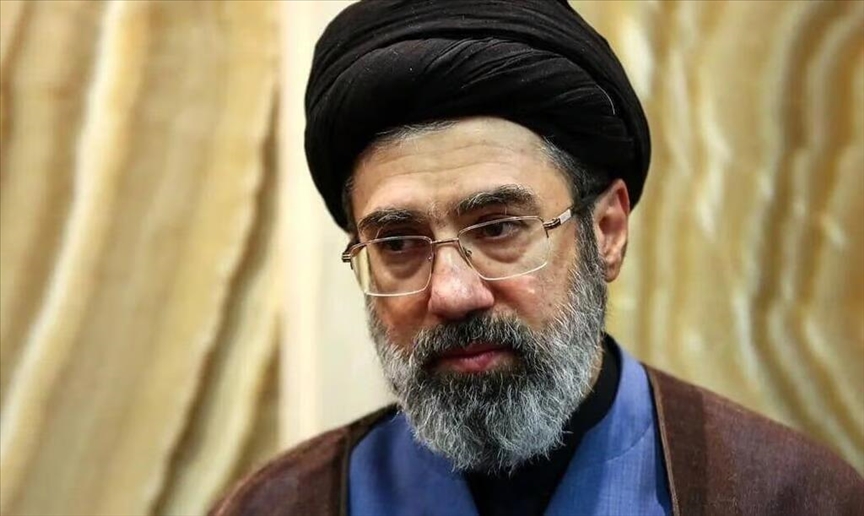
Iran’s newly appointed Supreme Leader, Mojtaba Khamenei, has issued his first public message since assuming leadership following the death of his father, Ali Khamenei. The message, released as a written statement and broadcast on Iranian state television, came amid the intensifying conflict involving Iran, the United States and Israel, and signals a continuation of the country’s hardline posture as the war deepens.
The message was read aloud on state television channels operated by Islamic Republic of Iran Broadcasting and carried across the government’s international outlet Press TV. The broadcast featured a still photograph of Mojtaba Khamenei along with samples of his handwriting, which officials said were included to verify the authenticity of the statement. Notably, the new supreme leader did not appear in a live broadcast, nor was any recorded video or audio message released. The absence of a personal appearance has fueled speculation regarding his condition and whereabouts, particularly following earlier reports suggesting he might have been injured during the early stages of the ongoing military confrontation.
In the written message, Mojtaba Khamenei began by paying tribute to his father and other relatives who, according to him, had been killed during the escalating conflict. He described their deaths as martyrdom and referenced a verse from the Quran—Surah Al-Baqarah (2:106)—which speaks of God replacing one sign with something better. The reference appeared to frame the leadership transition as part of a divine plan and to reassure supporters that the Islamic Republic would remain resilient despite the loss of its long-time leader.
The new supreme leader reflected briefly on the burden of succeeding his father, acknowledging the immense legacy left behind by the late Ayatollah. He recounted visiting his father’s body after his death and described witnessing what he called “a mountain of strength,” a phrase intended to convey admiration for the elder Khamenei’s steadfast leadership during decades of political and geopolitical tensions.
He also acknowledged that in the days immediately following his father’s death, the Iranian people played a decisive role in maintaining national stability. According to him, the interim period demonstrated the strength of Iran’s political and social institutions, as well as the loyalty of the population to the Islamic Republic.
“During the period after his passing, it was you, the people, who led the country and guaranteed its authority,” the statement said.
Throughout the message, Mojtaba Khamenei repeatedly emphasized the importance of unity and resilience among Iranians at a time of war. He called on citizens to remain steadfast and to place their trust in God while expressing gratitude to the country’s military forces and allied fighters.
He praised what he described as Iran’s “brave warriors” and “fighters,” referring to both the country’s regular armed forces and allied militant groups across the Middle East that form part of Iran’s regional security network.
The message also contained strong military rhetoric directed at Iran’s adversaries. One of the most striking elements of the statement concerned the strategic waterway known as the Strait of Hormuz. The new supreme leader declared that Iran would continue to use the possibility of closing the strait as leverage in the ongoing conflict.
The Strait of Hormuz is one of the world’s most critical energy chokepoints, through which a significant portion of global oil shipments pass every day. Any disruption in the narrow passage can have immediate consequences for international energy markets.
In his message, Mojtaba Khamenei warned that ships moving through the waterway could face attacks if Iran’s interests were threatened. The statement suggested that Tehran views control over the strait as a key strategic tool in the current confrontation.
The message also included direct warnings to the United States and to regional governments that host American military installations. Khamenei declared that all U.S. bases in the Middle East should be shut down immediately or risk being targeted by Iranian forces or allied groups.
While the message stated that Iran seeks friendly relations with neighboring countries, it stressed that military facilities used against Iran would be considered legitimate targets.
The new supreme leader also praised the network of armed groups aligned with Tehran across the region, commonly referred to by Iranian officials as the “resistance front.” This network includes militias and political movements in several Middle Eastern countries that cooperate closely with Iran.
According to Khamenei, these allied forces remain ready to support Iran in the ongoing conflict. He mentioned armed groups operating in Yemen and Iraq as examples of partners prepared to act if necessary.
The statement suggested that new fronts in the conflict could open if military strikes against Iran by the United States and Israel continue.
Khamenei also vowed that Iran would retaliate for deaths caused by recent attacks. He referenced several incidents, including an attack on a school in the southern Iranian city of Minab, which Iranian authorities say resulted in civilian casualties.
In the statement, he pledged that Iran would seek justice for those killed during the conflict and would not hesitate to retaliate against those responsible.
“We will not refrain from avenging the blood of your martyrs,” the message said.
He added that Iran would demand compensation for damages and loss of life. If such compensation was not provided, he warned, the country would move to seize assets belonging to its enemies.
The message made clear that the Iranian leadership intends to continue military resistance regardless of the economic and humanitarian costs of the conflict.
Khamenei emphasized that Iran would continue fighting until its enemies were forced to pay what he described as the price for their actions. He also suggested that those responsible for civilian casualties would face consequences.
The statement ended with a traditional Islamic salutation of peace and divine blessings. It was signed “Seyed Mojtaba Hosseini Khamenei” and dated March 12, 2026, corresponding to 21 Esfand 1404 in the Persian calendar.
Observers say the message reflects a strong effort by Iran’s leadership to demonstrate continuity after the death of Ali Khamenei, who had ruled the country for decades and shaped much of its modern political ideology.
By adopting a firm tone in his first public message, Mojtaba Khamenei appears to be signaling that the core policies of the Islamic Republic—particularly its confrontational stance toward Western powers and Israel—will remain unchanged under his leadership.
The statement also comes at a moment of intense geopolitical tension as the war involving Iran, the United States and Israel enters its second week.
The conflict has already begun to disrupt global energy markets, with oil prices rising sharply due to fears that the Strait of Hormuz could become a battleground.
Energy analysts say the possibility of shipping disruptions in the strait has pushed international oil prices above $100 per barrel, raising concerns about inflation and economic instability in many parts of the world.
As of the time of reporting, Iranian state media had not yet released a full official transcript of the message in Persian. However, analysts expect that the government may soon publish the complete text through official channels.
For now, the statement serves as Mojtaba Khamenei’s first public signal of how he intends to lead the Islamic Republic during what is shaping up to be one of the most dangerous crises in the region in recent years.