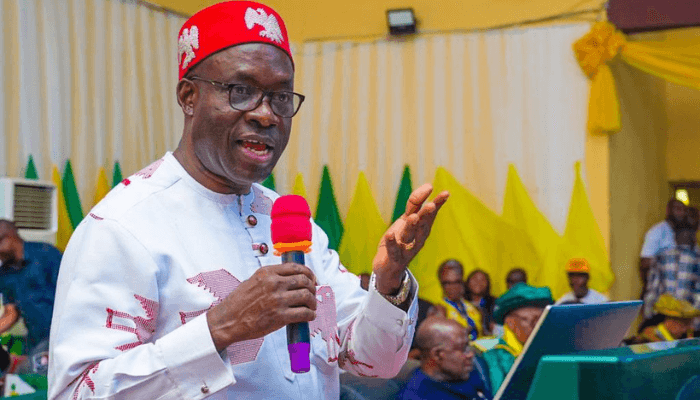
Anambra State Governor, Professor Chukwuma Charles Soludo, has ordered the immediate closure of the Onitsha Main Market for one week following the refusal of traders to comply with the state government’s directive to resume full commercial activities on Mondays and disregard the lingering sit-at-home practice.
The directive was issued on Monday during an unscheduled on-the-spot assessment of the sprawling commercial hub by the governor, who was accompanied by senior aides and key government officials. The visit came amid growing concern by the state government over the continued paralysis of economic activities every Monday, despite official assurances of improved security across the state.
Addressing traders and journalists at the market, Soludo described the shutdown as a decisive intervention in what he called a prolonged struggle to reclaim economic life in Anambra and the wider South-East from fear-driven disruptions. He warned that the one-week closure could be extended if traders persist in defying government directives, adding that security agencies had been instructed to seal the market to ensure full compliance.
“This is not a symbolic action. It is a serious step to protect law-abiding citizens and the economic future of our state,” the governor said. “The government cannot stand by while a few individuals willfully undermine public safety and disregard lawful directives meant to restore normalcy. This is plain economic sabotage, and we are not going to allow it.”
Soludo said the decision followed repeated appeals and engagements with market leadership, during which the government assured traders of enhanced security and urged them to return to business as usual. Despite those efforts, he noted that a significant number of traders once again kept their shops locked on Monday, effectively crippling one of West Africa’s largest markets.
According to the governor, the traders’ absence amounted to a silent but potent expression of fear, reflecting the lingering impact of years of violence and intimidation linked to the sit-at-home order initially imposed by the Indigenous People of Biafra (IPOB). While IPOB has since announced the suspension of the order, compliance has remained inconsistent, with many residents and business owners staying indoors on Mondays due to security concerns.
“You either decide that you are going to trade here or you go elsewhere. I am very serious about this,” Soludo warned. “If, after one week, this market does not reopen fully, it will be sealed for one month. We cannot continue to allow our economy to bleed.”
The atmosphere at the Onitsha Main Market on Monday was tense, as a joint task force comprising personnel of the Nigeria Police Force, the Nigerian Army, and other security agencies took over the premises, locking the gates and securing the perimeter. Commercial activities ground to a halt as traders and customers were turned away, marking one of the most forceful attempts yet by the Soludo administration to end the Monday shutdown.
As the market remains closed throughout the week, attention has shifted to the broader implications of the governor’s action. Analysts say the standoff in Onitsha underscores the deep-seated challenge of dismantling the sit-at-home culture, which has evolved from a political protest into a socio-economic habit sustained by fear and uncertainty.
The outcome of the shutdown may prove pivotal. When the market is scheduled to reopen next Monday, the response of traders will be closely watched. A full return to business would signal a breakthrough for the state government’s campaign to normalise economic activities, while continued closures could deepen tensions and test the administration’s resolve.
The Onitsha Main Market is a major economic artery not only for Anambra State but for the entire South-East, drawing traders and buyers from across Nigeria and neighbouring countries. Prolonged disruption at the market has far-reaching consequences for livelihoods, supply chains, and state revenue.
The Soludo administration has repeatedly argued that the sit-at-home practice has inflicted severe damage on the state’s economy, undermined education, and worsened poverty. The government has maintained that restoring normal activities on Mondays is critical to economic recovery and social stability.
In a related development, the Anambra State Government has announced plans to introduce pro-rata salary payments for public servants as an additional measure to discourage the sit-at-home culture. The Commissioner for Information, Law Mefor, disclosed this to journalists in Awka, stating that effective February 2026, civil servants’ salaries would be paid based on attendance on Mondays.
Mefor said the decision was reached during the end-of-tenure retreat of the Anambra State Executive Council, held in Awka, where the outgoing administration reviewed its four-year performance and set priorities for the new term beginning on March 17, 2026.
According to the commissioner, the policy is intended to reinforce the message that normal work routines must resume and that public funds cannot continue to support non-attendance. “Government cannot pay for services not rendered. Attendance on Mondays will now count,” he said.
The dual approach of market closures and salary adjustments reflects the administration’s determination to end what it describes as an abnormal disruption of public life. However, critics argue that punitive measures alone may not address the underlying security fears that keep traders and workers at home.
Some traders have privately expressed concern that while they support the return to normalcy, the risk of attacks and reprisals remains real. They argue that sustained security presence and confidence-building measures are necessary to complement enforcement actions.
For now, the Soludo government appears resolute. As Anambra stands at a critical juncture, the coming weeks may determine whether the state can finally reclaim Mondays as a day of productivity or whether fear will continue to dictate the rhythm of economic life.
The closure of the Onitsha Main Market has sent a strong signal. Whether it delivers compliance or fuels further resistance will shape not just the fate of the market, but the broader struggle to restore stability and confidence in Anambra State.