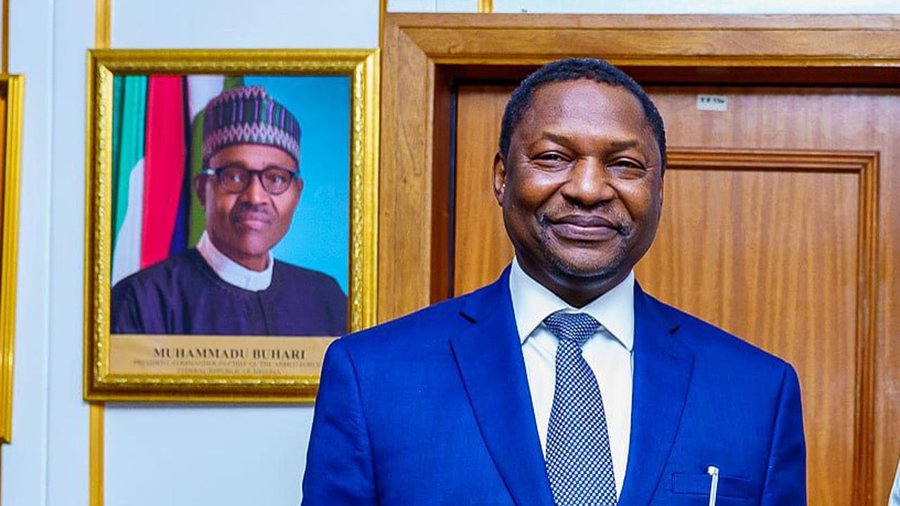
The Economic and Financial Crimes Commission (EFCC) is set to arraign a former Attorney General of the Federation and Minister of Justice, Abubakar Malami, SAN, before the Federal High Court in Abuja over allegations of large scale money laundering involving sums exceeding N8.7 billion. The arraignment, barring any last minute development, is scheduled to take place today before Justice Emeka Nwite.
Reliable sources within the anti graft agency disclosed that all arrangements had been concluded to ensure Malami’s appearance in court, where he is expected to take his plea alongside those of his co defendants. The EFCC is also expected to arraign Malami’s son, Abubakar Abdulaziz Malami, and an associate, Hajia Bashir Asabe, in connection with the alleged offences.
According to the commission, the defendants are facing a 16 count charge bordering on conspiracy, concealment of proceeds of unlawful activities, and the indirect acquisition of high value assets through corporate entities and proxies. The charge, marked FHC ABJ CR 700 2025, alleges that the offences were committed between 2015 and 2025, largely within the Federal Capital Territory, Abuja, during Malami’s tenure as Nigeria’s chief law officer.
Related posts:
- EFCC Says Mandate Is to Fight Corruption, Not Target Opposition Politicians
- Alleged ₦5 Billion Fraud: Former Aviation Minister Stella Oduah Arraigned in Abuja
- Abia Government Seals President Tinubu’s Campaign Office in Umuahia Over Alleged Tax Violations
- Ndume Urges President Tinubu to Withdraw Ambassadorial List Over Alleged Federal Character Violations
Investigators alleged that Malami and his son utilised a company, Metropolitan Auto Tech Limited, to conceal substantial sums of money suspected to be proceeds of unlawful activities. Specifically, the EFCC claimed that between July 2022 and June 2025, the defendants lodged N1.014 billion into a Sterling Bank account operated by the company. In addition, the commission alleged that a further sum of N600.01 million was deposited into the same account between September 2020 and February 2021.
The EFCC further alleged that the defendants retained N600 million as cash collateral for a N500 million loan obtained by Rayhaan Hotels Limited from Sterling Bank Plc, with knowledge that the funds used as collateral were derived from unlawful activities. According to the prosecution, the transaction was designed to legitimise illicit funds while disguising their true source.
In another count, the commission alleged that between November 2022 and October 2025, the defendants indirectly controlled the sum of N1.36 billion paid through the Union Bank account of Meethaq Hotels Limited. The EFCC maintained that the funds, which passed through the corporate account over several transactions, were illicit in origin and formed part of a broader scheme to launder proceeds of unlawful activities.
Several other counts in the charge relate to the alleged acquisition of high end residential and commercial properties in Abuja and other locations, purportedly to conceal the source and beneficial ownership of the funds used. The EFCC alleged that the defendants deployed a network of corporate fronts and individuals to acquire the properties in a manner calculated to disguise their ownership and origin.
Among the properties listed in the charge is a luxury duplex located on Amazon Street, Maitama, Abuja, allegedly acquired for N500 million. Another property at Onitsha Crescent, Garki District, was said to have been purchased for N700 million, while a property in the Jabi District of Abuja was allegedly acquired for N850 million.
Additional properties cited by the commission include a residence on Rhine Street, Maitama, allegedly acquired for N430 million; two properties in the Asokoro District reportedly purchased for N210 million and N325 million respectively; and a property in Efab Estate, Gwarimpa, valued at N120 million.
The EFCC further alleged that Malami utilised unlawful proceeds totalling N952 million to acquire multiple properties in Abuja, Kano, and Birnin Kebbi between 2018 and 2023. According to the charge, these acquisitions were carried out using proxies and corporate entities to obscure Malami’s beneficial ownership and to give the transactions an appearance of legitimacy.
Hajia Bashir Asabe, described by the EFCC as an employee of Rahamaniyya Properties Limited, was alleged to have played a central role in facilitating the acquisition of several of the properties. The commission alleged that she acted on Malami’s behalf to process payments, manage documentation, and conceal ownership details in furtherance of the alleged money laundering scheme.
The EFCC said the alleged acts contravened various provisions of the Money Laundering Prohibition Act, 2011, as amended, as well as the Money Laundering Prevention and Prohibition Act, 2022. The commission maintained that the scale and complexity of the transactions demonstrated a deliberate effort to conceal, retain, and disguise proceeds of unlawful activities over an extended period.
In preparation for trial, the EFCC listed a number of witnesses it intends to call, including its investigators, officials of commercial banks, bureau de change operators, and representatives of companies allegedly used in the transactions. Documentary evidence, including bank records, property documents, and corporate filings, is also expected to be tendered during the proceedings.
As of late last night, sources indicated that the commission was fully prepared for the arraignment, subject only to unforeseen developments. The prosecution team is expected to be led by Chief J S Okutepa, SAN, a senior advocate with extensive experience in high profile corruption cases.
The arraignment of Malami marks a significant development in the EFCC’s ongoing efforts to prosecute alleged corruption involving former public office holders. Malami served as Attorney General of the Federation and Minister of Justice from 2015 to 2023, a period during which he was Nigeria’s chief legal officer and a key figure in the administration’s legal and justice sector reforms.
The case has already generated significant public interest due to Malami’s former position and the magnitude of the sums involved. Legal observers note that the proceedings will test the EFCC’s capacity to successfully prosecute complex financial crimes involving sophisticated laundering methods and high value assets.
At the arraignment, the defendants are expected to enter their pleas, after which the court will determine issues relating to bail and the commencement of trial. The outcome of the proceedings is likely to have far reaching implications for Nigeria’s anti corruption drive and public confidence in the accountability of senior public officials.