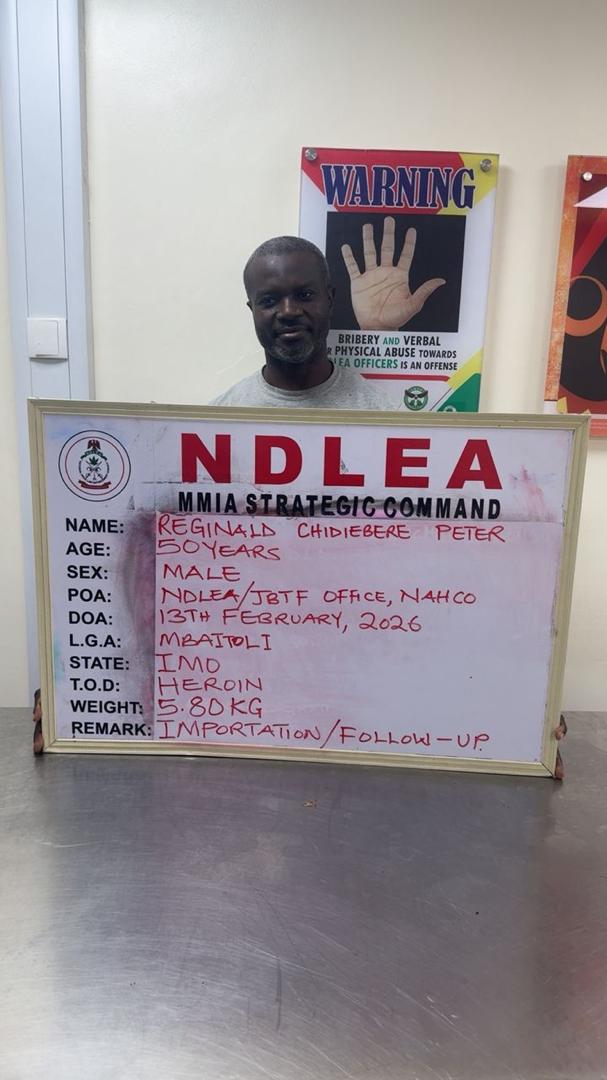
After more than a decade on the run, alleged drug kingpin Reginald Peter Chidiebere has been taken into custody following renewed investigations that linked him to large consignments of cocaine and heroin intercepted by operatives of the National Drug Law Enforcement Agency (NDLEA) at the Murtala Muhammed International Airport in Ikeja, Lagos.
The development was confirmed in a statement issued on Sunday, March 1, by the agency’s spokesperson, Femi Babafemi, who outlined the suspect’s long history with narcotics investigations and the circumstances that led to his eventual surrender.
According to the NDLEA, Chidiebere was first arrested in 2013 in connection with the importation of cocaine into Nigeria. He was subsequently arraigned before Justice Ayokunle Faji of the Federal High Court, Lagos, under charge number FHC/L/187c/2923. However, after being granted bail that same year, he allegedly absconded and went into hiding, evading prosecution for over 13 years.
The agency stated that the suspect remained at large until fresh intelligence in 2024 once again placed him at the centre of a major drug trafficking operation. In February 2024, his name reportedly surfaced as one of the masterminds behind the importation of 49.70 kilograms of heroin from South Africa. The consignment was intercepted by NDLEA operatives at the import shed of the Lagos airport, triggering an extensive follow-up investigation.
As part of that operation, anti-narcotics officers carried out a raid on February 19, 2024, at Golden Platinum Hotel & Suites, a property allegedly linked to Chidiebere and located at No. 16/18 Reginald Peter Chidiebere Street, Hope Estate, Ago Palace Way, Okota, Lagos. During the operation, an additional 2.20 kilograms of heroin was recovered from one of the hotel’s guests, identified as Igbuanugo Ebuka ThankGod.
The NDLEA said the discoveries further strengthened suspicions of Chidiebere’s involvement in an organised drug trafficking network operating through Lagos. Following the 2024 seizures, the suspect reportedly went underground once more to avoid arrest.
In response, the agency intensified its enforcement actions. It secured an interim forfeiture order on the hotel allegedly connected to him and moved to freeze bank accounts traced to his name and business interests. These financial restrictions, according to the NDLEA, significantly curtailed his ability to operate or sustain himself while in hiding.
The cumulative pressure of asset forfeiture, blocked accounts, and continued surveillance ultimately led to his surrender. The agency disclosed that Chidiebere turned himself in on February 13, 2026, and has since been taken into custody.
He is now expected to face both the pending charges dating back to his 2013 arraignment—after allegedly jumping bail—and fresh charges tied to the 2024 heroin consignments intercepted at the Lagos airport.
The arrest marks a significant development in the NDLEA’s long-running efforts to dismantle high-level narcotics networks operating within and through Nigeria. The agency has repeatedly emphasised its commitment to tracking suspects over extended periods, particularly those believed to be key figures in international trafficking operations.
In a related operation, NDLEA operatives in Imo State recorded another major breakthrough in the fight against illicit drug production. On Wednesday, February 25, 2026, officers dismantled a clandestine methamphetamine laboratory concealed in Isiozi Obiato, Umuaka, within the Njaba Local Government Area of the state.
During the raid, authorities recovered 18.4 kilograms of methamphetamine, along with substantial quantities of precursor chemicals and specialised equipment used in the manufacture of the synthetic drug. The seizure underscores growing concerns about the local production of hard drugs, in addition to international trafficking routes.
Methamphetamine production typically involves complex chemical processes requiring precursor substances and laboratory apparatus, indicating a level of organisation and technical expertise. The discovery of such a facility in Imo State suggests that domestic manufacturing operations may be expanding beyond previously identified hubs.
The NDLEA has in recent years intensified operations at airports, seaports, and border points, as well as inland enforcement actions targeting storage facilities, distribution networks, and production sites. The agency maintains that its strategy combines interdiction, financial disruption, and prosecution to weaken drug cartels structurally rather than merely intercepting shipments.
The surrender of Chidiebere after 13 years in hiding, coupled with the dismantling of a methamphetamine laboratory in Imo, reflects the agency’s dual focus on high-profile suspects and operational infrastructure. While legal proceedings are expected to determine the outcome of the charges against him, authorities view the development as a signal that long-term evasion does not guarantee immunity from prosecution.
Further updates on both cases are anticipated as investigations and court processes advance.