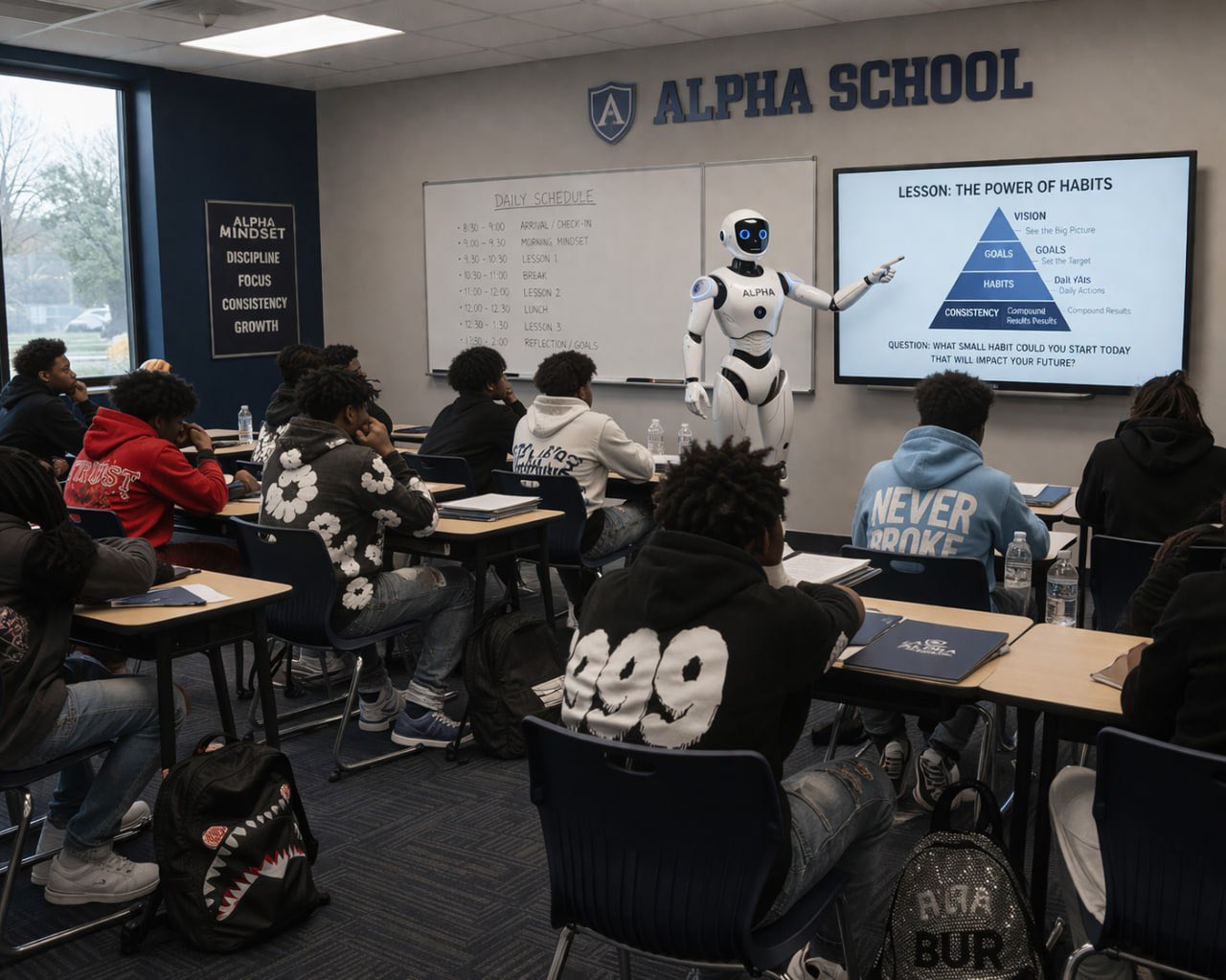
A new model of education driven almost entirely by artificial intelligence is set to debut in Chicago this year, marking a bold shift in how children may learn in the future. The institution, part of the expanding Alpha School network, will operate without traditional teachers, relying instead on AI-powered systems to deliver core academic instruction while human “guides” supervise and motivate students.
The development has sparked both enthusiasm and concern among parents, educators, and policymakers, as it challenges long-standing assumptions about the role of teachers, the structure of classrooms, and the nature of learning itself.
Among the early supporters of the initiative is Blake Mohseni, a finance professional who describes himself as deeply immersed in artificial intelligence. Speaking about the school’s model, Mohseni expressed strong confidence in its potential, even though his three-year-old daughter is still too young to enroll. He and his wife have already decided to send her to the school once she turns four.
“I’m a firm believer that this is the future,” Mohseni said, underscoring his view that technological transformation in education is inevitable. For him, the emergence of AI-driven learning environments represents not just innovation, but necessity in a rapidly evolving world.
The Chicago campus, expected to open in the city’s Loop district, will cater to students from kindergarten through eighth grade. Unlike traditional schools, where students spend most of their day in structured classroom settings with certified teachers, Alpha School condenses academic instruction into just two hours daily. During this period, students engage with AI-powered software that teaches core subjects such as mathematics, science, and reading.
The remainder of the school day is devoted to hands-on, experiential learning activities. These include workshops where students might build robots, participate in physical challenges, or engage in creative problem-solving exercises. The goal, according to the school’s leadership, is to strike a balance between cognitive development and practical skills, fostering both intellectual growth and creativity.
However, this model comes at a steep cost. Tuition for the Chicago campus is set at approximately $55,000 per year, positioning it firmly within the premium tier of private education. Despite the high price, demand appears strong, reflecting growing interest in alternative education models that promise personalized learning and accelerated academic progress.
The concept behind Alpha School is not entirely new. Founded in Austin, Texas, in 2014 by education entrepreneur MacKenzie Price, the network has steadily expanded across the United States, now operating nearly two dozen campuses and enrolling over 1,000 students. Price argues that AI allows for a level of customization and efficiency that traditional classrooms cannot match.
According to her, the technology functions as a one-on-one tutor for each student, adapting in real time to their pace and level of understanding. If a student struggles with a concept, the system slows down and provides additional support until mastery is achieved. Conversely, students who grasp material quickly can move ahead without being held back by the pace of a larger class.
“What’s lost from the traditional classroom?” Price asked rhetorically during a recent visit to Chicago. “Boredom, inefficiency, and lack of mastery.” She believes that AI has the potential to unlock human potential on a scale never before possible, fundamentally transforming education.
Inside Alpha classrooms, the environment reflects this philosophy. Instead of rows of desks facing a teacher, students work in open-plan spaces filled with beanbags and flexible seating arrangements. Laptops and tablets serve as primary learning tools, reinforcing the school’s emphasis on digital engagement.
Human interaction is not entirely absent, however. The “guides” who oversee students play a role in mentoring, motivation, and facilitating group activities. While they are not required to be certified teachers or subject-matter experts, they are responsible for ensuring that students remain engaged and on track. They also lead afternoon workshops and help students set personal learning goals.
Price insists that the model does not eliminate teachers but rather redefines their role. In her view, educators no longer need to deliver content directly, as AI can perform that function more efficiently. Instead, they can focus on supporting students’ emotional and developmental needs.
Yet, this reimagining of education has not been universally embraced. Critics argue that removing trained teachers from the learning process risks undermining essential aspects of education, particularly the human relationships that foster critical thinking, empathy, and social development.
Joe Vukov, an associate professor at Loyola University Chicago who studies the ethics of artificial intelligence, expressed concern about the broader implications of the model. He warned that education is not merely about information transfer, but about cultivating human connection and moral development.
“I worry that you’re changing the nature of what learning, at its best, has always looked like,” he said, highlighting the potential loss of interpersonal dynamics that traditional classrooms provide.
Other experts have pointed to the lack of independent research validating Alpha’s claims of success. Victor Lee, an associate professor at Stanford University’s Graduate School of Education, noted that while AI has shown promise in supporting teaching, there is limited evidence to support fully replacing teachers.
“There’s just so much that teachers do that goes beyond what even the most advanced AI systems can achieve,” Lee said. He also cautioned that the school’s reported high test scores may reflect the socioeconomic background of its students rather than the effectiveness of its model.
Despite these concerns, some parents have reported positive experiences. Sarah Cone, a venture capitalist, enrolled her daughter in Alpha’s Manhattan campus after struggling to find a suitable fit in traditional elite private schools. Within months, she said, her daughter had advanced significantly in both reading and mathematics, attributing the progress to the personalized nature of the curriculum.
“She’s learning at an incredible pace,” Cone said. “It’s been a remarkable transformation.”
The expansion of Alpha School comes at a time of broader national debate over education policy in the United States, particularly around school choice and the role of technology in classrooms. Government initiatives promoting AI literacy and voucher programs that support private education are adding further momentum to these discussions.
While some policymakers see AI-driven schools as a pathway to innovation and improved outcomes, others worry about equity, accessibility, and the potential diversion of resources from public education systems.
Price, for her part, maintains that her vision is inclusive and scalable. Although the high tuition currently limits access, she points to efforts within the network to provide financial aid and expand into charter school models, which would make education free for students.
As Alpha prepares to open its Chicago campus alongside several other new locations, the stakes are high. The model represents a significant departure from traditional education, raising fundamental questions about how children learn best and what role technology should play in shaping their futures.
For parents like Mohseni, however, the decision is clear. He believes that embracing AI in education is not just an option, but a necessity in preparing the next generation for a rapidly changing world.
“At the end of the day, the greatest asset we can give our children isn’t money,” he said. “It’s the ability to think, learn, and adapt. And this is where the future is heading.”