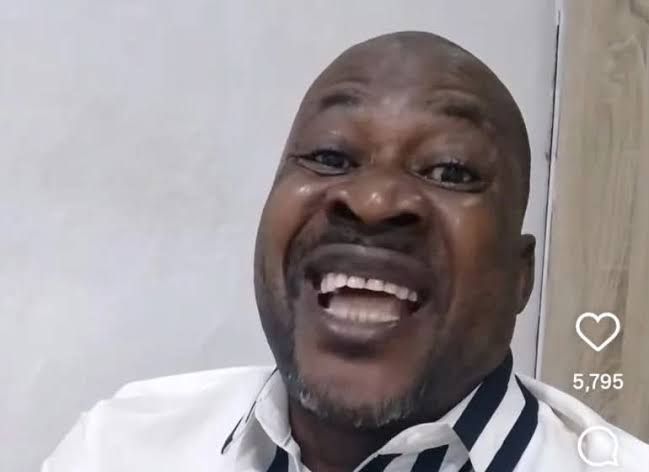
Nollywood actor Laide Olabanji has criticised successive Nigerian leaders over the country’s persistent development challenges, blaming poor governance and leadership failures for the nation’s deteriorating infrastructure and economic hardship.
The actor argued that Nigeria’s problem was not the country itself but the quality of people elected to lead it, insisting that meaningful national development would remain difficult without responsible and visionary leadership.
In his remarks, Olabanji said Nigerians had made the wrong political choices by repeatedly entrusting the country’s affairs to leaders who, in his view, had failed to deliver the development expected by citizens.
“We didn’t choose the wrong country; we only chose the wrong leaders. A country where there are no good leaders, the growth of such a country will be stunted,” he said.
To illustrate what he described as Nigeria’s leadership failure, the actor compared the country’s electricity situation with that of South Africa, recalling Nigeria’s historical contribution to the struggle against apartheid and the country’s independence.
Olabanji expressed disappointment that South Africa, which benefited from Nigeria’s diplomatic, political and material support during the anti-apartheid struggle, had made significant progress in electricity generation, while Nigeria continued to battle inadequate power supply.
“Nigeria was among those who fought for the independence of South Africa, but today South Africa is leading while Nigeria is behind,” he said.
He claimed that South Africa, with a population of approximately 50 million people, generates about 58,000 megawatts of electricity, whereas Nigeria, with an estimated population of 250 million, struggles with only about 1,000 megawatts.
“This tells you how much Nigeria has been spoilt,” he added.
His comparison was intended to highlight what he considered the failure of successive Nigerian administrations to develop critical infrastructure despite the country’s enormous human and natural resources.
Olabanji also lamented the condition of roads, healthcare facilities, fuel supply and other essential services, arguing that ordinary Nigerians were increasingly struggling to meet their basic needs.
He compared Nigeria’s electricity challenges with the situation in neighbouring countries, including Ghana and the Republic of Benin, popularly known as Cotonou.
“Cotonou has electricity, even Ghana, but Nigeria is in darkness. There is no light, no roads, no petrol, no hospitals, and we are in darkness. Even feeding is difficult,” he said.
The actor’s comments reflect widespread public frustration over unreliable electricity supply, rising living costs, inadequate public infrastructure and the difficulties confronting households and businesses across the country.
Nigeria’s electricity sector has remained a major concern for citizens and investors, with inadequate generation, transmission and distribution capacity continuing to affect manufacturing, commercial activities, healthcare delivery and educational institutions.
Many businesses and households depend on petrol and diesel-powered generators to supplement unreliable public electricity supply, increasing operating costs and placing additional financial pressure on consumers.
Olabanji further criticised supporters of the current administration, particularly those from the Yoruba ethnic group, accusing them of defending the government despite experiencing the same economic hardship as other Nigerians.
He argued that political loyalty should not prevent citizens from holding elected officials accountable for their performance, regardless of ethnic or regional affiliations.
“The Yoruba people supporting the current administration are hungry and sleeping in darkness, yet they want those who destroyed the country to return to power,” he said.
Concluding his remarks, the actor declared that Nigeria had suffered extensive damage under its political leadership.
“Nigeria has been destroyed,” he lamented.
His comments have added to the ongoing public debate about governance, political accountability and the country’s development trajectory ahead of the 2027 general election.
However, the electricity figures cited by Olabanji should be treated as his claims rather than verified comparative statistics. South Africa’s installed generation capacity, actual electricity output and available supply are different measures, just as Nigeria’s generation fluctuates and is not adequately represented by a single fixed figure.
Nevertheless, his central argument raises a longstanding question about why Nigeria, despite its large population, abundant natural resources and economic potential, continues to struggle with reliable electricity and essential public services.
For many Nigerians, the challenge remains finding leadership capable of translating the country’s resources into improved living conditions, stronger institutions and sustainable national development.