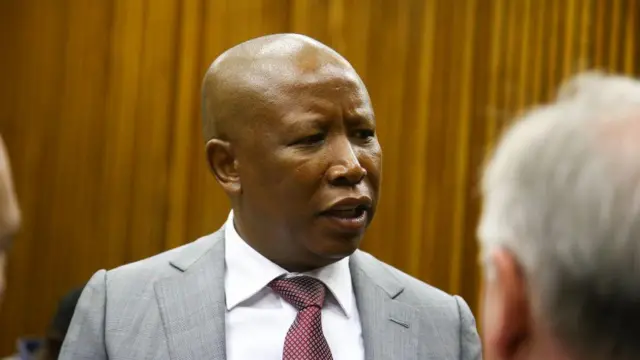
The leader of South Africa’s Economic Freedom Fighters (EFF), Julius Malema, has issued a strong rebuke of the recent wave of xenophobic attacks targeting foreign nationals, including Nigerians, questioning both the logic and the economic justification behind the violence.
Speaking against the backdrop of renewed tensions in parts of South Africa, Malema challenged those involved in attacks on immigrants to demonstrate any tangible economic benefits arising from their actions. He dismissed the widely circulated claim that foreign nationals are responsible for unemployment, describing it as a misplaced narrative that diverts attention from deeper structural issues within the economy.
“You claim that Zimbabweans and Nigerians are taking your jobs, and then you march, shut down shops, and attack people,” Malema said. “But after all that, how many jobs have you actually created?”
His remarks come as reports continue to emerge of harassment, intimidation, and violence directed at African migrants, particularly Nigerians, in several communities. Businesses owned by foreign nationals have reportedly been looted or forcibly shut down, while residents have been displaced, heightening fears and uncertainty among migrant populations.
Malema criticized the destruction of immigrant-owned enterprises, arguing that such actions are counterproductive and worsen the very economic conditions they are purported to address. According to him, many of these businesses provide employment opportunities not only for fellow migrants but also for South African citizens.
“When you shut down a shop that employs five people and claim it is taking jobs away, what happens next?” he asked. “After destroying that business, how many new jobs have you created to replace those lost? The answer is none.”
He emphasized that economic growth cannot be achieved through violence or exclusion but requires deliberate policies, investment, and skills development. Malema maintained that blaming foreign nationals for unemployment oversimplifies a complex issue rooted in broader economic challenges such as inequality, lack of industrial capacity, and insufficient job creation strategies.
In a particularly sharp critique, the EFF leader also targeted individuals driving the attacks, accusing them of lacking both the skills and the vision required to contribute meaningfully to economic development.
“These are individuals without the necessary skills to build or create opportunities,” he said. “Instead of focusing on productivity, they resort to destruction while presenting themselves as champions of a cause.”
Malema further distanced himself from political rhetoric that seeks to exploit xenophobic sentiments for electoral gain. He made it clear that he would not pursue political support by encouraging hostility toward other Africans, stressing that unity and cooperation across the continent are essential for sustainable development.
“I will not seek votes by promoting hatred against fellow Africans,” he stated. “Leadership must be about building, not dividing.”
His comments have added a significant political dimension to the ongoing crisis, which has already drawn strong reactions from Nigerian authorities and other stakeholders. The attacks have strained diplomatic relations and renewed calls for stronger protections for migrants living and working in South Africa.
Reacting to the situation, the Nigerians in Diaspora Commission (NIDCOM), under the leadership of its Chairman, Abike Dabiri-Erewa, condemned what it described as the deteriorating security conditions for Nigerians in South Africa.
In an official statement, the commission expressed concern that despite previous diplomatic engagements between Nigeria and South Africa, the situation had worsened rather than improved. Dabiri-Erewa noted that many Nigerians are now living in fear, with some unable to carry out daily activities due to the threat of violence.
“Contrary to expectations that earlier engagements would lead to a reduction in tensions, the reality on the ground indicates a worsening situation,” she said.
She revealed that children of Nigerian descent in affected areas have become increasingly reluctant to attend school due to safety concerns, while numerous business owners have shut down operations to avoid being targeted. The economic and social impact of the attacks, she noted, has been severe, affecting livelihoods and disrupting communities.
The commission also rejected what it described as the profiling and generalization of Nigerians, emphasizing that criminal behavior should be addressed on an individual basis rather than attributed to an entire nationality.
“Crime has no nationality,” Dabiri-Erewa stated. “Any individual found culpable should be investigated and prosecuted in accordance with the law. However, collective punishment and blanket labeling of Nigerians are unacceptable and dangerous.”
NIDCOM called on South African authorities to take immediate and decisive action to protect foreign nationals, including increasing police presence in vulnerable communities and ensuring that perpetrators of violence are held accountable.
The urgency of the situation has been underscored by reports of fatalities linked to the attacks. The Nigerian Consulate in Johannesburg confirmed the deaths of two Nigerian nationals, Amaramiro Emmanuel and Ekpenyong Andrew, under circumstances that have further heightened concerns about the safety of Nigerians in the country.
According to the consulate, Emmanuel reportedly died from injuries sustained after an alleged assault by members of the South African National Defence Force on April 20. Andrew, on the other hand, was said to have been arrested following an encounter with law enforcement officers in Pretoria before his body was later discovered at a local mortuary.
These incidents have intensified calls for a thorough investigation into the treatment of Nigerians and other foreign nationals, as well as broader reforms to address xenophobia and ensure accountability within security agencies.
Observers note that the recurring nature of such attacks points to deeper socio-economic and political challenges that require long-term solutions. While unemployment and inequality remain pressing issues in South Africa, experts argue that targeting migrants does little to address the root causes of these problems.
Malema’s intervention highlights the need for a shift in public discourse—from blame and hostility to constructive engagement and policy-driven solutions. His insistence on measurable outcomes underscores a broader argument that economic challenges cannot be resolved through violence but through inclusive growth strategies and regional cooperation.
As tensions persist, the situation continues to draw international attention, with calls for both governments to strengthen collaboration and ensure the protection of citizens across borders. For many affected communities, the immediate priority remains safety, while the broader challenge lies in addressing the underlying factors fueling xenophobia and restoring trust among diverse populations.