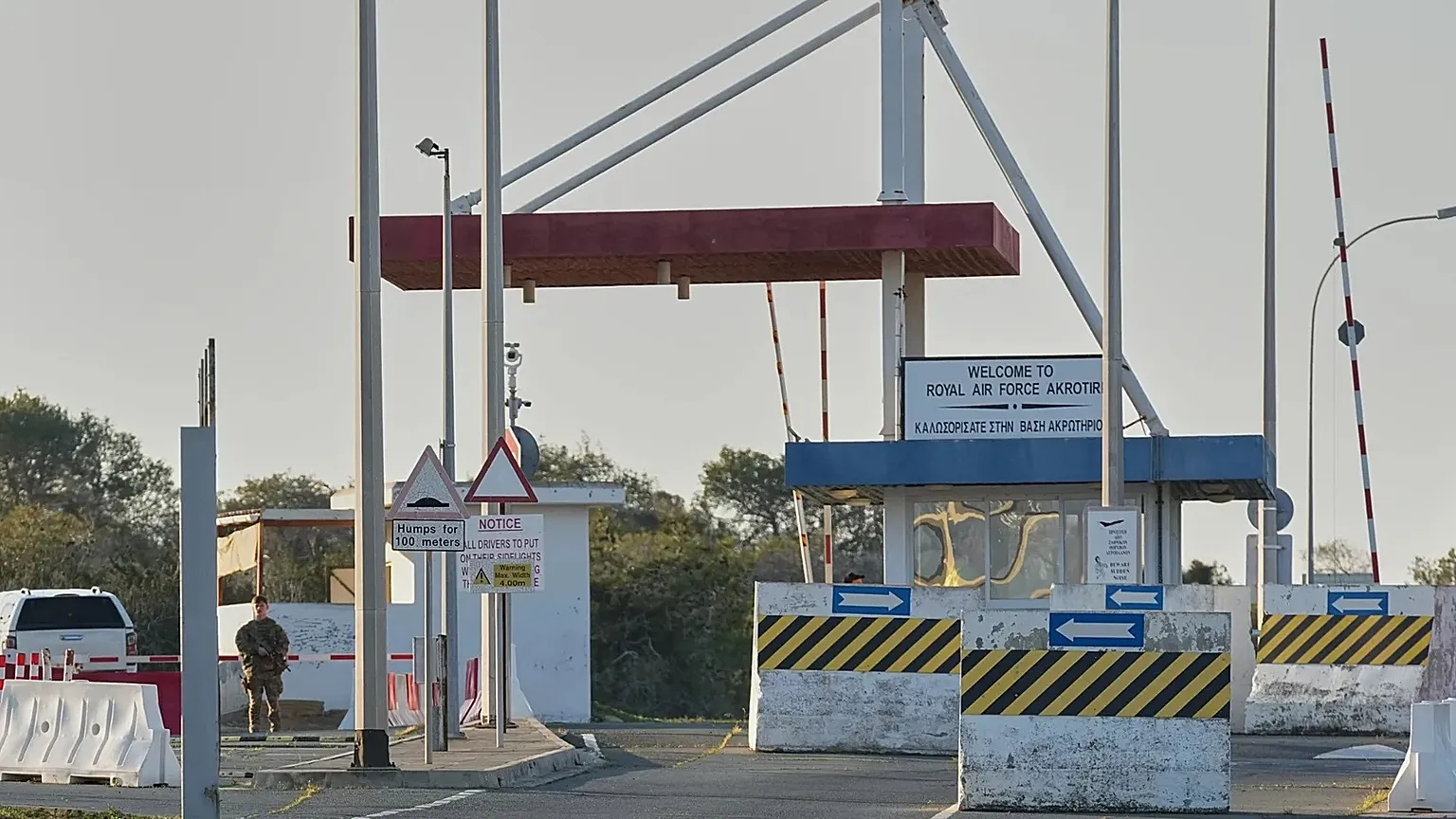
An Iranian drone struck the runway of a British military base in Cyprus early Monday, marking a significant escalation as the expanding confrontation between the United States and Israel on one side and Iran on the other ripples across the wider region. The incident has intensified geopolitical tensions in the eastern Mediterranean and prompted a swift response from the European Union, which pledged firm solidarity with Cyprus, one of its member states.
According to Cypriot authorities, the unmanned aerial vehicle involved was identified as a Shahed drone, a model widely associated with Iran’s military drone programme. President Nikos Christodoulides confirmed that the drone crashed shortly after midnight local time into facilities belonging to the British Sovereign Base Areas in Akrotiri. He described the impact as causing minor material damage, with no immediate reports of casualties.
British officials provided further clarification, confirming that the drone hit the airport runway within the base. UK Home Secretary Yvette Cooper stated in a televised interview that the strike specifically targeted the runway infrastructure. She noted that while authorities were not yet in a position to disclose detailed operational information, precautionary measures were immediately implemented to secure the installation and assess the extent of the damage.
The affected installation, RAF Akrotiri, is one of two British Sovereign Base Areas retained by the United Kingdom following Cyprus’s independence in 1960. Located near the southern coastal city of Limassol, the base plays a strategic role in British and allied military operations in the Middle East. It has long served as a forward operating hub for missions related to regional security, surveillance, and logistical support.
The strike occurred against the backdrop of intensifying hostilities involving the United States and Israel on one side and Iran on the other. In recent days, the conflict has broadened beyond its initial theatres, raising concerns that additional countries or territories hosting Western military infrastructure could become exposed to retaliatory measures.
President Christodoulides was quick to emphasise that Cyprus itself is not an active participant in the conflict and does not intend to engage in military operations. He underscored that the Republic of Cyprus maintains a position of non-involvement and seeks to avoid entanglement in escalating hostilities. However, the presence of British sovereign bases on Cypriot soil introduces complexities, given their strategic integration into allied defence arrangements.
The European Union responded promptly to the development. European Commission President Ursula von der Leyen held discussions with Christodoulides and subsequently issued a statement affirming collective support. While acknowledging that Cyprus was not directly targeted as a sovereign state, she stressed that the EU stands firmly and unequivocally with its member states in the face of any threat. Her remarks reflected broader European concerns about regional destabilisation and the potential for spillover effects into EU territory.
The drone strike followed Britain’s decision to permit the United States to use its military bases, including those in Cyprus, to conduct what were described as defensive operations aimed at intercepting or destroying Iranian missiles and launch systems. The UK government characterised these measures as part of collective self-defence arrangements with allies in the region.
Prime Minister Keir Starmer addressed the situation publicly, clarifying Britain’s stance. He emphasised that the United Kingdom was not involved in the initial strikes carried out against Iran and would not participate in offensive military action. However, he argued that Iran’s broader strategic posture—described as a “scorched-earth strategy”—necessitated defensive coordination with allied nations to protect shared interests and regional stability.
The incident underscores the vulnerability of military infrastructure situated in geopolitically sensitive zones. RAF Akrotiri has historically been utilised for operations ranging from counterterrorism missions to intelligence gathering and air support in Middle Eastern conflicts. Its geographic proximity to hotspots such as Syria, Lebanon, and Israel makes it strategically valuable but also potentially exposed in periods of heightened confrontation.
Security analysts note that the use of drones, particularly loitering munitions such as the Shahed series, reflects evolving warfare tactics that prioritise relatively low-cost, long-range unmanned systems capable of targeting fixed infrastructure. While the reported damage in this case was limited, the symbolic implications are significant. A strike on a NATO-aligned base—even if material impact is minimal—signals an expansion of the operational theatre and demonstrates the reach of drone capabilities.
Authorities have not disclosed whether the drone was intercepted or malfunctioned prior to impact, nor have they provided details about its launch origin. Investigations are likely ongoing to determine flight trajectory, point of origin, and potential intent. Given the strategic sensitivity of the base, intelligence assessments are expected to inform subsequent security adjustments.
For Cyprus, the event highlights the delicate balance it must maintain as an EU member located in a volatile region. While the Republic does not control British sovereign bases, their presence inevitably affects its security calculus and diplomatic posture. Christodoulides’ emphasis on non-participation appears aimed at insulating Cyprus from direct association with offensive operations while reaffirming its sovereign neutrality.
The European Union’s declaration of solidarity also carries political weight. Although defence policy remains primarily under national jurisdiction, collective messaging signals that any threats impacting EU member states—directly or indirectly—are treated as matters of shared concern. The bloc has faced mounting pressure to clarify its stance as regional instability intensifies.
As the US-Israeli confrontation with Iran evolves, the eastern Mediterranean may increasingly become a strategic intersection for competing military and political interests. The drone strike on RAF Akrotiri illustrates how rapidly regional crises can intersect with European security structures.
While the immediate physical damage appears limited, the broader geopolitical ramifications remain uncertain. Diplomatic channels are likely to be activated in parallel with heightened security measures, as stakeholders seek to prevent further escalation. For now, the episode serves as a stark reminder that in interconnected theatres of modern conflict, geographic distance offers limited insulation from unfolding hostilities.