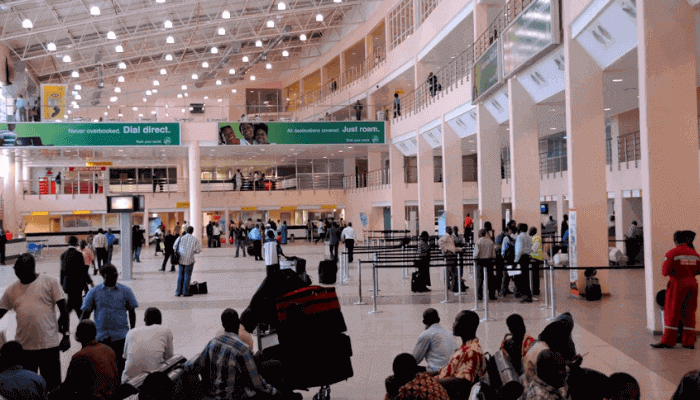
Nigerians attempting to travel to or transit through Qatar, Israel, Iran, Iraq, Syria, Kuwait, and the United Arab Emirates have been left stranded following the intensifying conflict between the United States, Israel, and Iran. The rapidly evolving security situation has triggered widespread airspace closures across the Middle East, forcing major international airlines to suspend or cancel flights and disrupting travel plans for thousands of passengers.
The crisis unfolded after coordinated airstrikes by the United States and Israel targeted multiple locations across Iran, including the capital, Tehran. In retaliation, Iran launched missile attacks against U.S. military bases in Qatar, Kuwait, Bahrain, Jordan, and Saudi Arabia, significantly escalating regional tensions. As military exchanges intensified, civil aviation authorities across the region moved swiftly to restrict or close airspace, citing safety concerns.
Several global carriers—including Air France, Air India, Turkish Airlines, Norwegian, Air Algérie, Qatar Airways, Emirates, and Lufthansa—announced the suspension of flights to affected destinations. Airlines emphasized that the closures were precautionary measures taken to protect passengers and crew amid uncertain and potentially dangerous airspace conditions.
Qatar Airways confirmed the temporary suspension of flights to and from Doha following the closure of Qatari airspace. In a statement, the airline stressed that passenger and staff safety remained its highest priority, apologizing for the inconvenience caused by the abrupt cancellations.
Passengers already onboard a Qatar Airways flight departing from Nigeria reported being asked to disembark after authorities declared that Doha’s airspace had been closed. One traveler described the confusion, saying the airline cited communication issues with the airport in Doha and informed passengers that onward travel was no longer possible. Another passenger expressed concern about academic and professional commitments disrupted by the cancellations.
Similarly, Air India announced the suspension of flights to all Middle Eastern destinations, citing the “developing situation” in the region. The airline communicated its decision through its official social media channels, noting that operations would resume once conditions stabilized.
Emirates also suspended flights to certain regional destinations, while European carriers including Lufthansa and Air France implemented rerouting and cancellation measures.
The closure of airspace was not limited to a single country. Syria shut portions of its southern airspace along its border with Israel for 12 hours, according to civil aviation authorities. Kuwait announced the temporary closure of its airspace after reporting that its military had intercepted incoming missiles. Jordan’s Air Force conducted drills to safeguard national airspace, and Bahrain imposed similar restrictions.
Russia’s air transport regulator, Rosaviatsia, cancelled all commercial flights to Israel and Iran until further notice, reflecting broader international caution.
The cascading closures created a ripple effect across global aviation networks, as airlines scrambled to reroute aircraft and avoid conflict zones. Industry experts noted that unlike ground transport, aircraft cannot simply “park” midair during emergencies, underscoring the urgency of preemptive cancellations.
In Nigeria, the disruptions have had immediate consequences. The Chairman of the International Airlines Operators Committee, Damilola Ogunyeye, confirmed that outbound flights were being cancelled as airlines responded to the volatile conditions. He described the development as deeply unfortunate, warning that persistent instability could erode passenger confidence in international air travel.
“In aviation, safety comes first,” Ogunyeye stated, emphasizing that airlines cannot afford to take risks in unpredictable airspace. He expressed hope that diplomatic efforts would soon restore stability.
Yinka Folami, President of the National Association of Nigeria Travel Agents, also confirmed that numerous passengers had been turned back home. He said airlines were advising travelers to await further instructions, given the security concerns in affected regions.
The Federal Airports Authority of Nigeria (FAAN) issued a public advisory acknowledging that ongoing restrictions were affecting international flight operations to and from Nigerian airports. According to FAAN, several scheduled services linking Nigeria with Middle Eastern destinations had been either delayed or cancelled.
The authority urged passengers to maintain direct contact with their respective airlines for up-to-date information on flight status, rebooking options, and travel advisories. FAAN stated that it was collaborating closely with international aviation regulators and airline operators to monitor developments and ensure passenger safety.
Amid the escalating crisis, the Federal Government of Nigeria released a warning to citizens residing in Iran and neighboring Gulf states. In a statement issued by the Ministry of Foreign Affairs, spokesperson Kimiebi Ebienfa said the government was closely monitoring the “evolving and volatile situation” in the Middle East.
The ministry cautioned Nigerians to remain vigilant and avoid sensitive areas, particularly military or government installations that could become flashpoints. Citizens were advised to restrict non-essential movement and avoid large gatherings until the security environment becomes clearer.
The government further instructed Nigerians abroad to comply strictly with directives from local authorities and to rely only on credible information sources. Embassies in Tehran and Gulf states—including Qatar, Bahrain, Kuwait, the UAE, and Saudi Arabia—have been directed to provide consular assistance where necessary.
The aviation crisis stems from renewed hostilities following failed negotiations between Washington and Tehran over Iran’s nuclear and ballistic missile programs. President Donald Trump described the U.S.-Israeli strikes as “major combat operations,” while Iranian forces responded with missile attacks targeting northern Israel and American military bases in the region.
Details regarding casualties and infrastructure damage remain limited, but the broader implications for global travel and regional stability are already evident. Energy markets reacted nervously, and international airlines continue to reassess flight paths to minimize exposure to risk.
For Nigerian travelers, the immediate concern remains practical: missed connections, postponed academic terms, disrupted business engagements, and prolonged uncertainty. With multiple airspaces closed and diplomatic tensions high, aviation analysts warn that normal flight operations may not resume quickly.
As military exchanges continue and diplomatic efforts appear stalled, the Middle East’s skies remain fraught with danger. For now, airlines, regulators, and governments alike are prioritizing caution, leaving thousands of passengers—including many Nigerians—waiting anxiously for a return to normalcy.