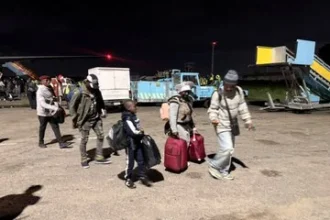
No fewer than 19 additional Nigerians have been placed on the United States government’s “worst of the worst” criminal list and are now scheduled for deportation, according to updated information published by the U.S. authorities.
Findings from the website of the U.S. Department of Homeland Security on Sunday revealed that the latest update has increased the total number of Nigerians slated for removal from the United States to 113.
The individuals named in the most recent update were convicted of various crimes, including sexual assault of a minor, fraud-related offences, assault, drug trafficking, money laundering and other serious violations of U.S. law.
According to a note accompanying the list, the affected individuals were arrested by officials of the U.S. Immigration and Customs Enforcement (ICE). They are expected to be deported to Nigeria after the completion of the required immigration procedures.
The statement published alongside the list emphasised that the action forms part of a broader enforcement initiative targeting convicted non-citizens.
“The U.S. Department of Homeland Security is highlighting the worst of the worst criminal aliens arrested by U.S. Immigration and Customs Enforcement,” the statement read.
It added that under the leadership of Secretary Kristi Noem, the personnel of DHS and ICE were carrying out what was described as an intensified deportation drive, focusing first on individuals convicted of serious crimes.
“Under Secretary Kristi Noem’s leadership, the hardworking men and women of DHS and ICE are fulfilling Donald Trump’s promise and carrying out mass deportations — starting with the worst of the worst — including the illegal aliens you see here,” the note stated.
Names of Newly Listed Individuals
Those newly added to the deportation list include Adeolu Solabu, Oladayo Agboola, Chinonso Ochie, Oluchi Jennifer Chimdimma Chime, Samuel Omorodion, Sunday Adediora, Sunday Kunkushi and Mkpouto Etukudoh.
Others are Marcus Unigwe, Kehinde James, Blessing Uchanma, Victor Adebisi, Richard Ugbah, Olaniyi Ojikutu, Oluwamuyiwa Olawoye, Okechukwu Amadi, Femi Jolayemi, Anthony Asanya, Izuchukwu Okoye and Ebele Agbasiele.
U.S. authorities did not immediately provide individual case summaries within the public notice but indicated that each of the listed individuals had been convicted of crimes that met the threshold for prioritised removal under current immigration enforcement policies.
Rising Deportation Figures
The latest update marks a significant increase in the number of Nigerians facing deportation in recent weeks.
Earlier reports indicated that 79 convicted Nigerians had initially been listed for deportation following their arrest by ICE. However, within a span of three weeks, that number has risen to 113, reflecting what appears to be a sustained and expanding enforcement effort.
The development comes amid a broader crackdown by U.S. authorities on criminal and undocumented migrants across the country. Federal agencies have reiterated their commitment to prioritising the removal of non-citizens convicted of serious crimes.
Immigration enforcement in the United States is overseen by the Department of Homeland Security, which coordinates border security, immigration control, and internal enforcement operations. ICE, as a component agency of DHS, is responsible for identifying, arresting and removing non-citizens who violate U.S. immigration laws.
Policy Context
The renewed emphasis on deporting individuals described as “the worst of the worst” aligns with long-standing enforcement priorities that focus on non-citizens convicted of violent or serious offences.
While deportation proceedings follow criminal convictions, individuals on the list are subject to additional immigration review processes before removal. This typically includes confirmation of identity, travel documentation, and coordination with the receiving country.
In cases involving Nigerian nationals, deportation procedures require cooperation between U.S. immigration authorities and relevant Nigerian government agencies to facilitate repatriation.
The publication of names on the DHS platform serves both as a public notification and as part of the agency’s broader transparency strategy regarding enforcement actions.
Implications for Nigeria
The increase in the number of Nigerians slated for deportation may have diplomatic and social implications. Past waves of deportations have prompted discussions about reintegration challenges for returnees and the broader issue of migration-related offences.
Although U.S. authorities maintain that deportations are conducted in accordance with due process and existing laws, advocacy groups have often called for careful consideration of humanitarian factors and post-deportation support systems.
For Nigeria, the rising figure underscores the need for continued engagement with diaspora communities and awareness campaigns on compliance with foreign laws.
Ongoing Enforcement Efforts
The updated list reflects what U.S. officials describe as an ongoing, systematic approach to immigration enforcement.
By prioritising individuals convicted of serious crimes such as sexual assault, drug trafficking, money laundering and violent offences, DHS and ICE aim to demonstrate that public safety remains central to their operational mandate.
As the enforcement drive continues, additional updates to the list may follow, depending on the outcome of ongoing investigations and immigration proceedings.
For now, the total number of Nigerians identified for deportation stands at 113, marking a notable escalation within a short period and signalling that U.S. immigration authorities remain firmly committed to executing removal orders against convicted non-citizens.