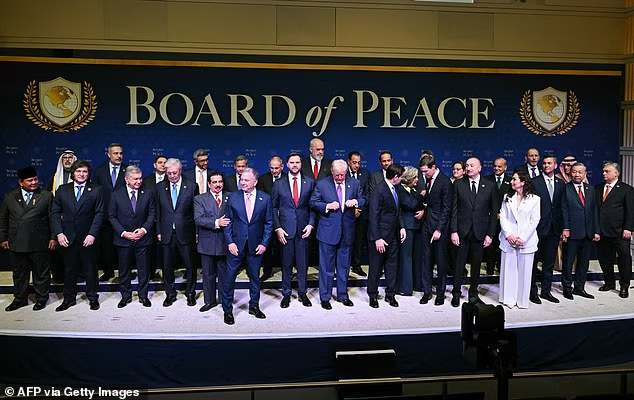
U.S. President Donald Trump has issued a stark warning to Iran, declaring that the United States could carry out military strikes if a nuclear agreement is not reached within the next 10 days. The ultimatum was delivered on Thursday during the inaugural meeting of the newly established Board of Peace in Washington, D.C., where the president blended calls for diplomacy with explicit threats of force.
Addressing nearly 50 world leaders participating either in person or virtually, Trump framed his remarks around the theme of global conflict resolution while simultaneously signaling that military options remain firmly on the table in dealing with Tehran. The president, who has frequently described himself as a leader determined to end wars rather than start them, acknowledged that negotiations with Iran have proven difficult and suggested that time for diplomacy may be running out.
“We may have to take it a step further, or we may not. Maybe we’re going to make a deal,” Trump said in reference to the stalled nuclear talks. “You’re going to be finding out over the next probably 10 days.”
The warning came amid mounting tensions between Washington and Tehran following a recent round of negotiations in Geneva, Switzerland. Those talks reportedly ended without significant progress, with Iranian negotiators requesting additional time and offering few concrete concessions. U.S. officials have expressed frustration over what they describe as limited movement from Tehran on key issues, including uranium enrichment levels and verification mechanisms.
While emphasizing that “good talks are being had,” Trump characterized Iran as a current geopolitical “hot spot” and underscored the need for what he termed a “meaningful deal.” According to the president, failure to achieve such an agreement would trigger unspecified consequences. “It’s proven to be over the years not easy to make a meaningful deal with Iran – we have to make a meaningful deal otherwise bad things happen,” he said.
The 10-day deadline marks a significant escalation in rhetoric and introduces a clear timeframe for potential action. Reports circulating in Washington suggest that contingency plans could involve strikes on Iranian nuclear facilities, ballistic missile infrastructure, and selected military installations. Although no formal operational decision has been announced, defense analysts note that recent U.S. force movements in the Middle East have expanded available military options.
In recent weeks, the U.S. military has significantly reinforced its regional posture, redeploying aircraft carriers, fighter squadrons, submarines and additional support assets. These movements, described by defense officials as precautionary and deterrent in nature, have been interpreted by some observers as preparation for potential escalation should negotiations collapse.
Trump’s remarks at the Board of Peace meeting reflected the dual-track approach that has characterized his foreign policy stance: combining public pressure with the possibility of diplomatic engagement. He reiterated his long-standing claim that he seeks to be remembered as a president who ends wars rather than initiates them. During the address, he again asserted that he had halted eight wars during his tenure, though he did not specify which conflicts he was referencing.
“An easy word to say but a hard word to produce – peace,” Trump said at the outset of the meeting. He emphasized that war carries enormous financial and human costs, arguing that negotiated settlements are far more economical. “There’s nothing less expensive than peace,” he stated. “You know, when you go to war, it costs you 100 times what it costs to make peace.”
The president highlighted what he described as the generosity of the United States and other participating nations in funding peace initiatives and conflict resolution efforts worldwide. The newly formed Board of Peace, according to administration officials, is intended to serve as a multilateral forum aimed at fostering dialogue and de-escalating global conflicts.
Despite the conciliatory framing of the event, Trump’s comments toward Iran injected a confrontational tone into the proceedings. He suggested that while diplomacy remains preferable, Washington will not hesitate to act if it perceives that negotiations are being used to stall without substantive compromise.
“A lot of people in this room hate each other – you know, sort of natural, I guess,” Trump remarked during the meeting, gesturing to the diverse gathering of international representatives. “But we’re bringing love back into the room like the old days.”
The juxtaposition of conciliatory rhetoric with a military ultimatum has drawn scrutiny from foreign policy observers. Some analysts argue that imposing a short deadline could increase pressure on Tehran to make concessions, while others warn that rigid timelines risk cornering both sides and narrowing diplomatic space.
Iran has not formally responded to the 10-day ultimatum, but officials in Tehran have previously rejected what they characterize as coercive tactics. Iranian leaders have maintained that any agreement must respect the country’s sovereign rights and include guarantees against future unilateral withdrawal or sanctions.
The nuclear issue has long been a flashpoint in U.S.-Iran relations. Previous negotiations resulted in agreements that were later abandoned or modified, contributing to mutual distrust. Current talks are reportedly focused on limiting uranium enrichment activities, enhancing international inspections, and addressing regional security concerns linked to missile development and proxy networks.
As the 10-day window unfolds, global attention is likely to intensify around both diplomatic backchannels and military signaling. Financial markets and energy sectors are particularly sensitive to developments involving Iran, given its strategic position in the Middle East and its role in global oil supply chains.
Trump’s ultimatum places the spotlight squarely on the next phase of negotiations. While the administration insists that diplomacy remains the preferred outcome, the visible military build-up and explicit deadline underscore the seriousness of Washington’s posture.
Whether the coming days yield a breakthrough or a further deterioration in relations remains uncertain. What is clear is that the stakes extend beyond bilateral tensions, carrying implications for regional stability, global energy markets and the broader architecture of nuclear non-proliferation.