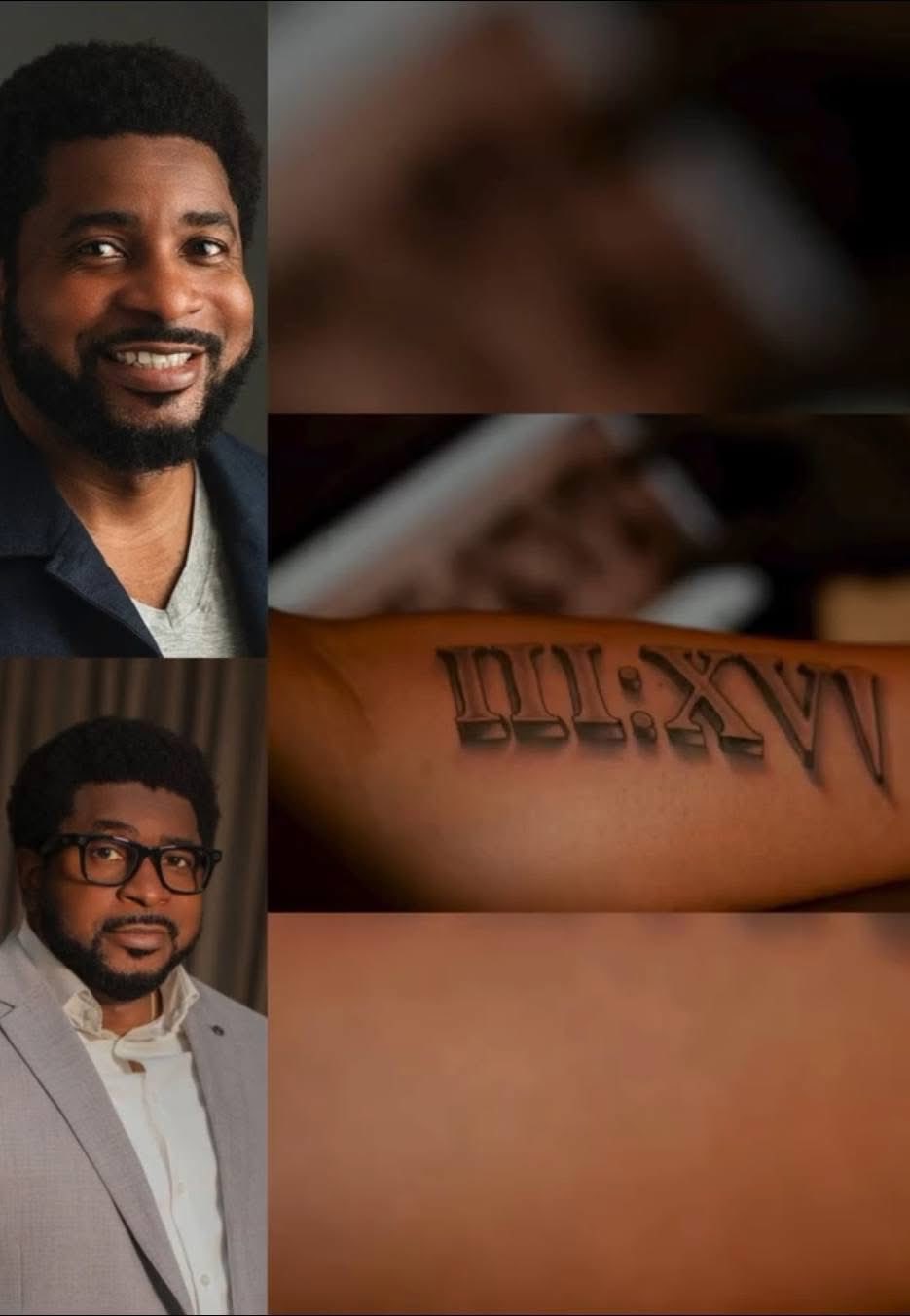
Popular relationship coach and pastor, Kingsley Okonkwo, has stirred fresh debate within Christian and social circles after openly challenging long-standing religious attitudes that condemn tattoos, insisting there is no biblical or scientific basis for labeling them sinful or immoral. His comments came amid public reactions to a visible John 3:16 tattoo on his body, which drew criticism from some believers who questioned its appropriateness for a pastor.
Speaking during an interview on News Central, Okonkwo described the widespread hostility toward tattoos in many religious spaces as rooted more in assumptions and cultural conditioning than in scripture. He argued that such views are not only unfounded but also harmful to personal freedom, inclusion and broader societal development.
“There is no scripture that says a child of God cannot have a tattoo,” Okonkwo stated firmly. “People keep shouting that tattoos are bad, yet nobody can explain why. There is no scriptural proof, no scientific proof—just assumptions that have been passed down and accepted without question.”
According to the pastor, many religious leaders and worshippers have elevated personal opinions, denominational rules or inherited church culture to the level of divine law, often without critically examining their origins. He warned that this tendency fosters judgmental attitudes and restricts healthy engagement with evolving social realities.
Okonkwo criticised the practice of linking outward appearance to moral character, saying such thinking reflects an outdated worldview that hinders growth. He noted that tattoos, clothing styles or lifestyle choices are often blamed for criminality or moral decay without any logical or empirical basis.
“We keep looking for something physical to blame for bad behaviour,” he said. “If a criminal has tattoos, then tattoos must be bad. If someone dresses a certain way and commits a crime, then the clothes are the problem. That kind of reasoning doesn’t make sense and does not help society move forward.”
To illustrate his point, Okonkwo offered a simple analogy. “If someone wore jeans and robbed a bank, does that mean jeans are now evil?” he asked. “Should we ban jeans because a criminal once wore them? That’s the level of logic we often apply when it comes to tattoos.”
He emphasised that moral character is shaped by values, convictions and personal choices, not by physical markings on the body. According to him, both virtuous and immoral individuals can have tattoos, making it unreasonable to use body art as a moral measuring stick.
“I can give you ten good people with tattoos, and you can give me ten bad people with tattoos,” Okonkwo said. “So what exactly does that prove? Absolutely nothing. It tells you that tattoos do not determine character.”
The pastor stressed that Christianity, at its core, is a faith centred on inner transformation rather than outward appearance. He argued that excessive focus on physical expressions distracts from more important spiritual principles such as love, integrity, compassion and justice.
Beyond the issue of tattoos, Okonkwo connected this mindset to what he described as the church’s long-standing reluctance to engage with certain sectors of society, particularly politics. He observed that many Christians deliberately avoid spaces they consider morally “dirty,” only to later lament the quality of leadership and governance.
“We stay away from politics because we say it is corrupt,” he said. “We stay away from entertainment because we say it is worldly. We stay away from certain professions because we say they are ungodly. Then we turn around and complain that everything is bad.”
According to Okonkwo, this withdrawal creates a vacuum that is filled by individuals with little regard for ethical standards, reinforcing the very problems believers claim to oppose. He argued that meaningful change requires presence and participation, not isolation and condemnation.
“If good people avoid important spaces, those spaces will not magically become good,” he said. “We can’t keep running away from society and then expect society to reflect our values.”
Okonkwo urged Christians to re-examine how faith is expressed in a modern, diverse world. He encouraged believers to focus on personal spirituality, ethical conduct and positive impact rather than superficial judgments based on appearance or cultural stereotypes.
He also warned against confusing cultural norms with biblical doctrine, noting that many practices condemned in churches today have more to do with tradition than scripture. In his view, failing to distinguish between the two has led to unnecessary divisions and the exclusion of people who might otherwise be positively influenced by the faith.
“Jesus never judged people by how they looked,” Okonkwo said. “He dealt with the heart. He engaged people where they were and transformed them through love, not condemnation.”
His comments have generated mixed reactions across social media and religious communities. While some applauded his stance as refreshing and liberating, others accused him of promoting moral laxity or undermining Christian discipline. Supporters, however, argue that Okonkwo is simply calling for a more thoughtful and scripture-based approach to faith.
The debate has also reopened broader conversations about how religious institutions adapt to changing cultural expressions without compromising core beliefs. For many younger believers, tattoos have become a form of personal storytelling, artistic expression or even faith declaration, as seen in Okonkwo’s own John 3:16 inscription.
By addressing the issue publicly, Okonkwo has forced a confrontation with assumptions that often go unchallenged in religious spaces. Whether one agrees with his conclusions or not, his remarks have highlighted the need for deeper reflection on what truly defines faith, morality and Christian identity.
As discussions continue, his message remains clear: external appearance should never overshadow internal values. In a society grappling with complex moral and social challenges, Okonkwo believes the church must move beyond surface-level judgments and refocus on principles that genuinely transform lives.
“Faith should make us better people,” he said. “It should help us love more, understand more, and contribute more to the world around us—not reduce everything to how someone looks.”