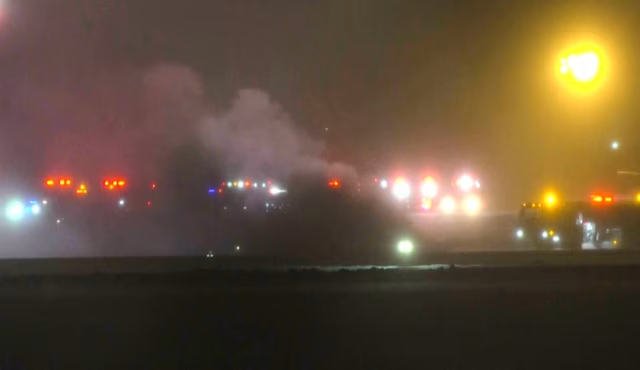
A private jet carrying eight people crashed while attempting to take off from Bangor International Airport in the US state of Maine on Sunday night, triggering an emergency response and the immediate shutdown of the airport amid severe winter weather conditions.
The Federal Aviation Administration (FAA) confirmed that the aircraft involved was a Bombardier Challenger 600, a mid size business jet commonly used for private and charter flights. According to the agency, the jet went down during its take off roll at approximately 7.45 pm local time. The FAA said it had launched an investigation into the incident but did not immediately release further details on the cause of the crash.
The accident occurred as a powerful winter storm swept across large parts of the United States, bringing heavy snowfall, freezing rain, and dangerously low temperatures to the Northeast. Maine was among the states hardest hit by the storm, which meteorologists identified as Winter Storm Fern. At the time of the crash, the state was experiencing intense snowfall, strong winds, and below freezing temperatures that significantly reduced visibility and complicated flight operations.
Bangor International Airport, where the crash took place, is a key regional aviation hub that provides direct air links to major US destinations including Orlando, Florida, Washington DC, and Charlotte, North Carolina. The airport is located about 200 miles north of Boston and is frequently used by both commercial airlines and private aircraft, particularly for transatlantic refuelling stops and charter operations.
Air traffic control audio recordings from the moments leading up to the crash suggest that weather conditions were a significant concern on the airfield. According to reports, there was an exchange between air traffic controllers and pilots regarding poor visibility and the need for aircraft de icing. While it remains unclear which specific aircraft were involved in those discussions, the recordings provide insight into the challenging conditions at the airport shortly before the incident.
In one transmission, an air traffic controller is heard authorising a pilot to depart from Runway 33. Less than two minutes later, the same radio frequency carries an urgent and alarming message indicating that something had gone seriously wrong.
“All traffic is stopped on the field. All traffic is stopped on the field,” a controller is heard saying, signalling the immediate suspension of all aircraft movements at the airport.
Moments later, another controller gives a stark update on the situation, reporting the condition of the aircraft involved in the crash.
“Aircraft upside down. We have a passenger aircraft upside down,” the controller said, underscoring the severity of the accident.
Emergency response teams were immediately dispatched to the scene as airport authorities moved to secure the airfield. According to CNN, the airport was shut down to all incoming and outgoing flights to allow emergency vehicles unhindered access to the crash site. Firefighters, medical personnel, and airport rescue crews worked in difficult weather conditions to reach the aircraft and assess the situation.
In a subsequent radio transmission, an air traffic controller indicated that officials believed there were three crew members and possibly five passengers on board the aircraft at the time of the crash, bringing the total number of people on board to eight. Authorities did not immediately confirm the condition of those on board, and there was no official statement on injuries or fatalities as of Sunday night.
The FAA said it would work alongside other agencies, including the National Transportation Safety Board (NTSB), to determine the cause of the crash. Investigators are expected to examine a range of factors, including weather conditions, aircraft performance, runway conditions, pilot actions, and any mechanical issues that may have contributed to the incident.
Aviation experts note that winter storms pose significant risks to flight operations, particularly during take off and landing phases. Snow and ice accumulation on aircraft surfaces can affect lift and control, while reduced visibility and slippery runways increase the likelihood of accidents. Strict de icing procedures are typically required before take off in such conditions, but even with precautions, extreme weather can overwhelm safety margins.
Winter Storm Fern has already caused widespread disruption across the Northeast, with thousands of flights cancelled or delayed over the weekend. Airports across the region have struggled to keep runways clear of snow and ice, while airlines have warned passengers to expect continued delays as the storm system moves eastward.
In Maine, state officials have urged residents to avoid unnecessary travel due to hazardous road conditions and poor visibility. Emergency services have been stretched by a surge in weather related incidents, including traffic accidents, power outages, and downed trees.
The crash at Bangor International Airport adds to growing concerns about aviation safety amid extreme weather events, which scientists say are becoming more frequent and severe due to climate change. While air travel remains one of the safest modes of transportation, incidents linked to adverse weather underscore the importance of rigorous safety protocols and real time decision making by pilots and air traffic controllers.
Airport authorities said further updates would be provided as more information becomes available. In the meantime, passengers scheduled to travel through Bangor International Airport were advised to check with their airlines for the latest information on flight status and possible rescheduling.
As investigators begin the painstaking task of reconstructing the events leading up to the crash, attention will focus on whether weather related factors, operational decisions, or technical issues played a decisive role. For now, the incident stands as a dramatic reminder of the challenges faced by aviation operations during severe winter storms, and the critical importance of safety in the skies.