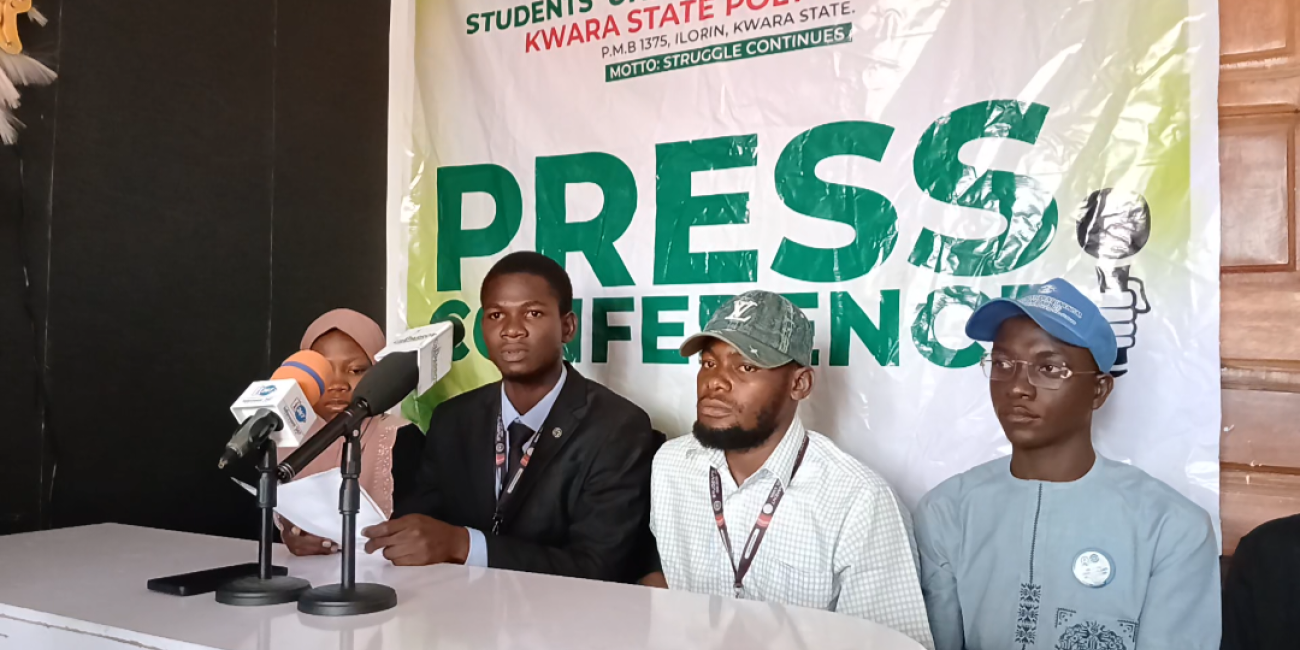
Students of Kwara State Polytechnic have renewed their call for the immediate and permanent discontinuation of the use of the institution as a National Youth Service Corps (NYSC) orientation camp, citing prolonged disruption of academic activities, displacement of students, and what they describe as an excessive security response to a peaceful protest.
The demand was made on Thursday during a press conference in Ilorin, the Kwara State capital, by the President of the Students’ Union Government (SUG), Comrade Maruf Ibrahim, who said the situation had moved beyond administrative inconvenience and had become a serious human, welfare, and safety crisis for students.
Addressing journalists, Ibrahim said students came to the institution to pursue education and personal development but were now facing uncertainty, homelessness, and intimidation.
Related posts:
- University of Nigeria, NYSC disown credentials paraded by Minister of Technology, Uche Nnaji
- Police Arrest Violent Agaba Masquerade Over Attack on Residents in Anambra Community
- Traditional Rulers in Umuahia Demand Presidential Pardon and Release of Nnamdi Kanu
- Nurses Condemn Brutal Killing of FMC Abuja Nurse, Demand Justice and Urgent Security Reforms
“Today, we speak with heavy hearts but clear conviction,” he said. “We are students, young Nigerians, who came to Kwara State Polytechnic to learn, grow, and prepare for our future. What we are experiencing is no longer just an administrative matter. Our studies have been disrupted, our accommodation taken away, our safety threatened, and our voices ignored.”
According to the SUG, the continued use of the Polytechnic as an NYSC orientation camp, reportedly necessitated by security challenges elsewhere in the state, has imposed severe hardship on students. The union said hostels paid for by students were taken over, academic activities suspended, sports and campus life halted, and many students suddenly left without shelter or clear alternatives.
Ibrahim emphasised that the students’ agitation was neither political nor sponsored by any individual or group.
“Let us be clear from the outset,” he said. “This struggle is not political, sponsored, or manipulated by any external force. It is the genuine cry of students defending their welfare, dignity, and right to education.”
The SUG traced the origin of the crisis to several months ago, explaining that while students recognise the importance of the NYSC scheme to national unity, the lack of planning, consultation, and alternative arrangements had turned the Polytechnic into a place of anxiety and hardship.
According to the union, on December 8, 2025, the Students’ Union Government formally wrote to the Polytechnic management, outlining concerns over the takeover of student facilities for NYSC activities and appealing for proper planning and prioritisation of student welfare. The letter, the SUG said, received no response.
Again, on January 18, 2026, during a meeting involving the Polytechnic management, NYSC officials, and representatives of the Ministry of Youth Development, students raised further concerns. They warned that students who had already paid for accommodation would be displaced, academic calendars disrupted, and many students stranded without the financial capacity to secure alternative housing.
Despite these warnings, the SUG said a memo was subsequently issued declaring a three-week holiday, effectively forcing students to vacate the campus at short notice, without adequate support or assurances regarding their safety and belongings.
Ibrahim said that on January 19, 2026, the union appealed for calm among students and opted for dialogue rather than confrontation. Letters were sent to relevant authorities requesting that students occupying hostels be allowed to remain on campus, that their property be protected, and that the Polytechnic cease to be used as an NYSC orientation camp after the current batch.
“These appeals were ignored,” he said.
With no response from authorities and no clear assurances, students organised what the union described as a peaceful protest aimed at drawing attention to their plight. According to the SUG, the demonstration was met with a heavy security presence and what it described as a violent response.
Ibrahim alleged that security operatives entered the campus with armoured vehicles, fired tear gas, and forcefully evacuated hostels. He said several students and staff members sustained injuries during the operation, while the Students’ Union building was also affected.
“The use of force against unarmed students was unnecessary and deeply painful,” he said. “Students did not choose violence. Students chose dialogue. Students chose peace.”
Reiterating the union’s position, Ibrahim stressed that students are not opposed to the NYSC programme and should not be treated as criminals for demanding basic rights such as shelter, safety, and uninterrupted education.
“Students are not enemies of the NYSC programme,” he said. “Students are not criminals for demanding shelter, safety, and education. Students deserve to be consulted, protected, and respected.”
The SUG therefore called for the immediate and permanent discontinuation of the use of Kwara State Polytechnic as an NYSC orientation camp. The union argued that the campus is primarily a learning environment and is neither designed nor funded to function as a long-term substitute for a purpose-built orientation facility, particularly at the expense of enrolled students.
The students also appealed to key national institutions to intervene urgently to prevent further escalation and recurrence of similar situations. Those mentioned include the Federal Ministry of Youth Development, the Director General of the NYSC, the Inspector General of Police, the Department of State Services, the leadership of the National Association of Nigerian Students, the National Association of Polytechnic Students, and the management of Kwara State Polytechnic.
“Your intervention is needed now, not after more students are displaced, injured, or silenced,” the SUG said. “Peace cannot exist where students are ignored, and stability cannot be built on suffering.”
According to the union, Nigerian tertiary institutions must remain safe and stable spaces for learning rather than zones of fear and uncertainty.
“Students are the future of this country, and how we are treated today reflects the Nigeria we are building tomorrow,” Ibrahim said.
The SUG commended students of Kwara State Polytechnic for remaining united and peaceful despite the challenges, insisting that the agitation is rooted in dignity, fairness, and institutional responsibility.
“We remain open to dialogue. We remain committed to peace. But we will not be silent while student welfare is trampled,” Ibrahim added.
“Solidarity forever. God bless the Federal Republic of Nigeria.”