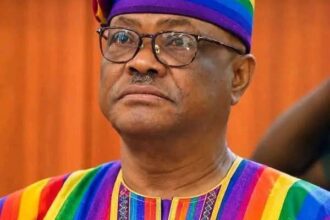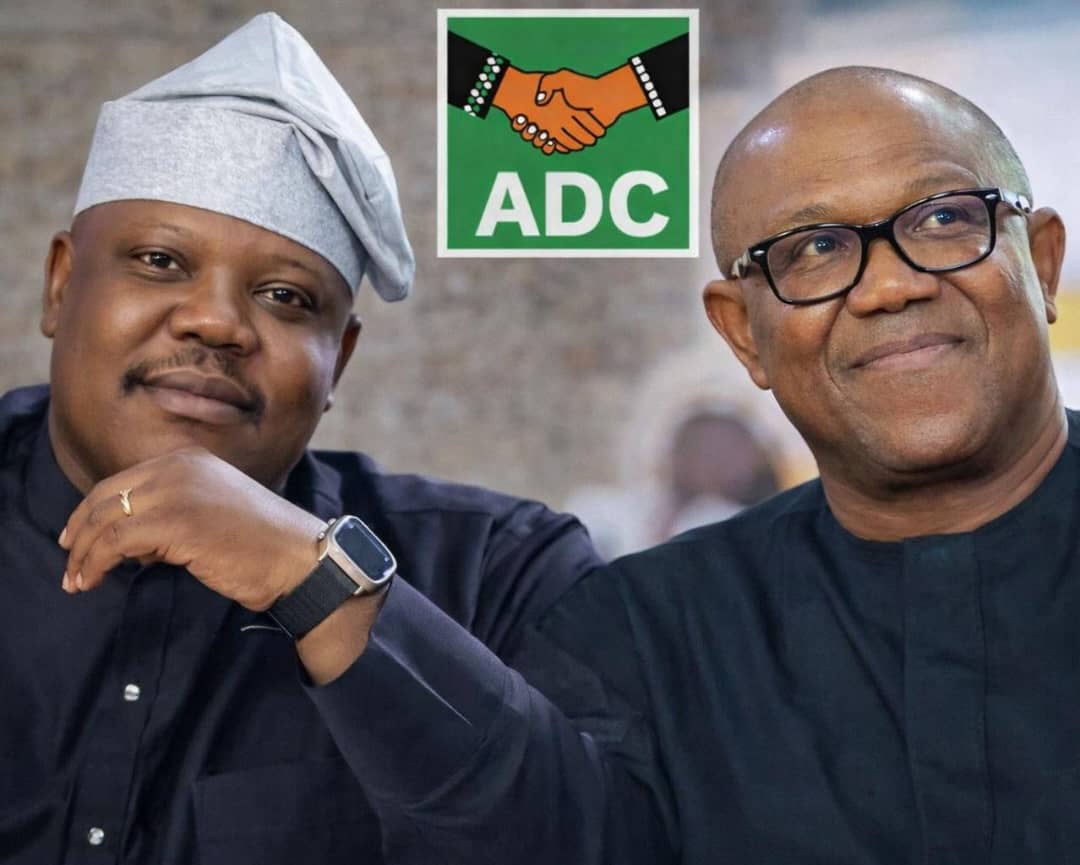
Former Ekiti State Governor, Ayodele Fayose, has declared that the Peoples Democratic Party (PDP) is no longer Nigeria’s dominant opposition party, blaming its decline on deep internal divisions and leadership failures, while describing former Labour Party presidential candidate Peter Obi as the single most influential figure within the African Democratic Congress (ADC) ahead of the 2027 general elections.
Fayose made the remarks during an interview on ARISE News with senior anchor, Dr Reuben Abati, where he offered a blunt assessment of the state of opposition politics in Nigeria, the lingering crisis within the PDP, and the shifting dynamics shaping the road to 2027.
Speaking candidly, the former governor argued that the PDP’s weakened status was self-inflicted and not the result of external pressure from the ruling All Progressives Congress (APC). According to him, internal disunity, unresolved leadership struggles and a lack of strategic cohesion had eroded the party’s standing as a credible alternative to the ruling party.
Related posts:
- OmoBarca Welcomes Peter Obi to ADC, Hails a New Dawn for Progressive Politics
- Tanzania’s President Samia Suluhu Hassan wins re-election with 98% amid deadly protests, opposition outcry
- Senate passes bill prescribing life imprisonment for defilement of minors
- Politics is not for selfish gain, It is a tool for service, I am in it because of my people – OmoBarca
“You must be very honest. When you are weak, tendencies are there for you to fall to the right of the stronger side,” Fayose said, stressing that political dominance is often determined by internal strength rather than external aggression.
He rejected suggestions that President Bola Ahmed Tinubu or the APC were responsible for the PDP’s troubles, insisting that the party’s challenges were homegrown.
“The challenges in the PDP, it’s not the fault of Asiwaju, the president. No,” Fayose said. “The failure in my home, God forbid, is not the fault of my neighbour.”
Describing the party’s condition, Fayose said the PDP had become a deeply fractured organisation incapable of presenting a united front to Nigerians.
“The issues are very clear. The PDP is a house that is divided against itself,” he said, adding that persistent internal conflicts had weakened its capacity to function effectively as a national opposition.
Fayose’s comments come at a time when the PDP has continued to grapple with defections, leadership disputes and questions over its ideological direction since losing the presidency in 2015 and failing to reclaim it in subsequent elections. Analysts say the party’s inability to manage internal rivalries has steadily reduced its influence, particularly among younger voters and urban constituencies.
Turning to the broader political landscape, Fayose argued that Nigeria traditionally operates a two-dominant-party system at any given time, but said the identity of those parties can change depending on political momentum and public sentiment.
“In Nigeria, we don’t have more than two dominant parties at a time,” he said, suggesting that the emergence of the ADC as a relevant platform was closely tied to Peter Obi’s political trajectory.
Fayose described Obi as the central force giving the ADC national visibility and relevance, dismissing claims that other high-profile politicians associated with the party carried comparable political weight.
“Are we saying ADC is not dominant?” Fayose asked rhetorically. “Recently, Obi moved there. And I’ve said it. Obi is the only life in ADC.”
When Abati pointed out that other political figures, including former Vice President Atiku Abubakar, had also been linked to the ADC, Fayose responded sharply, downplaying their current political influence.
“I’m not saying they are not human beings,” he said. “I’m saying they are largely spent forces.”
Fayose went further to emphasise Obi’s unique ability to generate political traction, arguing that his influence transcends party labels.
“Let Obi not go to ADC. Let Obi go to another party,” he said. “Let’s say Obi is in Accord. Obi is the only traction. Obi is the only meaning. Obi is the only factor. Obi is the only person in ADC that matters.”
According to Fayose, Obi’s political appeal, particularly among young voters and urban professionals, has reshaped opposition politics since the 2023 presidential election, when the former Anambra State governor emerged as a major national contender despite running on the platform of a relatively small party at the time.
He noted that Obi’s movement galvanised a new demographic of politically engaged Nigerians, many of whom remain dissatisfied with the traditional political establishment.
Fayose argued that without Obi, the ADC would struggle to command national attention or relevance, regardless of alliances or coalitions.
“And if Obi had not gone to ADC, I’m not saying Obi will win this election. I’m not saying Obi will not win this election,” he said. “But I’m telling you, even if you don’t feed Obi, if ADC fails to feed Obi, their case will be worse than their coming together.”
Political observers say Fayose’s remarks reflect a growing consensus that Obi remains one of the most potent opposition figures ahead of 2027, even as debates continue over his electoral prospects and the viability of alternative platforms outside the APC and PDP.
The former Ekiti governor’s assessment also highlights the shifting nature of opposition politics in Nigeria, where party loyalty is increasingly fluid and political relevance is driven by personal credibility, public perception and grassroots mobilisation rather than party structures alone.
Fayose, a long-standing PDP figure known for his outspoken views, has often positioned himself as an internal critic of the party’s leadership. His comments are likely to reignite debates within the PDP about its future direction and the need for urgent reforms to prevent further erosion of its base.
Analysts note that while the PDP retains a significant presence across several states, its struggles at the national level have opened space for alternative movements and platforms, particularly those appealing to younger and reform-minded voters.
Meanwhile, Fayose’s characterisation of other opposition heavyweights as “spent forces” underscores the generational and ideological shift underway in Nigerian politics, where established political figures increasingly face scepticism from voters demanding new approaches to governance, accountability and economic management.
As the 2027 elections approach, the role of Peter Obi and the platform he ultimately consolidates around are expected to remain central to opposition calculations. Whether the ADC can translate Obi’s popularity into a nationwide political structure capable of challenging the APC remains an open question.
For now, Fayose’s remarks serve as a stark reminder of the fluidity of Nigeria’s opposition politics and the extent to which individual political capital, rather than party legacy, is shaping the contest for power.
With internal divisions still unresolved within the PDP and the ADC seeking to define itself as a viable alternative, the coming months are likely to witness intensified realignments, negotiations and strategic positioning across the political spectrum, as opposition forces search for a formula capable of mounting a credible challenge in 2027.