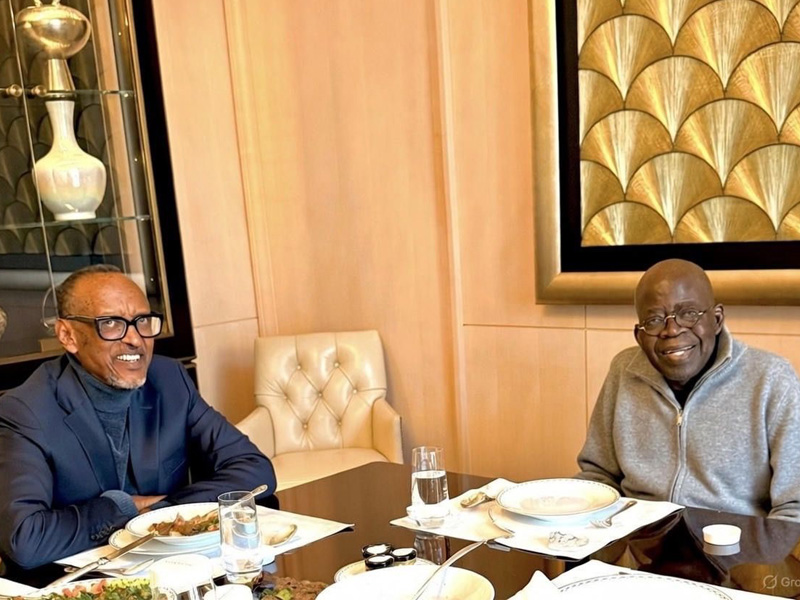
The Presidency has dismissed reports and widespread social media claims suggesting that a photograph showing President Bola Ahmed Tinubu in a meeting with Rwandan President Paul Kagame in Paris, France, was generated using artificial intelligence, describing the narrative as misleading and inaccurate.
In a statement issued on Monday, the Senior Special Assistant to the President on Media and Publicity, Temitope Ajayi, said assertions that the image was artificially created amounted to a misrepresentation of facts and a misunderstanding of how digital enhancement tools are sometimes used in modern photography.
Ajayi maintained that the photograph was authentic and captured a real meeting between the two African leaders during their engagements in Paris on Sunday. He explained that President Tinubu and President Kagame not only met but also shared meals as part of their diplomatic interactions in the French capital.
Related posts:
- PBAT Media Centre Debunks Claims Linking President Tinubu to Alleged Distribution of Buses for 2027 Campaign
- Imo Police Command dismisses allegations of torture, organ harvesting and killings at Tiger Base Anti-kidnapping Unit
- Okonjo-Iweala denies viral post criticising Tinubu over insecurity and Christian genocide
- Tinubu nominates Reno Omokri, Fani Kayode, Mahmood Yakubu, Okezie Ikpeazu as ambassadors
“The narrative that the picture of Presidents Bola Tinubu and Paul Kagame taken in Paris yesterday was AI-generated is not correct,” Ajayi said. “Both President Kagame and President Tinubu met in Paris and had lunch together on Sunday. The two leaders later had dinner with President Emmanuel Macron the same evening.”
According to the presidential aide, the controversy arose from the quality of the original photograph, which was taken with a mobile phone and later enhanced to improve clarity. He said the enhancement process, which involved the use of the Grok tool, should not be misconstrued as evidence that the image itself was artificially generated.
“The picture was taken with a phone and obviously had poor quality,” Ajayi explained. “The photographer only later used Grok to improve the picture quality. That is not a reason to conclude it was AI-generated.”
Ajayi criticised media reports and online commentary that suggested otherwise, faulting what he described as a rush to judgment without adequate verification. He argued that responsible journalism required reporters and editors to seek clarification before drawing conclusions, particularly on matters involving official presidential engagements.
“The writer or editor should have asked questions before this wrong conclusion,” he added.
The clarification followed reports by PUNCH Online and reactions on social media platforms, particularly X, formerly known as Twitter, where users questioned the authenticity of the image after noticing a Grok watermark. The image, which was released by the Presidency on Sunday, showed President Tinubu and President Kagame seated together during what was described as a private engagement in Paris.
Shortly after the photograph was posted on President Tinubu’s official X handle, it began to attract scrutiny from users who flagged it as potentially artificial. The presence of the Grok watermark, associated with an artificial intelligence tool developed by Elon Musk’s xAI company, fuelled speculation that the image may have been generated rather than captured during a real meeting.
In the post accompanying the image, President Tinubu said the discussion with President Kagame focused on global developments and the future of Africa. “This afternoon, I had a private lunch with H.E. President Paul Kagame of Rwanda to discuss the current state of world affairs and advancing Africa in an ever-changing global landscape,” the President wrote.
The same photograph was also shared by the President’s Special Adviser on Information and Strategy, Bayo Onanuga, who provided additional context. “President Bola Tinubu at a private lunch in Paris with the President of the Republic of Rwanda, Paul Kagame, discussing world affairs and advancing Africa. Sunday, January 4, 2026,” Onanuga wrote.
Despite these explanations, the image continued to generate debate online after a Community Note was added to the President’s post. The note suggested that while a meeting between the two leaders had reportedly taken place, the image itself appeared to be AI-generated due to the presence of the GrokAI badge.
The Community Note stated, “While a meeting between Mr Tinubu and President Kagame is reported to have been held in Paris, the image in this post appears to be AI-generated, given the GrokAI badge.”
Grok, the artificial intelligence system referenced in the controversy, is known for its ability to generate text, create images, and perform real-time internet searches. Its image enhancement and generation capabilities have made it popular among users seeking to improve visual quality or create entirely new digital content.
The Presidency’s clarification has brought renewed attention to the growing intersection between artificial intelligence and public communication, particularly in the context of government messaging and official imagery. Analysts say the controversy highlights the challenges institutions now face in maintaining public trust in an era where AI tools are increasingly used for editing, enhancement, and content creation.
While the Presidency insists that the image in question was genuine and merely enhanced for quality, the debate has triggered broader conversations about transparency and best practices in the use of AI-assisted tools by public offices. Some commentators argue that clearly labelling enhanced images could help avoid confusion, while others maintain that quality enhancement does not diminish the authenticity of an image if the underlying event actually occurred.
For the Presidency, however, the central issue remains the veracity of the meeting itself. Officials have emphasised that the engagement between President Tinubu and President Kagame was real and formed part of a series of high-level diplomatic interactions in Paris involving African and European leaders.
President Tinubu has been in Europe since December 28, having departed Lagos for an end-of-year break. His stay has included both private engagements and diplomatic meetings, including interactions with fellow heads of state and participation in discussions on global and continental issues.
The Presidency reiterated that President Tinubu’s engagements abroad are routinely communicated to the public through official channels and that there was no attempt to mislead Nigerians or the international community through the release of the photograph.
As artificial intelligence continues to shape media production and consumption, the incident underscores the need for clearer public understanding of the distinction between AI-generated content and AI-enhanced material. It also reflects the increasing scrutiny faced by public officials and institutions in an age where digital tools can both improve communication and complicate perceptions of authenticity.
For now, the Presidency has urged the public and the media to rely on verified information and to exercise caution in interpreting digital artefacts, stressing that the Tinubu–Kagame meeting in Paris was real and that the photograph in question merely benefited from post-capture quality enhancement rather than artificial fabrication.