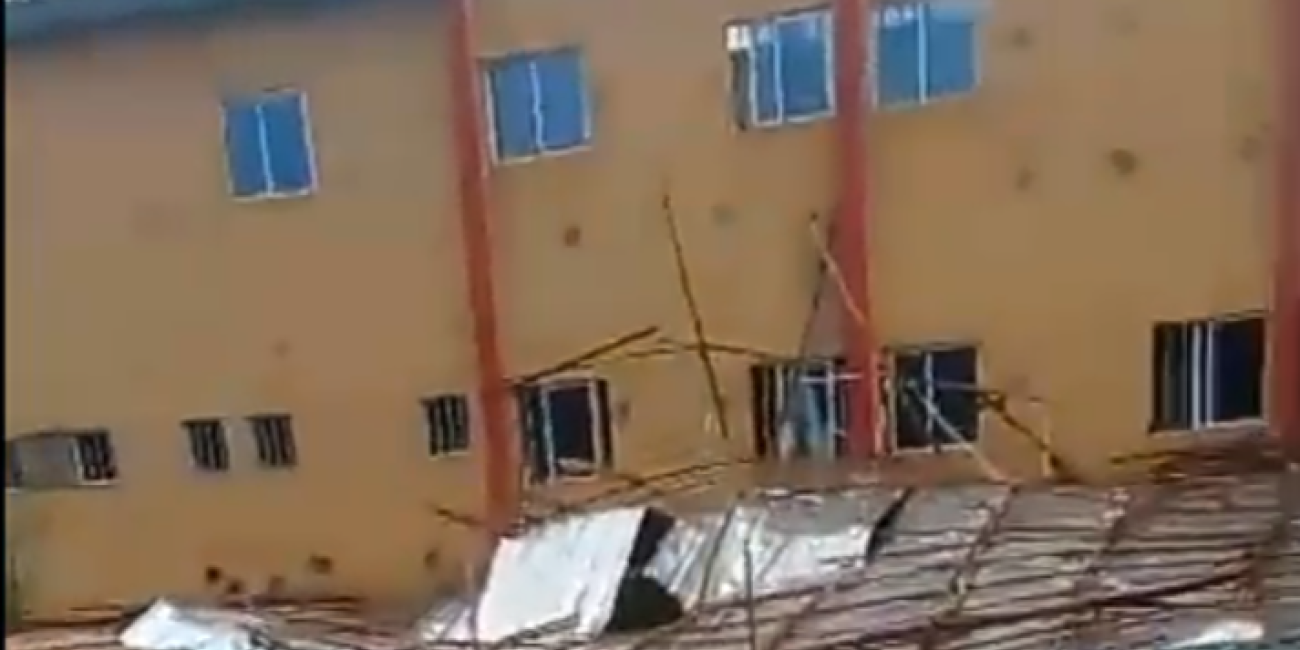
A recently completed Smart Green School constructed by the Enugu State Government at Ishielu Amagunze in Nkanu East Local Government Area has suffered major structural damage after a windstorm ripped off the roof of the one-storey building, raising fresh concerns about construction quality, project oversight and the prudent use of public funds under the state’s multibillion-naira education initiative.
The incident, which occurred just weeks after the facility was reportedly completed and declared functional, has triggered widespread public criticism and renewed debate over allegations of substandard execution and weak quality control in the implementation of the Smart Green School programme. A video of the damaged school, seen on Saturday, shows the entire roofing structure torn off, with wooden trusses and roofing sheets scattered behind the school compound.
The footage, which has since circulated widely on social media, captures the shock and frustration of local residents, many of whom expressed relief that the windstorm struck when pupils were not in school. Several voices heard in the video lamented what could have been a major tragedy if classes had been in session at the time of the incident.
“Let us thank God that the children were not in school,” one resident said in the recording. “One can only imagine the level of disaster that would have happened if pupils were inside this building.”
Beyond the immediate relief that no lives were lost, the incident has provoked anger and deep concern within the community. Residents and commentators questioned the structural integrity of the building and the standards applied in awarding and executing contracts under the Smart School programme.
“This Ishielu Amagunze Smart School was recently completed and declared functional, yet a simple windstorm blew off the entire roof,” a commentator said in the video. “If you go to Awkpufu community and see the so-called Smart School project there, you will begin to ask serious questions about the criteria used in selecting contractors for these projects.”
The collapse of the roofing structure has reignited broader public debate about the quality of infrastructure being delivered under the Smart Green School initiative, which the administration of Governor Peter Mbah has repeatedly presented as a cornerstone of its education and human capital development agenda. Education has been consistently described by the government as a flagship sector, with officials highlighting massive budgetary allocations and ambitious plans to modernise learning facilities across the state.
Official budget documents for the 2026 fiscal year underscore the scale of the state’s commitment to the programme. According to the proposed budget, the Enugu State Government earmarked ₦158 billion for the construction of 16 Smart Senior Secondary Schools and an additional ₦68 billion for the construction of 10 Technical and Vocational Education and Training (TVET) schools across the state. These TVET projects are expected to include workshops, science laboratories, hostels and specialised technical equipment.
Further allocations include ₦30 billion for equipping and furnishing technical colleges, ₦15 billion for upgrading 106 public secondary schools into model senior secondary schools, and ₦10 billion for equipping and furnishing Smart Schools across the state’s 260 political wards. The budget also proposes ₦30 billion for a statewide school feeding programme to support pupils in Smart Schools.
In total, well over ₦300 billion has been budgeted or proposed for education infrastructure, equipment and feeding programmes under the Smart School initiative for the 2026 budget year alone. Against this backdrop, the failure of a newly completed school building under what residents describe as a routine windstorm has intensified public calls for transparency and accountability.
Critics argue that projects executed with such enormous public investment should meet basic engineering and safety standards, including the ability to withstand common weather conditions. Windstorms are not unusual in the region, particularly during the rainy season, and experts say properly designed and constructed school buildings should not experience catastrophic structural failure shortly after completion.
Some observers have pointed to possible deficiencies in structural engineering design, the quality of materials used, or the supervision of contractors during construction. Others have raised concerns about contract inflation, cost-cutting measures and alleged kickbacks, suggesting that these practices may compromise building integrity and endanger lives.
“The problem is not ambition,” said a civil society advocate familiar with public infrastructure monitoring in the state. “The problem is implementation. When you allocate hundreds of billions of naira to education infrastructure, the public expects durable, safe and functional facilities, not buildings that fail at the first test of nature.”
As of the time of filing this report, the Enugu State Government and relevant education authorities had yet to issue an official statement explaining the cause of the structural failure at Ishielu Amagunze or announcing any investigation into the incident. The absence of an immediate response has further fuelled speculation and public anxiety, with many residents calling for clear answers and decisive action.
Civil society groups, education stakeholders and concerned citizens are now demanding an independent technical audit of Smart School projects across the state. They argue that such an audit is necessary to assess construction quality, contractor compliance with specifications, adherence to engineering standards and overall value for money.
For residents of Ishielu Amagunze, the incident has shifted the conversation from policy ambition to practical realities on the ground. While many acknowledge the importance of modernising education infrastructure, they insist that the safety of children must remain paramount.
“Education is important, but our children must be safe,” a community member said. “If this can happen to a new school, then something is clearly wrong. We need answers, and we need assurance that this will not happen again.”
As public scrutiny intensifies, the Ishielu Amagunze windstorm incident is likely to become a critical test of the Enugu State Government’s commitment to accountability, quality assurance and responsible stewardship of public resources in the delivery of its flagship education projects.