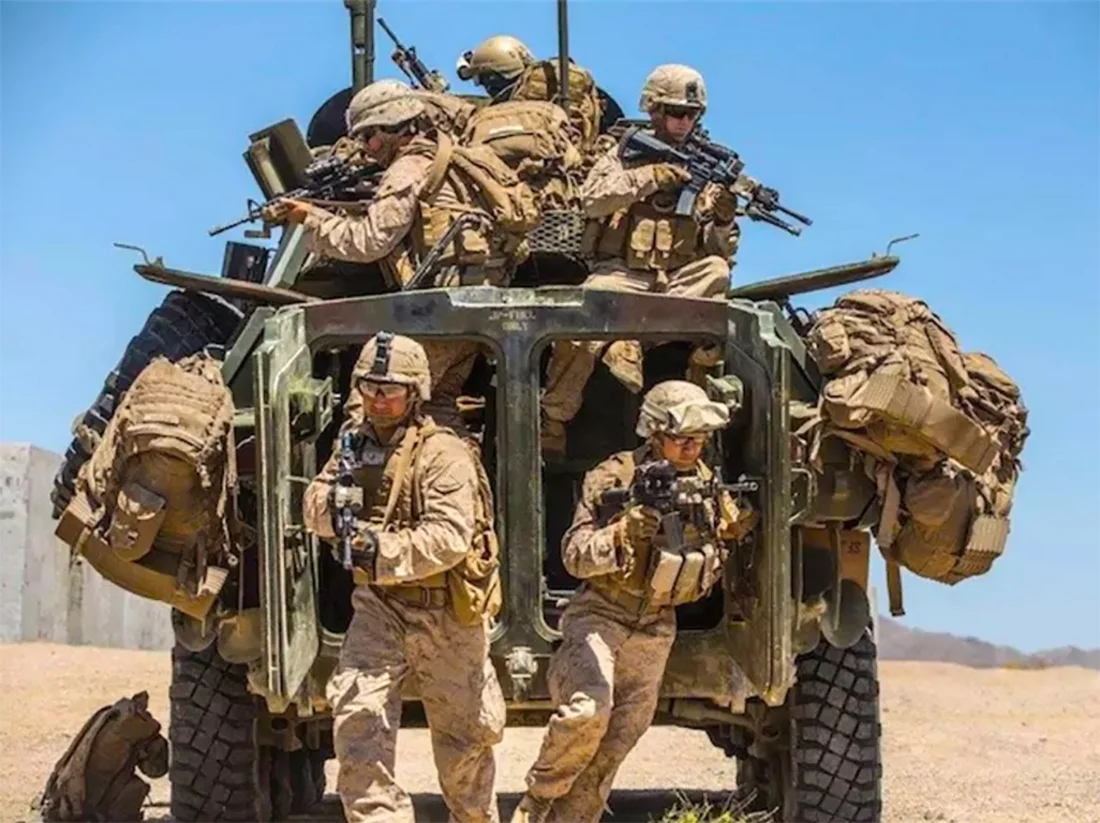
The United States is deploying a major amphibious assault ship alongside thousands of Marines and sailors to the Middle East, according to U.S. defense officials, as tensions with Iran intensify amid the protracted conflict with Israel.
The move represents a significant escalation in Washington’s military posture in the region and comes as the war between Iran and Israel approaches its fourth week. While officials have not publicly detailed the precise operational mandate of the deployment, the scale and composition of the forces involved suggest a combination of deterrence, force protection, and contingency planning.
According to officials familiar with the matter, the amphibious assault ship—designed to carry helicopters, landing craft, armored vehicles, and Marine expeditionary units—will transport thousands of service members into the broader theater of operations. Such vessels are typically deployed when the United States seeks flexible, rapid-response capabilities that can support a wide range of missions, from combat operations and evacuations to maritime security and humanitarian assistance.
Although the Pentagon has declined to provide granular operational details, analysts note that amphibious ready groups are often positioned to provide leverage in fluid conflict environments. Their presence can signal readiness to conduct limited strikes, secure strategic maritime corridors, reinforce allied assets, or respond to emerging threats without immediately committing ground forces on a large scale.
The deployment follows earlier reports that Washington had been evaluating multiple military options in response to Iran’s actions in the Persian Gulf, including potential operations aimed at reopening the Strait of Hormuz. The strategic waterway, through which roughly a fifth of the world’s oil supply transits, has been effectively closed by Iran since hostilities escalated.
The closure has reverberated across global energy markets. Oil prices have surged sharply since the outbreak of the conflict, reflecting fears of sustained disruption to crude exports from the Gulf. Energy traders remain on edge, with volatility driven by uncertainty over how long the Strait could remain inaccessible and whether military operations might expand further.
Brent crude has been trading near $110 per barrel following earlier spikes triggered by concerns about prolonged instability. Economists warn that sustained prices at or above this level could compound inflationary pressures in major economies, disrupt supply chains, and slow global growth. Energy-importing nations, particularly in Europe and Asia, are closely monitoring developments, given their reliance on Gulf exports.
U.S. President Donald Trump has framed the military buildup as part of a broader effort to safeguard freedom of navigation and regional stability. At the same time, he criticized certain allied nations for declining to participate in operations aimed at reopening the Strait of Hormuz. Speaking to reporters, Trump suggested that the reluctance of some partners to contribute naval assets would not be overlooked.
“They won’t forget it, and neither will we,” he reportedly said, underscoring frustration within the administration over what it views as uneven burden-sharing among Western allies.
Defense officials have emphasized that the United States is not seeking a wider war but is prepared to act decisively if American interests or allied infrastructure are threatened. The presence of Marines and sailors aboard the amphibious assault ship enhances operational flexibility, allowing the U.S. to scale its response according to evolving conditions.
The broader conflict has already expanded beyond direct military exchanges to include strikes on critical infrastructure. Energy facilities in both Iran and neighboring states have been targeted in retaliatory attacks, intensifying concerns that the war could engulf additional regional actors. Insurance premiums for shipping in the Gulf have risen significantly, and some commercial vessels have rerouted to avoid high-risk areas.
Meanwhile, Iran’s new supreme leader, Mojtaba Khamenei, used a nationally broadcast message marking Nowruz—the Persian New Year—to call for unity and resilience. In his remarks, he urged Iranians to remain steadfast in the face of external pressure and framed the confrontation as a struggle for national sovereignty.
Khamenei’s message sought to consolidate domestic support at a time when economic strains are mounting. Sanctions, combined with wartime disruptions to exports and shipping, have increased pressure on Iran’s economy. Nonetheless, Tehran has signaled that it will not back down from what it describes as defensive measures against external aggression.
Despite the ongoing conflict, cultural and religious observances continue across the region. Communities have marked Nowruz and Eid al-Fitr—celebrating the end of Ramadan—even as security concerns persist. The juxtaposition of festivity and warfare underscores the complex social dynamics within societies navigating both spiritual traditions and geopolitical crises.
Military analysts caution that the deployment of amphibious forces, while significant, does not necessarily indicate imminent offensive operations. Rather, it reflects a strategy of deterrence and preparedness. By positioning substantial naval and Marine assets within operational reach, Washington increases its capacity to respond swiftly to developments, including potential attempts to further disrupt maritime commerce.
However, the risks of miscalculation remain substantial. The Strait of Hormuz is a narrow and heavily trafficked corridor, and any confrontation involving naval vessels, drones, or missile systems could escalate rapidly. Diplomatic channels remain active, though publicly muted, as regional and global powers seek to prevent the conflict from spiraling into a broader war.
Energy markets continue to respond to every new development. Traders are pricing in the probability of extended disruptions, while governments weigh the release of strategic petroleum reserves or alternative supply arrangements. Central banks, already navigating complex monetary environments, are factoring elevated oil prices into inflation projections.
For Washington, the deployment signals a balancing act: projecting strength without triggering full-scale regional escalation. The amphibious assault ship and accompanying personnel provide options short of immediate ground invasion while reinforcing U.S. commitments to maritime security and allied defense.
As the conflict enters its fourth week, uncertainty dominates the strategic landscape. Diplomatic efforts to de-escalate have yet to produce a breakthrough, and both sides appear entrenched in their positions. The arrival of additional U.S. forces underscores the seriousness with which Washington views the evolving crisis.
Whether the deployment will deter further escalation or contribute to heightened tensions remains to be seen. What is clear, however, is that the conflict’s implications extend far beyond the battlefield, shaping global energy markets, alliance dynamics, and economic stability at a critical juncture for the international community.