United States President Donald Trump has disclosed that he personally cautioned Israeli Prime Minister Benjamin Netanyahu against launching strikes on Iranian gas facilities, as hostilities between Israel and Iran continue to unsettle global energy markets and heighten geopolitical uncertainty.
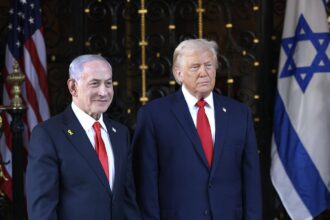
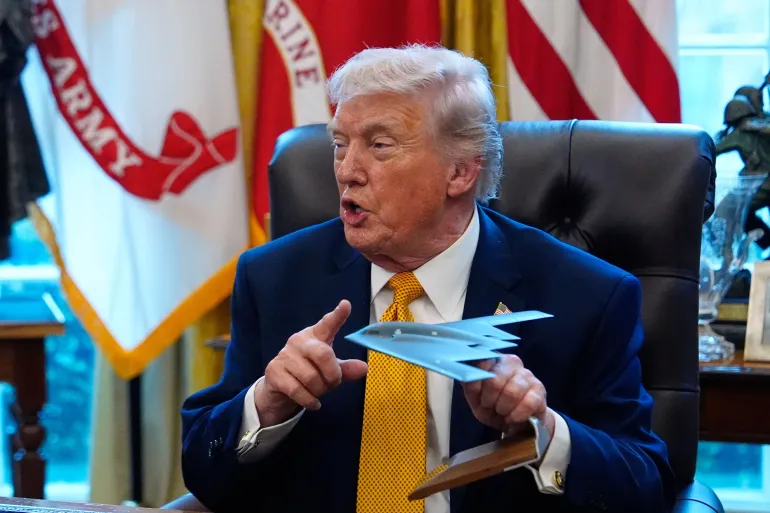
Speaking to reporters in the Oval Office, Trump confirmed that he directly intervened when concerns emerged over potential Israeli attacks on Iran’s critical gas infrastructure. Asked whether he had warned Netanyahu against targeting Iranian gas fields, the president responded unequivocally: “I did. I told him, don’t do that, and he won’t do that.”
The remarks come amid escalating tensions triggered by Israeli strikes on energy-linked infrastructure, including Iran’s South Pars gas field, one of the largest natural gas reserves in the world. The attack sent shockwaves through global commodity markets, intensifying fears of supply disruptions in an already fragile energy landscape.
Trump emphasized that while the United States and Israel maintain close strategic coordination, their alliance does not preclude moments of divergence. “We get along great. It’s coordinated, but on occasion, he’ll do something, and if I don’t like it… and so we’re not doing that anymore,” he said, suggesting that Washington has asserted its position firmly on the issue of energy infrastructure.
His comments appeared to signal a calibrated attempt to distance the United States from direct involvement in strikes that could further inflame the region and destabilize energy supplies. Earlier, Trump had written on social media that he “knew nothing” about Israel’s strike on South Pars. That assertion, however, was later complicated by reports from U.S. officials indicating that Washington had prior awareness of the planned operation, though it did not participate in its execution.
The distinction between prior knowledge and operational involvement reflects the delicate balance the administration is attempting to maintain: preserving close security cooperation with Israel while avoiding direct entanglement in actions that could provoke wider regional escalation.
The conflict between Israel and Iran, which began on February 28, has rapidly expanded beyond conventional military targets to encompass strategic infrastructure. Energy assets have become focal points, underscoring the economic dimension of modern warfare. Following Israel’s strike on South Pars, Iran retaliated by targeting energy sites in Qatar, further widening the geographic scope of the confrontation and raising alarms among Gulf states.
Energy markets reacted swiftly. Oil prices spiked amid fears of supply disruptions in the Persian Gulf, a region that accounts for a significant share of global hydrocarbon exports. Analysts warned that sustained attacks on production or export infrastructure could produce prolonged volatility, compounding inflationary pressures in major economies.
Trump has sought to reassure markets by reiterating that the United States is deliberately refraining from directly attacking Iran’s energy infrastructure. He underscored that Washington’s military posture remains focused on strategic deterrence rather than economic sabotage. Nevertheless, he coupled that assurance with a stark warning: if Tehran continues to strike energy facilities in neighboring countries, particularly Qatar, the United States could escalate its response dramatically.
Referring again to South Pars, Trump stated that the gas field could be “massively” targeted if Iran fails to halt its attacks on Qatari energy installations. The language signaled that while the U.S. is exercising restraint, it retains significant military options should the conflict intensify.
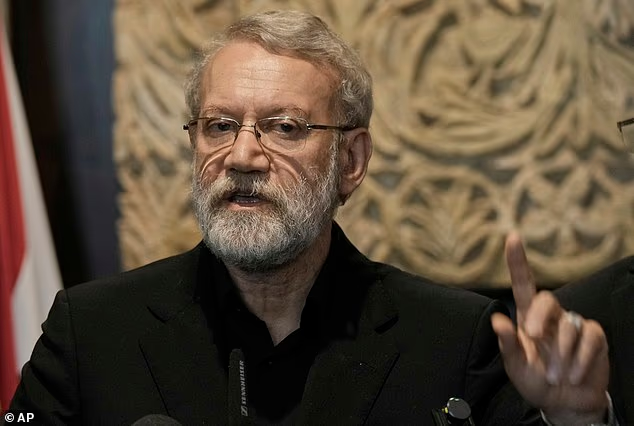
Iran, for its part, has adopted an uncompromising tone. Officials in Tehran warned they would show “zero restraint” if their energy infrastructure is attacked again. The rhetoric reflects both the strategic and symbolic importance of energy facilities to Iran’s economy, which remains heavily dependent on oil and gas exports despite years of sanctions.
The war’s stated objective, according to Trump, is to prevent Iran from acquiring nuclear weapons capability and to degrade its missile and naval assets. However, the administration has offered limited public detail regarding a comprehensive long-term strategy. While military operations appear to be focused on containment and deterrence, questions persist about end-state objectives, diplomatic off-ramps, and the potential for protracted confrontation.
Critics have noted that targeting energy infrastructure risks broadening the conflict beyond its original security rationale. Energy facilities represent economic lifelines not only for the countries directly involved but also for the global economy. Attacks on such assets can trigger cascading consequences, from rising fuel prices to supply chain disruptions and currency instability.
The South Pars field itself holds outsized significance. Shared between Iran and Qatar, the field underpins a substantial portion of global liquefied natural gas supply. Any sustained damage could affect export volumes, contractual obligations, and international energy security. The fact that Iran responded by striking energy sites in Qatar has deepened concerns that the conflict could disrupt shipments critical to Europe and Asia.
Financial markets remain sensitive to each development. Commodity traders are closely monitoring statements from Washington, Tel Aviv, and Tehran for signals of either escalation or de-escalation. Insurance premiums for shipping in the Gulf have risen, and energy companies are reassessing risk exposure across the region.
Beyond immediate market reactions, the longer-term economic implications remain uncertain. Prolonged instability could deter investment in regional energy projects, delay infrastructure expansion, and complicate global energy transition plans. Countries heavily dependent on imported oil and gas may face renewed fiscal strain if prices remain elevated.
Within diplomatic circles, there is growing discussion about the necessity of backchannel negotiations to prevent further escalation. However, public rhetoric on all sides remains hardline. Trump’s insistence that he personally restrained Netanyahu from further targeting gas fields suggests that Washington is acutely aware of the strategic risks associated with broadening the scope of attacks.
At the same time, his warning of potential “massive” retaliation underscores the precarious equilibrium currently in place. The United States appears determined to prevent Iran from leveraging energy strikes as a strategic tool, while simultaneously seeking to avoid a full-scale regional war that could engulf additional Gulf states.
As the conflict continues, uncertainty dominates the geopolitical landscape. Oil prices fluctuate with each new development, and diplomatic channels remain opaque. The interplay between military operations and economic consequences is increasingly evident, reinforcing the reality that modern conflicts extend well beyond battlefields into financial markets and global supply systems.
For now, Trump maintains that the central objective remains curbing Iran’s nuclear ambitions and degrading its military capabilities. Yet the evolving nature of the confrontation—particularly the targeting of energy infrastructure—raises profound questions about how far each side is willing to go and what the ultimate cost may be for regional stability and the global economy.
With rhetoric intensifying and infrastructure under threat, the international community watches closely, aware that any further miscalculation could produce consequences far beyond the Middle East.