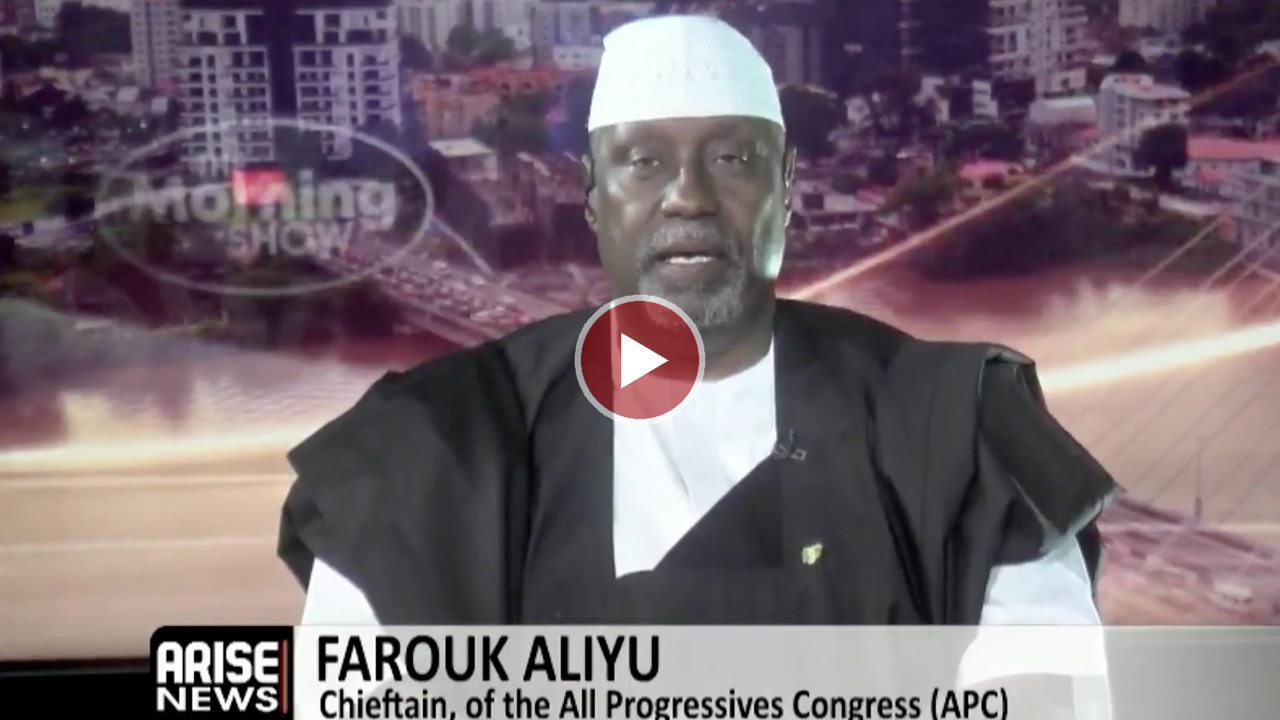
A chieftain of the All Progressives Congress (APC), Farouk Aliyu, has weighed in on the recurring national debate over religious balance in party tickets, stressing that the choice of presidential running mates is ultimately a political calculation guided by demographics, with the electorate having the final say at the polls.
Speaking during an interview on ARISE NEWS on Friday, Aliyu urged Nigerians to focus less on speculation about religious imbalance and more on numbers, representation and voter confidence, noting that political parties are expected to make decisions based on electoral realities rather than sentiment.
According to him, the responsibility for selecting candidates and their running mates rests squarely with political parties and their flag bearers. He said while religion often dominates public discourse, what should matter most to voters is whether those elected will govern fairly and impartially, irrespective of faith.
“In terms of their values and their governance, it is for the people to decide. If a party presents a Muslim Muslim ticket and the people of this country feel strongly against it, then they have the right to vote for any party of their choice,” Aliyu said.
The APC chieftain argued that demographic considerations, particularly in the northern part of the country, make it practical for parties to consider Muslim candidates where the numbers clearly support such a decision. He maintained that this reality should not be misconstrued as exclusion or favoritism.
“In my opinion, the numbers will be looked at when deciding whether to pick a Muslim or a Christian. The figures are there to show it clearly. In the northern part of the country, there are more Muslims than Christians, that is beyond doubt,” he said.
Aliyu added that while parties are free to choose candidates from any religious background, electoral strategy often compels them to align their choices with population distribution.
“Any party can decide to pick a Christian from the north. But if you are going strictly by numbers, certainly there are more Muslims in the northern part of the country, which means it may be politically advantageous for the party to take a Muslim from that region,” he explained.
Addressing concerns that a Muslim Muslim ticket could alienate Christians in the southern part of the country, Aliyu dismissed such fears, reiterating that representation should reflect demographic realities rather than assumptions of marginalisation.
“No, we are talking about numbers. In the northern part of this country, there are more Muslims than Christians. So representation follows the numbers. That is the reality,” he said.
He also acknowledged that decisions perceived as ignoring demographic balance could generate political tension, particularly in the north.
“Certainly, if you drop a Muslim for a Christian in the north, there will be a problem. That is because of the numbers. That is exactly what we are talking about,” Aliyu stated.
Beyond the issue of religious representation, the APC chieftain addressed broader criticisms of political leadership and governance, particularly claims that decision making at the highest level is driven by a narrow circle of elites.
Aliyu rejected suggestions that President Bola Tinubu governs with advice limited to individuals from affluent urban areas, insisting that the President draws input from a wide range of advisers across the country.
“I think there are so many people around the President who are not from Ikoyi or Victoria Island. I can name a lot of them. Of course, he works closely with people he knows and trusts, but as President of Nigeria, you cannot say he is leading the country with just a few people,” he said.
He added that Tinubu’s administration benefits from diverse perspectives drawn from different regions and backgrounds, helping to ensure inclusive governance.
“There are people across the country who help him to govern this country. I am sure President Bola Tinubu is not running Nigeria with a small clique,” Aliyu said.
Aliyu concluded by reiterating that in a democracy, political parties are free to make strategic choices, but ultimate power rests with the electorate.
“At the end of the day, it is the people who will decide. Parties can make their calculations, but Nigerians will have the final say through their votes,” he said.